Gem Diamonds Finance Blog – Full Year 2013

Gem Diamonds is split into segments where mining takes place (Lesotho and Botswana); where diamonds are manufactured (Mauritius) and sales and marketing, which takes place in Belgium.  The group currently only has one producing mine, the Letseng mine in Lesotho and the Ghaghoo mine in Botswana is currently under construction.  The Letseng mine is renowned for its regular production of large, good quality diamonds and is the highest average dollar per carat kimberlite diamond mine in the world.  The mine is 70% owned by the group with the other 30% being owned by the government of Lesotho.  The mine has total resources of 5.3M carats and the rough diamonds are sold on tender in Antwerp.  The Ghaghoo mine is 100% owned by the group, where they hold a 25 year mining licence and has a total resource of 20.5M carats.  In Belgium the group sorts, values and sells the diamonds over 10 tenders per year and some diamonds are selected for polishing and sold through direct selling channels to high end clients.  Gem Diamonds have released their full year results for the year ending 2013.

gemdincome

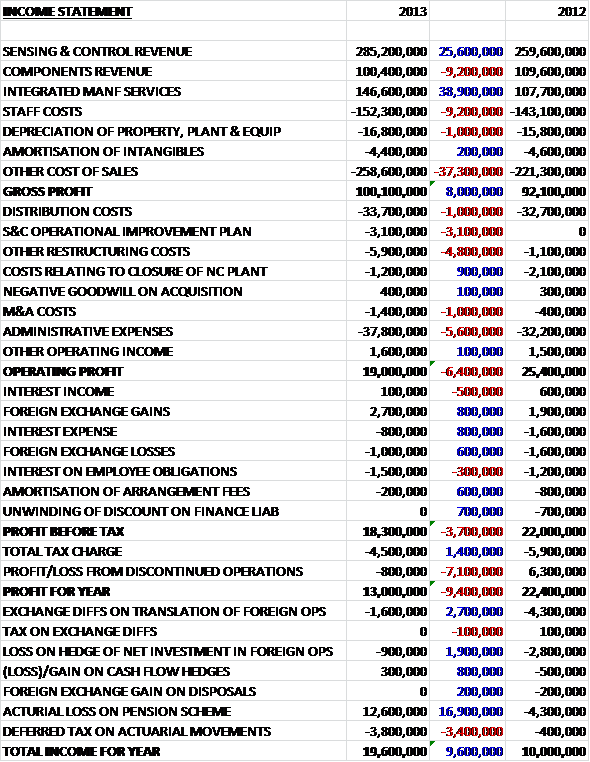
Revenues were up $10.7M when compared to last year and although costs of inventories grew by $17.8M, a similar decrease in other cost of sales meant that gross profit was $11.1M higher than in 2012.  Admin costs saw decreases in both corporate expenses and share based payments but a $3.2M fall in the foreign exchange gain counteracted these.  The lack of $16.2M worth of impairments that occurred last year (mainly related to the failed project in Angola), however, meant that operating profit increased by some $27.2M before a decrease in the income from bank deposits  and increased interest on debt meant that profit before tax was some $24.3M higher at $59M.  Income tax this year was up by $2.4M and last year there was a massive $118.7M loss from discontinued operations ($48.4m of which was related to the recycling of foreign currency translation reserve on disposal and $63.7M on remeasurements to fair value) which was not repeated this year and the overall profit for the year was $38.2M, $140.5M better than in 2012.

gemdassets

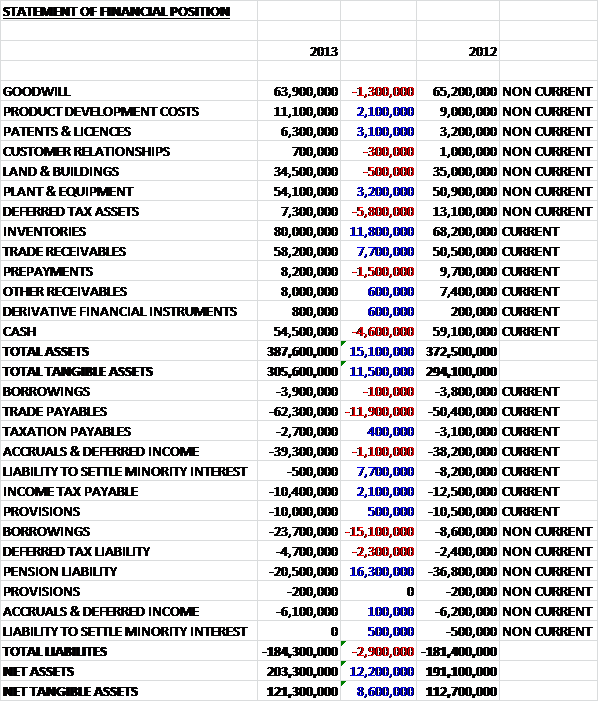
Total assets were down by just under $50M.  This was driven by a $23.2M fall in plant & equipment, a $16.4M reduction in financial assets, a $5.9M fall in decommissioning assets and a $4.6M decline in the value of goodwill, only partially mitigated by a $6.7M increase in inventories and a $3.9M clime in the value of exploration and development assets.  The investment property relates to a commercial unit located in the Almas Towers in Dubai which is being let out on a rental agreement that terminates in 2015.  The value of liabilities also fell, with the highest fallers being a $6.5M reduction in deferred tax liabilities (although this was still very high at $64.8M), a $6.3M decline in rehabilitation provisions, a $3.8M fall in accrued expenses and a £3.3M reduction in trade payables.  This was not enough to really halt the decline in net assets values, with net tangible assets down by a disappointing $26.6M at $350.7M.
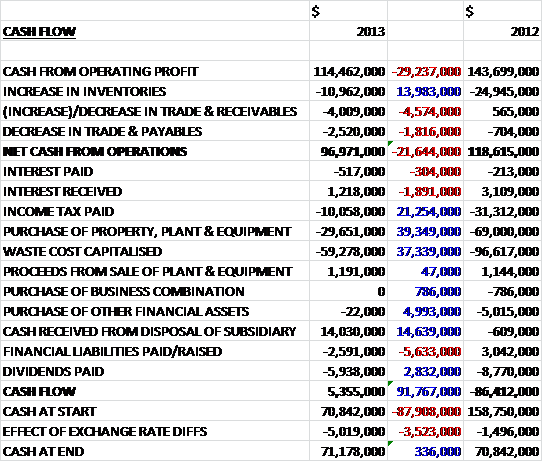
gemdcash

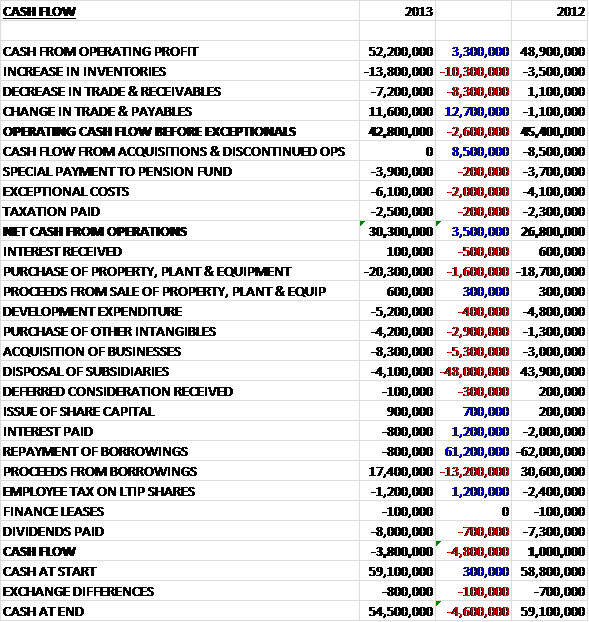
Before movements in working capital, cash profits were down by $29.2M.  A smaller increase in inventories than last year meant that net cash from operations was down by $21.6M to just under $97M, which was a little disappointing.  All of this cash was spent on the purchase of property plant and equipment ($39.3M less than in 2012) which included just under $10M spent on the new ore crushers, new modular coarse recovery and other costs at Letseng whilst $19.2M was spent on the phase 1 development costs at Ghaghoo; dealing with the waste ore ($37.3M less than last year); and income tax ($21.2M less than last year).  A receipt of $14M from the disposal of a subsidiary (the Australian business) then paid for $2.6M of financial liabilities paid and just under $6M of dividends paid to the Lesotho government before leaving a positive cash flow of $5.4M, which was some $91.8M better than the huge cash outflow last year.  Not bad, but the operational cash flow does not seem to be covering the capital expenditure at the moment, although this will probably change once the Botswana mine gets underway.

In 2007 the group entered into an agreement in relation to the Chiri Concession in Angola, which is believed to be a diamondiferous Kimberlite.  Last year the group decided not to continue with the project which led to the total resource and development costs being written off to the value of $14.8M.  There was also a write-off of some capital expenditure to expand the Letseng mine, which cost $1.4M.  Also last year the group entered into a sale agreement for the disposal of its Australian mining activities, the Ellendale mine.  The sale was finalised in January and the proceeds of $14.8M were received during the current year.  There is also a dispute over the amount of tax owed and possible disputes have been identified over $3.6M.

The demand for diamonds in the coming years is expected to outpace supply.  The growth in demand, particularly in China and India, is being fuelled by urbanisation and a growing middle class.  At the same time, the supply from the world’s mines is diminishing and is unlikely to reach previous levels of production primarily due to the continued depletion of existing deposits and the scarcity of economically viable global diamond deposits.  This, together with the capital intensive nature of developing and operating a diamond mine creates high barriers to entry.  Despite the increased importance of China and India, the US remains the world’s dominant diamond consumer and ongoing economic recovery has resulted in improved demand from this region since 2008.  Meanwhile diamond prices are now above pre-economic crisis levels and the rough diamond market was relatively stable in 2013.  Looking ahead, the group expects diamond prices to remain stable in 2014 with the potential for modest price increases.

In 2013 the Letseng mine produced 95,053 carats, down from the 114,350 carats produced last year.  During the year, the group recovered a 12.47 carat blue diamond from the mine which sold for $7.5M and helped the mine achieve a $2,043 per carat average price compared to $1,932 last year.  The total tonnage of ore mined was 6.2MT and 84% was sourced from the Main Pipe with 16% coming from the Satellite pipe (this compares to 76% from the main pipe in 2012).  This, together with some internal basalt dilution that took place resulted in the reduced number of carats produced.  The plan going forward is to achieve a 75:25 split from the two pipes.  Waste tonnes in 2013 was up 10%, according to plan, and the requirements to access the higher grade satellite ore.  During 2014 the mining contractor will deliver four new 100 tonne dump trucks and two new 300 tonne hydraulic excavators which will improve the waste mining efficiency in line with the anticipated waste mining in future.

A number of initiatives to reduce diamond damage were embarked on during the year.  A test was undertaken to determine whether plant tonnage throughput was related to diamond damage but despite testing during the first quarter of the year, no correlation was found.  In the second quarter, the secondary and tertiary crushers were replaced with more diamond friendly technology and the overall size fragmentation of blasted ore was reduced.  These initiatives resulted in a marked reduction in diamond breakage in the larger diamonds in the latter part of the year.

Also during the year a new resource drilling campaign was commenced, which aimed to improve the geological knowledge of the Letseng kimberlites.  A total of 9,400 metres of drilling was planned, 30% of which in kimberlite with the remainder in Basalt.  So far, 4,700 metres of drilling has been completed with the remainder to be finished in Q1 2014.  After the new crushers were installed, a plant upgrade has been mooted in order to expand the production capacity and a pre-feasibility study should be completed in Q1 2014.  During the latter part of 2013, a project to upgrade the existing recovery process through the construction of a new coarse recovery plant was developed and approved and should include new X-Ray technology to pick up the high value type II diamonds.

Also during the year, the group signed a new processing contract where the plant contractor will operate the two processing plants until 2017.  The contract includes a lower margin paid to the contractor but makes provision for performance based payments.  Next year at the mine the group will focus on the design of the new coarse recovery plant with a view to commissioning in 2015; the refinement of the expansion project; the continuation of test work with new waste sorting technology; revisiting the optimal timing of moving from open pit mining to underground mining in the satellite pipe; additional exploration drilling to increase the knowledge of the resource and continued cost management.

diamonds_2398382b

During the year good progress seems to have been made on the Ghaghoo mine.  The mine is quite a challenge because it has 80 vertical metres of sand overburden before reaching the rock.  The 473 metre long sand portion of the access decline was completed in July with a further 500 metres of basalt development being completed during the year.  Kimberlite ore was intersected in November some 134 metres below the surface.  As of the end of the year, the access decline had reached a depth of 145 metres and a further 50 metres of decline development is required to reach the first production level break-off at a depth of 154 metres below the surface.  The sinking of the ventilation shaft was delayed to 2015 as a redesigned ventilation system has allowed the group to sink smaller holes.  These should be complete by the end of Q1 2014.

The processing plant will be fully commissioned well ahead of a sustainable feed of run of mine ore becoming available from underground and a build-up to a steady state production rate of 60,000 tonnes per month is planned by the end of next year.  It is expected that about 200,000 to 220,000 carats will be extracted from 720,000 tonnes of ore per annum.  All mining infrastructure has been completed and is operating satisfactorily.   During the year, $19.2M was spent on the project and due to the delays associated with the development of the sand portion of the access decline, the total phase 1 capital budget increased to $96M, of which $71.2M has been spent to date.

Going forward, work will continue on the development of the access decline and subsequent access to the orebody, followed by commercial production in the second half of 2014 and activities related to the sinking of the ventilation holes will be completed in the first quarter with the processing plant being fully commissioned by May.

During the year a 164 carat diamond resulted in 11 exceptional polished diamonds with a total weight of 83 carats.  Operating costs per tonne treated increased to LSL 152.92 from LSL 125.57 due to the weighting of the amount of ore mined from the Main pipe.  Overall the group has 3.46 million carats of provable reserves with 1.38 in Lesotho and 2.08 in Botswana.  Indicated resources for the two mines are 1.42 million carats in Lesotho and 15.49 in Botswana.  Both reserves and resources increased at Lesotho due mainly to depth extension in both ore bodies.

At the current share price the P/E ratio is a pretty good value 13.5, falling to an even better value 12 on next year’s broker estimates.  There is currently no dividend paid to shareholders but the board intend to pay a maiden dividend at the end of the 2014 financial year based on continued strong performance.  In some ways these results were quite disappointing – net assets fell by quite a substantial amount due to reductions in plant & equipment and financial assets.  Cash flow, although positive, was only so good because the group received the cash balance from the prior disposal and as it stand, operating cash flows did not cover all the expenditure.  Having said that,  Letseng mine is clearly a great assets, with so many good quality diamonds produced and once the capital expenditure calms down, the cash flow should improve.  Add to this, the improving long term market for diamonds and Gem Diamonds starts to look like a good investment.  I will probably buy in here with further visibility of how the Botswana mine is progressing.

On the 12th May the group released a statement covering trading for Q1 2014.  It was noted that the net cash position at the end of the quarter stood at $89.1M which as an improvement from this time last year.  The demand for rough diamonds continued the positive trend seen in Q4 last year with increased buying activity and strong prices.  Trading activity in the polished market also remained positive.  At Letseng, 26,055 carats were recovered compared to just 18,775 in the same quarter of last year and 27,227 in Q4 2013.  Waste stripping increased due to the shorter haul distance on the new cutback that started in January.  35% of the ore was sourced from the satellite pipe during the quarter compared to 0% in Q1 2013 and 56% last quarter with half the remainder being sourced from the main pipe and half from old stockpiles which, along with some power outages during the quarter, caused the reduction in the carats obtained when compared to Q4 2013.

The average price achieved for the rough diamonds during the quarter was $2,723 which took the 12 month rolling average to $2,383.  As previously reported, there were two exceptional large diamonds recovered, the 162.02 carat diamond sold for $11.1M and the 161.31 carat diamond sold for $2.4M.  The new coarse recovery plant project is on track for the scheduled commissioning in Q2 2015 which will improve the recovery of high value type II diamonds.  Construction on the plant is due to commence in Q3 of this year.  The development of the Ghaghoo mine is progressing well and it remains on schedule for commercial production in the second half of the year.  Kimberlite was intersected in the first production tunnel on level one in May and drilling of the first ventilation holes was completed with the second hold 80% complete.  So far, $76.3M of the $96M capital budget has been spent.  This seems to be a decent update on the whole.

On the 16th July the group released a revised Resource and Reserve statement.  The updated statement reflects a significant increase in the Letseng Indicated Resource category of 127% to 3.23M carats.  This is as a result of a 100 metre depth extension beneath the current pit bottoms to a new depth classification of approximately 350 metres below the current mine pits on both the satellite and main pipe ore bodies.  The extension has not only resulted in a significant increase in Indicated Resources but also shows an increase in the Letseng Probable Reserves, up 64% to 2.26M carat which means that the entire 22 year life of mine plan is now classified as a Reserve.  In addition to this the average diamond price for the mine has increased by 19% due in part to the improved recovery of large stones.  This all seems very good to me I have taken a position here.

On the 29th July the group released a statement covering trading in the first half of the year.  The cash position has improved further to $114M and the board remains on track to pay a maiden dividend at the end of the financial year.  At Letseng, the number of carats recovered was up 29% on the same period of last year at 54,678.  This was driven by the higher percentage of ore from the Satellite pipe and technical improvements in plant throughput.  Waste mining for the period was 2% higher and new, larger mining equipment was commissioned in May which will ensure access to adequate ore in both pits and improved unit costs.  During the period, 36% of the ore was sourced from the Satellite pipe and the Alluvial Ventures plant continued to run and the contract has been extended to the end of 2015.

During Q2 a large diamond of 132.55 carats was sold for $7.5M which took the exceptional diamonds to three for the half year.  The new coarse recovery plant remains on track for completion in Q2 2015 and work to identify improvements to throughput and diamond breakage has progressed to the point that the first phase of the upgrade at Plant 2 has been approved.  Phase one of the project will commence in Q3 2014 and is planned to complete by Q1 2015.  It will deliver an increase in treatment capacity of 250,000 tonnes per annum as well as further reducing diamond damage at a cost of approximately $5M.

In Botswana the development of the Ghaghoo mine is progressing well and on schedule with 2,400 carats having been recovered to date during the commissioning of the plant.  These included a 20 carat and two 10 carat stones, all larger than the 7 carat diamond recovered during the exploration phase.  Optimisation of the treatment plant process is ongoing during the commissioning phase and the production build-up to 60,000 tonnes per month is still anticipated before the end of this year.  To date, three production tunnels are progressing within Kimberlite on the first production level, 154 metres below the surface whilst and exploratory tunnel and training slope have been developed in the kimberlite on level zero at 130 metres below the surface. High volumes of water from basalt fissures have been encountered on one area which contributes to difficult mining conditions and necessitated the procurement of additional pumping capacity and the drilling of additional bore holes.  Drilling of the second ventilation hole is complete and the third and final hole has been drilled to a depth of 121 metres and is due for completion in July.  The first tender for Ghaghoo’s production is scheduled to take place before the end of the year and so far $82M of the total $96M budget has been spent.

The extension of the Alluvial Ventures contract, the new larger mining fleet and improved plant availability have contributed to a positive revision of full year 2014 production with an expected 95,000 to 100,000 of carats now expected to be mined.  This is certainly a positive update and all seems to be progressing well, although the water encountered in Ghaghoo should be watched.  Happy to continue holding.

On the 5th August the group announced that it had recovered a whopper of a diamond!  It is 198 carats white type IIa diamond and shows no florescence.  I am not sure what most of that means but it is huge and expected to achieve a good price when sold later in the year.

Tesco Finance Blog – Full Year 2014

Tesco has now released its full year results for the year ending 2014.

tescoincome

Revenue was up overall due to a £256M increase in Asian sales, counteracted by falls in UK, Europe and Bank revenue.  Employee costs increased by £386M but operating expenses on retail property, and cost of inventories fell considerably, by almost £600M in the case of the latter.  There was no return of the near half a million pound goodwill impairment seen last year but other cost of sales picked up this slack.  Overall, gross profit was down by £144M when compared to 2013.  Admin expenses were up slightly but the group made a £278M profit on property items compared to a £290M loss last year which caused the operating profit to increase by £249M.  An increase in pension costs and the reduction of joint venture profits gave a profit before tax and discontinued operations some £202M better than last year.  Tax was down £182M and the loss from discontinued operations (this year classified as the Chinese and US operations) fell by £562M, which included a £540M write-down of goodwill in the Chinese operation.  This meant that overall profit for the year was up by £946M to £970M.

tesco assets

Total assets were pretty much on a par with last year.  During the year the largest increases were a £1.856BN hike in assets of a disposal group held for sale, relating mainly to the Chinese business, a £1.356BN increase in loans and advances to customers and a £494M increase in short term investments.  These were counteracted by a £1.774BN reduction in the value of investment properties as £1.623BN of investment property was reclassified as property, plant and equipment due to the level of service provided to some mall tenants in Asia (there was a £707M impairment on some European property), a £668M fall in goodwill as Chinese goodwill was moved to assets held for sale and a £469M decline in the value of derivative financial instruments (possibly moved to “short term investments”?).

Liabilities, however, increased by just under £2BN due to a £911M hike in liabilities of the disposal group, an £843M increase in customer deposits, an £815M growth in pension obligations and a net £379M increase in borrowings.  These were somewhat mitigated by reductions in deferred tax liabilities, trade payables and deferred income.  Overall, net tangible assets fell by a substantial £1.372BN to £10.927BN.

tescocash

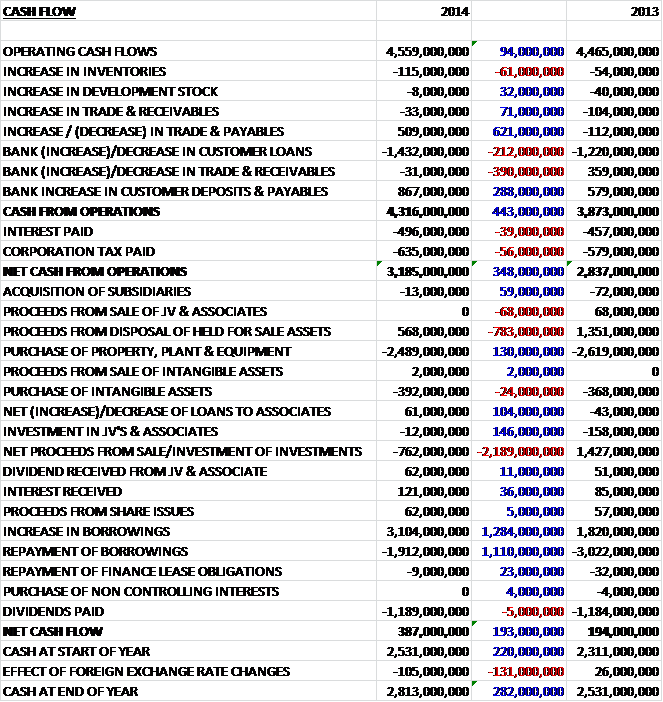
Before movements in working capital, cash profits were broadly flat on last year, up by just £94M.  An increase in payables drove the cash from operations up by £443M when compared to last year before slight increases in interest payments and tax paid meant that net cash from operations was £348M better than in 2013 at £3.185BN.  The bulk of this was spent on capital expenditure with £2.489BN going on new property, plant and buildings (£130M less than last year) and £392M on intangible assets.  The group also spent £762M on investments but did get £568M from the sale of disposal assets.  This is pretty much all the cash accounted for so the £1.189BN of cash spent on dividends is paid for by a net £1.192BN increase in borrowings with a few other smaller items giving a net cash flow of £387M. It is clear, therefore, that the dividends are being paid entirely from new loans.

Trading profit for the UK business was £2.191BN, an £81M fall when compared to last year mainly due to the drag from the larger stores and the continuing competition from the discounters.

Trading profit for the Asian business was £692M, a £41M decline when compared to 2013.  Regulatory restrictions in South Korea continue to be a drag on sales but the work done to refresh some of the stores has delivered some encouraging results and 71 new convenience stores were opened during the year.  It has been a challenging year in Thailand as the recession and political unrest in the country took its toll.  Performance in Malaysia was more resilient with two new stores opening and the home shopping business starting up.

Trading profit for the European business was £238M, a £91M collapse on last year.  The group faced weak momentum from the end of last year and larger stores particularly underperformed, although performance has been improving throughout the year.  In particular, Turkey faced very challenging economic and competitive conditions and the group continues to try and find a way to turn a profit from the country and in order to try and achieve this, they are in negotiations with some potential partners.  Poland was a particular focus this year and the group’s plans has caused an improved like for like sales trend during the year.  Ireland was a difficult market with severe pressure on consumer spending and aggressive competition from the discounters.  Capital expenditure in Europe was reduced by 40% and it is expected that this will be the level going forward.

Trading profit for the bank was £194M, a £3M increase when compared to last year.  This increase was despite the loss of legacy insurance distribution income.  The group also set aside another £20M provision for payment protection insurance.   Customer accounts for credit cards, loans, mortgages and savings were up 14% and in its first year of trading, mortgages reached a balance of £700M.  Profit from the insurance business was down 17% reflecting increased competition driving premiums down.  The current account remains on track to be launched during 2014.

There is clearly a lot of work to be doing and management seem to be concentrating on the UK business for now.  So far, £1BN has been invested into the brand in six key areas:  staff, stores, range, price, branding and online.  The investment is long overdue as acknowledged by the CEO but some progress has been made.  More staff have been employed and they have been trained in customer service and customers have reported some improvement.  During the last two years about a third of the UK stores have been refreshed with improvements made to store environments.  Up to now most of the focus has been on the smaller stores but since the large stores have been such a drag on results, the focus is now on the superstores. Next year, 110 of the Extra stores will be improved aiming to use the restaurant and food brands to make the stores more of a destination in their own right.  Clearly this refresh will result in a short term increase in costs but should be worth it in the long term.

Both the premium own brand and the healthy living brand have been relaunched during the year and again, customer feedback has been good.  After the horse meat fiasco, the group has also spent more money improving the supply chain.  Price is clearly another area that Tesco has been losing out on following the rise of Lidl and Aldi.  The group is making an initial £200M investment in reducing prices, starting with staples such as milk, carrots, onions and eggs.  Tesco now offer one hour delivery slots for their groceries and non-food items which is better than most retailers.  Capital expenditure for the group is going to be capped at £2.5BN for the next three years which seems like a sensible idea.

During the period the group entered into an agreement with China Resources Enterprise ltd to combine Chinese retail operations which will leave the group with a 20% share. The difference between the carrying value and the sale value has meant that the group has taken a £540M hit to remeasure the net assets, which is rather substantial.  In November the group completed the sale of most of its US assets to YFE Holdings and the remaining assets in the country are in the process of being disposed of.  The exit of Japanese operations was completed in January 2013.

After the end of the reporting date, the group entered into an agreement with Tata to form a 50:50 joint venture in India.  Tesco will initially invest £85M.  The group also acquired Sociomantic Labs, a Berlin based digital advertising company for £124M.  Sociomantic operates in 14 countries worldwide.  The group is now without a Chief Finance Officer as Laurie McIlwee resigned from his position after 14 years at the company.  The group welcome Mark Armour as a new non-executive director.

Net debt remained unchanged and finished the year at £6.597BN.  At the current share price the P/E ratio is a rather expensive 20.4 but when discontinued operations are discounted, this falls to 10.3 with a figure of 10.4 predicted for 2015.  At the current share price the yield is an impressive 6% but as we have seen, this is currently being covered by new debt.  These are difficult times for Tesco.  They seem to be having problems in the majority of their markets and in the UK and Ireland the relentless rise of the German discounters and the migration of customers away from the large super stores is really starting to hurt.  It was disappointing to see net assets fall by well over £1BN and even with the £2.5BN cap on capital expenditure, there will not be enough of the cash from operations (£3.185BN) to cover the dividends at the current level and it is hard to see where any growth is going to come from in the short term.  The headline P/E is very expensive but this is mostly due to the write-down of the Chinese assets which seems to have been a costly mistake.  Overall, it is hard to justify buying any more shares, even at these depressed prices.

On the 29th May the group released a quick statement to confirm that the joint venture agreement with CRE in China had been approved.

On the 3rd June the group released a statement confirming that the 50:50 joint venture with Tata in India had been approved.  The business will be known as Star Bazaar and already has a small number of stores.

On the 4th June the group released a statement covering Q1 trading.  So far this year prices have been cut on some products and delivery charges  whilst the store refresh programme is steaming on ahead, with 100 now completed and 200 more expected before the end of the year.  As expected, this has impacted short term sales performance  but with volumes on the lines where investment has been focused up 28%, there seems to be some success in the strategy.  Q1 saw a continuation of the challenging consumer trends in the UK and the deflationary impact from lower price, along with a reduction in the level of untargeted promotions (responsible for more than half of the underperformance relative to the last quarter) which led to a 3.7% fall in like for like sales in the country.

International sales increased by 0.5% at constant exchange rates but in a reflection of the strengthening pound, there was an 8% fall at actual rates. Like for like sales in Asia fell by 3.2%, an improvement on the 5.6% fall recorded last quarter but the difficult conditions in Thailand continued, with a 5.3% fall and disappointingly sales in Malaysia recorded a fall having shown an increase last quarter.  In Europe like for like sales decreased by 1% as increased sales in Turkey, Hungary, Czech Rep and Poland were counteracted by large declines in Slovakia and Ireland where there is intense competition.  These figures are not great and are not enough to tempt me at these bargain levels.

On the 10th July, Tesco announced they had found a replacement CFO.  Alan Stewart will join the group having gained experience as CFO for M&S and Thomas Cook.

On the 21st July the group made a surprise announcement that Philp Clarke will be stepping down as CEO to be replaced by Dave Lewis in October of this year.  Dave joins from Unilever where he is Global President, Personal Care.  He has been at Unilever for 28 years  and has experience in business turnarounds.  It seems a new direction was needed and it will be interesting to see how Dave applies his experience to the retail sector. Also hidden in the announcement was a profit warning.  Current trading conditions are more challenging than anticipated.  The overall market is weaker and combined with increasing investments to improve the customer offer, trading profit of the first half of the year will be somewhat below expectations.  It seems to me that the turnaround for Tesco is still some way off.

On the 29th August, Tesco released yet another profits warning and have guided trading profit expectations next year to be below £2.5BN with profit in the six months to August 2014 to be £1.1BN.  It was also announced that Dave Lewis will be starting his job as CEO a bit earlier than expected, on the 1st September, hence the timing of this update I suppose.  Reflecting the current trading and expectations going forward, the interim dividend has been cut by 75% to 1.16, which as I have mentioned previously, seems like a prudent step.  Additionally, they are implementing further reductions in capital expenditure and for the current financial year, it will probably come in at around £2.1BN, some £400M less than originally planned with IT and the roll out of the store refresh programme facing the brunt of the constraint.  It will be interesting to see how the new CEO copes and I will be watching with interest.

On the 22nd September, Tesco announced that it had identified an overstatement of its expected profit for the half year due to accelerated recognition of commercial income and delayed accrual of costs.  As a result group profits will be £250M less than the guidance posted previously. Oh dear.

On the 23rd September the group announced that the new CFO, Alan Stewart, will join Tesco from today and not the start of December as previously announced.  I would hazard an opinion that he is badly needed and if there was a CFO in place, some of these problems would not have occurred.

On the 1st October it was announced that the FCA had commenced an investigation following the overstatement of expected profit. This was to be expected I guess.

On the 6th October the group announced that they had appointed two new much needed non executive directors.  Richard Cousins has been CEO of Compass for the last eight years and he sounds like a very good appointment.  Mikael Ohlsson is currently non executive director at Volvo, Ikano ans Lindengruppen having previously been CEO of IKEA group.

On the 16th October it was announced that Berkshire Hathaway, Warren Buffet’s investment vehicle, had sold down to below 3% of the company equity.  He has taken quite a hit with this sale so must really not see much of an investment case here.


Photo Me Finance Blog – Full Year Results 2014

Photo Me has now released its final results for the year ending 2014.

photoincome2014

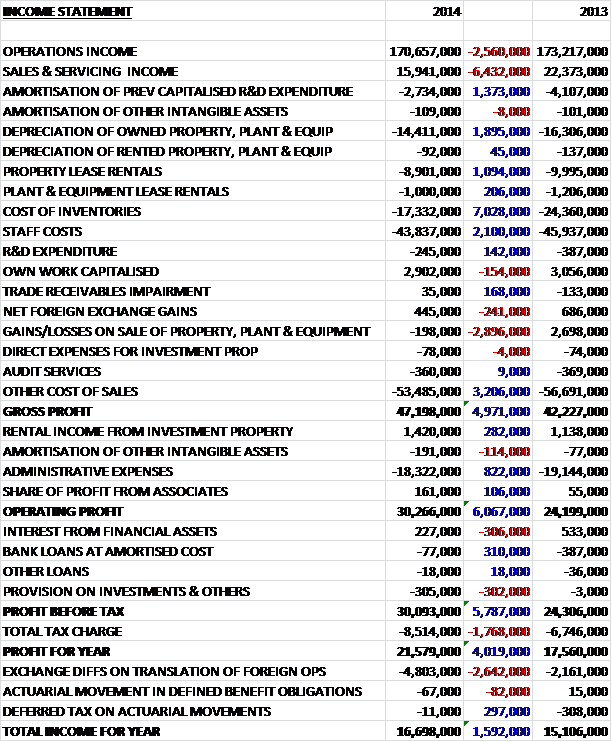
Compared to last year revenue was down across both business segments with operations revenue falling by £2.6M and Sales & Servicing revenue collapsing by £6.4M.  The group benefited from a fall of £1.9M in depreciation of equipment when compared to 2013 and a £1.4M decline in the amortisation of capitalised R&D spend.  Cost of Inventories also showed a good decline, falling by £7M to £17.3M and staff costs were also down slightly, falling by £2.1M.  The group did not benefit from the £2.9M gained from the sale of the property that occurred last year but a further £3.2M fall in other cost of sales meant that gross profits were some £5M higher than in 2013.  Due to a fall in admin expenses, operating profit looked even more healthy, up by £6.1M to £30.3M.  A decrease in bank loan interest was broadly counteracted by a fall in interest from financial assets but £300K worth of provisions and a £1.8M hike in the tax bill took some toll on the profit for the year but despite this, it still finished up by £4M at £21.6M.  A very decent performance.

photoassets2014

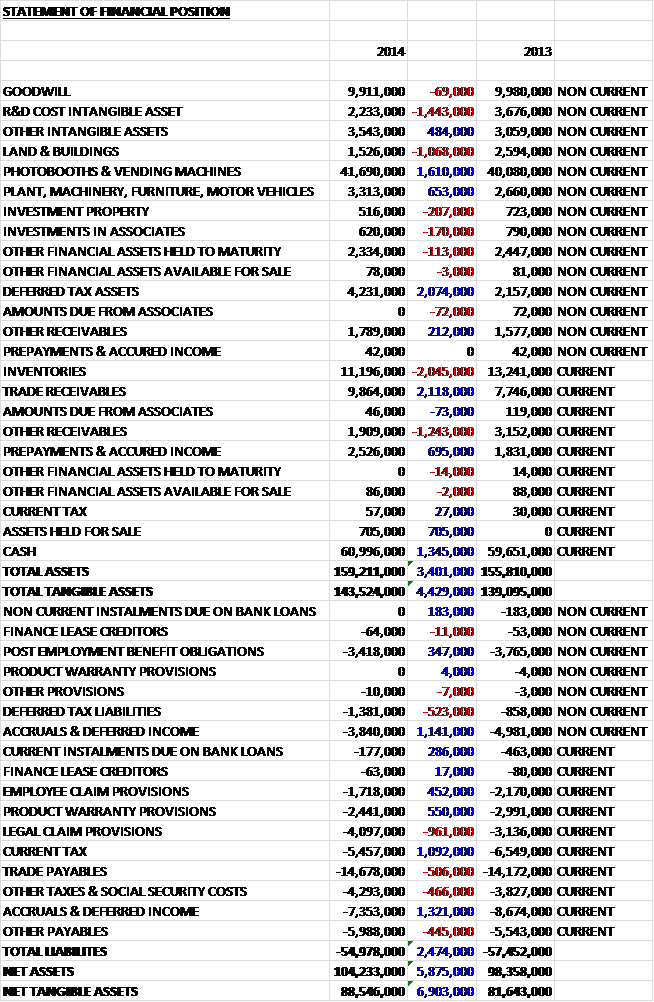
When compared to the end point of last year, assets were up £3.4M driven by a £2.1M increase in trade receivables, a £2.1M increase in deferred tax assets, a £1.6M hike in the value of the machines, a £1.4M growth in cash levels and £705K of assets held for sale relating to vacant land at the Bookham head office site.  This is somewhat mitigated by lower inventories, capitalised R&D costs, buildings (relating to the lower value of the rental property after future rents were sold) and “other receivables”.  £2.1M of the other intangible assets are “droit du bail” – payments in France for the right to occupy a space to site vending equipment.  Liabilities fell during the year, driven by a £2.5M reduction in accruals & deferred income and smaller falls in the level of tax liabilities and both employee claims and product warranty provisions.  These falls were mitigated by a near £1M increase in legal claim provisions and a half million pound increase in trade payables.  Overall then the net tangible assets increased by £6.9M to a very healthy £88.5M.

photocash2014

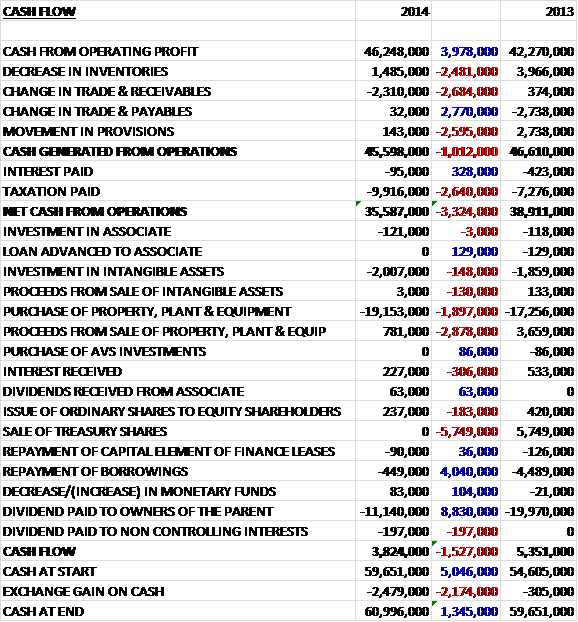
Before movements in working capital, cash profits were nearly £4M higher than last year.  Movements in provisions and inventories, however, meant that cash generated from operations before tax was some £1M lower than in 2013.  The group then paid more in tax and the net cash from operations came in at £35.6M, some £3.3M less than during last year.  The bulk of this cash (£19M) was spent on plant and equipment, presumably new machines, and this spend was £1.9M more than last year.  The group also earned £2.9M less from the sale of property, plant and equipment, presumably relating to the investment property rents sold last year.  There was also the lack of £5.7M gained in 2013 from the sale of treasury shares.  Now that borrowings are negligible, there is much less (£4M less than in 2013) spent on repaying loans and the group also spent £8.8M less on dividends.  The result of all this is a positive cash flow of £3.8M, some £1.5M less than last year, mainly due to higher tax paid and movements in working capital. Not quite the stellar performance that occurred in 2013but this is still very impressive and it can be seen that both substantial capital expenditure and dividend payouts can be maintained using operational cash flow.

The group has capital commitments of £6.1M for the supply of property, plant and equipment but given the cash reserves, there is no issue of this not being met.  The group has managed to sell land at the head office site valued at £705K for £4.2M which will be yet more cash to add to the hoard.

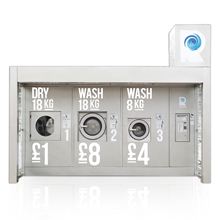
Photo-Me has been trialling heavy duty laundry units in France and Belgium sited predominantly outside supermarkets.  The results from the trials from both a durability and takings standpoint were sufficiently good that an aggressive roll-out of the products has commenced in France and Belgium initially, with other European countries to follow.  At the end of the year, the group has 519 units n field and following the relocation of the manufacturing capability to Hungary, the target is to have about 2,000 units in field by the end of 2015.  The machines are very cash generative and have an EBITDA margin of about 50%.

Operating profit for the Operations segment was £30.7M, a £2.6M increase over last year.  This division makes up the vast majority of group profits and the company benefited from the progressive rollout of the higher margin Starck booths, growth in the laundry estate and lower manufacturing costs.  The overall estate grew as the removal of 553 low value amusement machines in the UK was counteracted by 1,260 new photobooths (mostly Starck), evenly split between the three geographic areas.  In the UK the group obtained a contract to run machines located in Morrison supermarkets, which included 300 booths and there was a good performance in both Japan and France but Germany showed some weakness after a strong performance last year.  Due to the lower manufacturing costs, the group is gradually expanding into new territories and operations have been established in Thailand, South Korea, Malaysia, Vietnam and Poland.

After the successful trial, the group now has laundry machines in France, Belgium, Ireland, Germany, Netherlands and the UK and as well as supermarkets, units are also present at campsites, universities, military barracks and riding stables.  Digital printing kiosks are focused on Continental Europe, particularly in France and Switzerland.  The market for printed photos is fairly mature but there continues to be innovation with regards to the products offered.  There has been a continued reduction in the numbers of Amusement machines but the group has recently introduced some 4D experience rides to the estate and the business remains profitable.

revoluton

Operating profit for the Sales & Servicing segment was £3.5M, a vast improvement on the £638K loss last year.  Of this, £1.3M was from the sale of laundry units. The decline in revenue was due to the falling minilab sales, as was expected, and the lower staff costs, R&D costs and the previously mentioned laundry sales accounted for the increase seen in profits.

A lot of progress is being made on reducing costs.  There is now a centralised logistics platform for the group which has led to savings from reduced stock levels and staff numbers.  The focus going forward is on manufacturing costs with the use of new technology and low cost manufacturing bases.  The cost of producing a photo booth has reduced dramatically in recent years, which has enabled the group to consider moving into some emerging markets.  The Laundry units have now also been outsourced to Hungary which will give cost savings in future but did not occur until early 2014.

There are a number of ways that the group is looking for growth.  They have a strong market position in their established countries and adding new units is quite difficult to achieve.  However, as mentioned above, 300 new units have been added to Morrison supermarkets and a new contract has been negotiated to station photobooths within the London Underground network.  Therefore the focus has to be on new markets.  As well as the new countries mentioned above, China is still an immature market and the group now has 500 units in the country with a view to having 1,200 by the end of 2015 with an additional 200 in South Korea.

The group is also looking to increase prices cautiously to determine whether there is an impact on demand.  A price rise as a result of a software upgrade has been affected in Japan and the group is targeting a price increase in one of the smaller European markets to determine the effect.  I can’t help thinking this is a bit greedy.  It would surely be less risk to expand into the new markets, rely on new products and reduce the manufacturing costs (all of which are being done) rather than to try and raise prices and risk killing the proverbial goose that lays these golden eggs.

The principal operating cost is the commission paid to owners of the sites where the machines are positioned.  The commission paid on the laundry units is generally lower as they are usually stationed in outside areas and the rate over the whole estate is currently about 32%.  This commission is an area the group is focusing on, along with logistics and manufacturing costs.

Net cash at the year end point was £63.1M, an increase of £1.7M on last year.  This is certainly quite a substantial cash pile the group is sitting on.  The total dividend for the year of 3.75p was a 25% increase over last year and the board are looking at another 30% increase next year with the possibility of special dividends too as the board issue a rather bullish outlook statement.  The current yield is 4.1% but it looks as though this could rise in the coming year.  The current P/E ratio is 24.6, falling to 21.2 next year.  When the huge cash pile is considered, this actually seems fairly good value for a company of this calibre.

Overall then, this was a good set of results.  Profits are up on slightly lower revenues, net assets are up and there was a strong cash flow, despite a slightly lower operational cash flow due to working capital movements and higher taxation.  The yield is decent, with a very real possibility of further payouts; there is no debt and a huge cash pile.  The shares are not massively cheap but I still see these as a decent buy.  They are my largest holding at present, as situation that I am very comfortable with.

On the 12th September the group released an interim management statement.  It was reported that the momentum seen last year has continued with an increase in profitability in the year to date in line with expectations.  Profitability has improved across all geographic regions with Asia increasing profits by 50% and the UK and Europe both increasing profits by over 15%.  At constant exchange rates, overall the group increased profits by 25% on a small increase in sales but the continued strength of Sterling reduced results by about 5%.  The manufacturing facility in Hungary is working well and the expected increase in production remains on track.  In France and Belgium, there was continued revenue increase for laundry machines sited for at least one year and results from the newly launched countries have been promising.  The net cash position was £55M, a similar level to the same stage last year after payment of the special dividend.  The board remain confident for the outlook for the full year.  All good – if these were not my largest holding I would consider topping up.

On the 23rd October the group announced a statement covering the first five months of the year.  They said that the positive trends announced in the last update had continued and on a constant currency basis, turnover has improved compared to the same period of last year and pre tax profits have moved ahead strongly so that the board are confident of the outlook for the full year.  The Photobooth business is performing well with growth in all major geographic areas and a particularly strong performance in Japan.  Progress with the rollout of the laundry units continued to go well and the total deployed is now over 700 units, more than 600 of which are located in France.  The group is focused on deploying laundry units in 3 other countries and intends to expand to most of the other countries where they are already present.  The financial performance of the laundry business has been strong and the cash position of the group remains very strong.  All good, positive stuff.

Air Partner Finance Blog – Full Year Results 2014

Air Partner has now released its full year results for the year ending 2014.

airpartnerincome2014

Overall revenues were up by £14.8M, driven by a £17.9M increase in commercial jet and a £9.5M hike in private jet broking sales, somewhat mitigated by a £4.2M fall in freight brokering revenue and other service revenue that more than halved during the year.  Cost of sales also increased, to give a gross profit some £2.7M higher than in 2013.  Admin expenses increased to the tune of just under £3M, which seems partly to relate to £1M of estimates of invoices for air charter revenues, these were not retained this year which affected the admin costs by this amount (admin costs were also positively affected last year year by the release of £443K worth of provisions).  This meant the operating profit was £246K less than last year. Finance costs increased somewhat, partially due to the previously mentioned release of provisions in the previous year of £89K to make the annual profit £1.9M, £346K lower than in 2013.

airopartnerassets2014

Overall when compared to the end of 2012 (due to the change in reporting dates), assets were down by £7.5M.  This fall was driven by a £5.6M reduction in trade receivables and a £4.5M decline prepayments and accrued income only partially mitigated by a £2.7M increase in cash levels, although it should be noted that £8.8M of the £18.4M are customer deposits on the jet card.  Liabilities also decreased during the period, driven by a £2.6M fall in trade payables and a £2.5M reduction in accruals.  This all meant that net tangible assets were down to the tune of £1.8M to £11.2M, which is a little disappointing.

airpartnercash2014

Before the movement in working capital, cash profits were up £1.2M to £4.1M.  A decrease in both receivables and payables, however, meant that cash generated from operations was down £1.4M to £5.6M.  A much lower tax rate took it a bit closer to last year’s total, £400K less at £4.9M.  The main capital expenditure was computer software at just under £600K which was paid for by the £815K bought in by the sale of the aircraft.  The cash was then spent on dividends and the purchase of their own shares (both about £2M) and the cash flow of £1.6M is fairly comfortable, albeit some £1.1M less than in 2013.

Commercial Jet Broking increased its underlying pre-tax profit by 38% to £2.3M with growth driven by excellent performances in the UK, US and France which was achieved despite the slowdown of some government work.  Tour Operating in Europe achieved good results, contributing 35% of the division’s revenues.  Through its Aberdeen and Houston offices, the group also gained good traction in the oil and gas industry, increasing these revenues by 54%.  Some of the projects undertook during the year were evacuations, rescuing stranded cruise ship passengers and flying the world cup to different countries before the tournament started in Brazil.  The Conference and Incentive market remained slow, however, and the sector remained very competitive with low margins.

Underlying pre-tax profit in the Private Broking Sector increased by 36% to £1.5M with significant growth occurring in the UK and the US, driven by investment in high calibre staff.  The group has seen strong interest from high net worth individual leisure traffic which has encouraged JetCard to continue to perform well with sales up 29%.  The traction gained in continental Europe was not as good as expected, however, and market conditions remained challenging but are expected to improve in the coming year as Eurozone economies start to recover.

At £200K, underlying pre-tax profit in the Freight Broking business was flat when compared to last year despite the 26% fall in revenue due in part to the end of a large government contract.  In the last half of the year, however, there has been an increase in the level of new business.  There were two significant programmes completed during the year – delivering humanitarian aid to the Philippines; and flying equipment to the Winter Olympic Games in Sochi.  Investment has been made in industry specialists based in Cologne and Istanbul and progress is being made building new business around the Air Partner Time Critical offering.

Privatjet_3_RET_1024x768

During the year the board undertook a thorough review of its investment in IT which resulted in a significant impairment of previous IT investment and this, along with some restructuring costs led to a one-off charge of £1.4M which included a £774K impairment of the IT system and £646K of restructuring costs.  The group has historically underinvested in technology and as part of the review, there will be an uptick in investment and the associated costs which will include Microsoft’s CRM software that will be implemented across the group.

There were a number of changes to the board announced during the year with Tony Mack retiring at the AGM.  Grahame Chilton was appointed non-executive director and has good broking experience and CFO Gavin Charles left in April.  He was replaced on an interim basis by Neil Morris, previously Group Financial Controller and the search for a permanent replacement is on going.

Overall then, this was a mixed set of results. Progress seems to be being made in the jet broking sectors with the others struggling a bit more. The underlying profits are actually up on last year and there is a good cash balance with a healthy cash flow, albeit slightly worse than last year due to the movements in working capital, but the decline in net assets is a little disappointing.  It is also a time of upheaval with some new board members being appointed.  A final dividend of 14p per share was announced and going forward, management hope to be able to grow the dividend by 10% per year. This gives an annual yield of 6% which is pretty decent.  At the current share price the P/E ratio stands at 17.8 but this reduces to a better value 11.4 on an underlying basis.  I think the underlying investment here is pretty decent but I am planning on waiting on the sidelines for a better idea of how the freight market will pan out next year, along with seeing how the new IT systems will bed in.

On the 5th June it was announced that Neil Morris had been appointed the Chief Financial Officer after doing the job on an interim basis since March, despite the group employing an executive search firm to assist with finding a new candidate.

On the 5th June the group also issued an AGM statement.  Trading in the year to date was slow as is the case usually during that time of year with a gradual improvement in orders as the group enters the traditionally more busy summer period.  The Commercial Jet division continued its transition away from military work with new programmes started for tour operators and energy clients but the division has seen fewer one-off contracts for tender in recent months.  Trading in the Private Jets division remained strong with both the UK and US performing well.  The Freight division continued to show improvements in trading from a low base.  The group continued to have a strong cash position, with net cash standing at £18M.  There is nothing in this statement that encourages me to take the plunge.  Indeed there seems to be a veiled profit warning with regards the Commercial Jet division.

On the 28th July the group released a trading statement.  Since the AGM statement, trading has been weaker than expected due to a poor performance at the Commercial Jet division which has seen a continued absence of ad hoc projects.  Trading in the other divisions has been as expected with the Private Jet business delivering strong performance in the UK and the US, and the Freight division continued to make progress.  Net cash stood at a healthy £19M, although £11M of this are JetCard deposits.  The board now believe that the first half of the year will show a pre-tax profit of £1.1M with the second half of the year likely to be in line with prior years.  Despite this, the board have announced a 10% increase in the interim dividend which gives a stonking dividend yield of 6.2%.  The clues for this profit warning were actually in the AGM statement and I will continue to sit on the sidelines until there is a better idea of Commercial Jet profitability.

On the 20th August the group announced the appointment of Peter Saunders as non-exec director.  He has previously worked as CEO of the Body Shop and replaces Chuck Pollard who decided after five year to step down from the board.

Sainsbury Finance Blog – Full Year Results 2014

Sainsbury has now released its full year results for the year ending 2014.

sainsburyincome2014

Revenues from the retail stores were up £618M on last year and the newly acquired bank made revenues of £28M.  Cost of sales were also up, including employee costs that increased by £115M and the gross profit was some £110M higher than in 2013.  A number of one-off items were present, including £148M of past service credit related to the closure of the pension scheme to future accrual, a £76M payment with regards to VAT refunds on nectar points and a £92M impairment of land and buildings where the group no longer intends to build supermarkets, which were counteracted by an increase in other admin costs to give an operating profit £127M higher.  Finance costs were broadly unchanged and taxation just a little bit higher so the profit for the year was £716M, a hike of £114M over last year which seems to be a decent outcome.

sainsburyassets2014

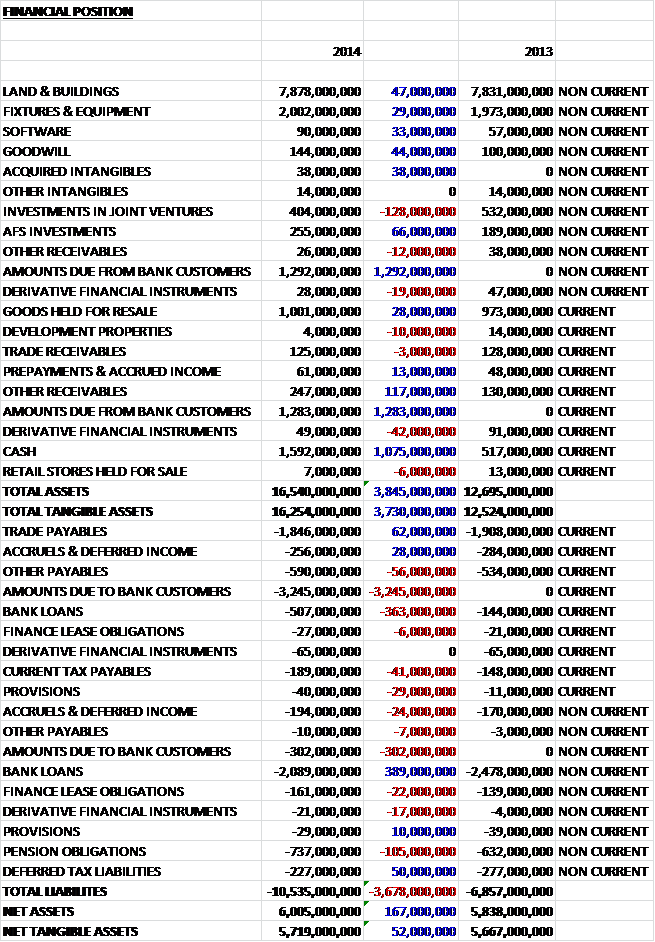
Assets were up by some £3.845BN over the end of last year.  These increases were predominantly relating to the acquisition of the bank with loans to customers totalling £2.575BN, a £1.075BN increase in cash levels and a £117M increase in other receivables which are bank funds in the course of settlement, only partially mitigated by a £128M reduction in investments in joint ventures.  As would be expected, liabilities also increased due to the £3.547BN in customer bank deposits acquired with the bank. The only other increase of note was a £105M hike in pension obligations.  All of this meant that the increases in liabilities and assets broadly cancelled each other out and net tangible assets only increased by £52M year on year to £5.719BN.  Still, this is better than a fall and is a substantial amount of equity.

sainsburycash2014

Before movements in working capital, cash profits were some £72M higher than last year at £1.366BN.  Due mainly to a decrease in payables (partly driven by Easter phasing), however, this became £1.227BN after working capital movements, £41M lower than last year.  After interest and tax, this became £939M in net cash from operations.  This cash was almost entirely swallowed up by £916M in capital expenditure. The bank acquisition came with £1.016BN of cash when the acquisition costs are taken off, which accounts for the positive cash flow of £1.075BN at the end of the year.  The group also gained £335M from the sale of property, plant and equipment which paid for the dividends.   There was a small net increase in borrowings but this was not particularly material.  Overall then, the £1.075BN of cash the group made is clearly good but when it is realised this is entirely due to the cash received with the bank, this does not look so spectacular.  It is also apparent that the dividends are not being paid out of operating cash flows, which entirely go on capital expenditure but from sale and leaseback proceeds.

Retail sales grew by 2.7% with like for like growth at 0.2% which was lower than Sainsbury’s own guidance due to the difficult market and it is a little worrying to see that decent increases were experienced in the first half of the year but like for like sales declined by 3.1% in the final quarter.  The convenience business grew sales by 19% to £1.8BN and online groceries increased by 12% to over £1BN.  Retail underlying operating profit increased by 5.1% to £873M, reflecting cost savings of £120M during the year with a similar level of cost savings expected next year.  Bank income fell by 4.2% to £229M mainly due to a reduction in the earned interest rates on the loan book due to strong competition, and also a decline in commission due to price deflation in car insurance.  The Bank delivered an underlying operation profit of £53M, 10.2% less than last year due to the above reduction in income and a provision relating to potential customer redress payable in respect of Card Protection Plan insurance.  The bank is expected to make a similar level of profit next year.

The group have invested in own brand products and they are growing at over twice the rate of branded lines and account for about half of food sales.  The Premium Taste the Difference range achieved double digit growth and a new factory has been opened to create desserts for the range using British ingredients.  The Basics range is doing less well and sales declined during the year, the response has been to rebrand with new packaging so hopefully the decline can be reversed.  A big part of Sainsbury’s success in recent times has been down to trust, as demonstrated during the horsemeat scandal where no products were found to be contaminated.  Indeed, the group have been DNA testing their food for 10 years to guarantee provenance and this has been expanded during the year.  Also, there is a strong commitment to source locally with pork and chicken now 100% British.

The group have made a big investment in the TU clothing line this year and it generated annual sales of about £750M.  A two year deal has been signed with designer Gok Wan whose designs prove popular with customers.  The back to school range this year was the most successful such event in the group’s history.  General Merchandise sales are now over £1BN and Sainsbury is the 6th largest homeware retailer by value.  Cookware and Kitchen appliances have enjoyed double digit growth and the group have outperformed the market in all their entertainment categories.  Some of the stores have been converted to “department store” layouts and they have progressed well so the concept is being rolled out in more than 150 stores in the coming year.  The Digital entertainment offering has been slower to gain traction than expected but progress is being made.  Meanwhile the pharmacy business is continuing to develop through in-store and hospital out-patient pharmacies.

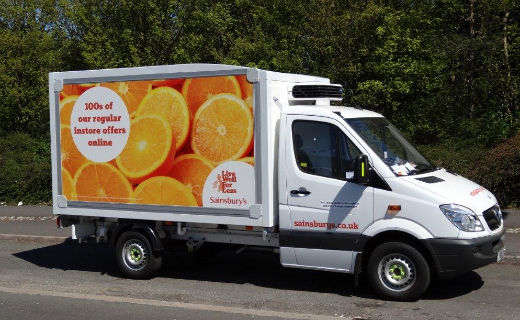
Convenience store sales have increased by 19% year on year but securing appropriate sites have become increasingly competitive.  The website has been enhanced during the year to give a more intuitive search and the new mobile website will be a boon going forward.  Overall, online grocery sales increased by 12% year on year although a decline in marketing spend whilst the website was upgraded did impact sales growth in the short term. There are plans to open a dedicated online fulfilment centre within the next few years in Bromley-By-Bow to help meet the growing demand in the South East.

van_small

Clearly one of the major events of the past year was the purchase of Lloyds Bank’s 50% share in Sainsbury Bank.  The group spent £199M in cash and £5M in deferred consideration.  With this acquisition came net assets of £352M with a goodwill payment of £45M.  The bank also came more than £1BN of cash balances included in the above net asset figure.  As the group build the new systems for the bank, profit growth will be constrained by double running costs and a total of £260M in transition costs and capital expenditure will be incurred in moving to the new platform (£45M next year).  The bank currently has 1.6M customer accounts and the products are designed for customers of the supermarkets, for example the Nectar Credit card that gives extra points on Sainsbury purchases.  The insurance market has become increasingly price driven which has reduced retention and profitability, despite this Home Insurance has performed quite well.  The Travel Money bureau performed well with sales increasing by 23% year on year and 107 new ATMs have been opened.

The mobile phone network is still in its first year of business and progress has not been as quick as expected.  The network is a joint venture with Vodafone and it includes Nectar incentives.  In order to support this, the group have opened phone shops in some of the larger stores.  In its first year the joint venture suffered losses of £4M due to start-up costs and is expected to make a similar loss next year.  The ebook business is still very small and in its first year of trading and is being offered on the website.  The Energy business offers gas and electricity and again, uses Nectar points as incentives.  The group have gained 60% more customers than last year as the business makes progress.

There have been a number of investments in land and infrastructure.  This includes a £500M project with Barratt at Nine Elms with 737 new homes, a new supermarket and local shops, restaurants and office space.  The group have also opened a new £30M convenience depot in Thameside to support the growth of the convenience network in the South East and work has begun on a new distribution facility in Daventry to support the general merchandise business.

As mentioned previously, this is a bit of a milestone for Sainsbury.  CEO Justin King steps down at the AGM to be replaced by Commercial Director Mike Coupe and Mike has had quite a while to learn the ropes.

Going forward, despite some signs of economic recovery, the food retail sector is likely to remain challenging.  Customers continue to focus on value and as such the discounters have continued to gain market share, although Sainsbury seems to be less affected by this trend than some other supermarkets, indeed they are the only “big 4” supermarket to maintain market share this year.  However, the group are still planning on opening 13 new supermarkets and 91 convenience stores during the upcoming year.

Net debt is currently running at £2.384BN, an increase of £222M over the end of last year.  This was driven by the additional funding used to acquire the bank and an increase in working capital.  The shares look undervalued on a P/E level as the underlying ration is 9.9, although this is expected to increase to 10.8 next year this is still on the value end of the spectrum.  Likewise, after a 3.6% increase in the final dividend, dividend yields are strong, being at 5.5% this year at the current share price and predicted to rise to 5.6% next year.

Overall then, this has been an interesting year for Sainsbury.  As many of its rivals struggle, the group has been able to cling on to increasing retail revenues and profits.  Worryingly this trend may be reversing, however, as was seen in Q4.  The purchase of the 50% of the bank they did not already own is also clearly a big step forward.  Profitability will be constrained in the short term but medium term, this should be a decent source of income albeit with the regulatory risks attached.  The other businesses are also still in their infancy but it is good to see some diversification taking place.  The core issue, however, is the changing way that customers shop for groceries.  They are more driven to discounters, convenience stores and online groceries and while Sainsbury has made good progress on its convenience and online offering, the large superstores are becoming more and more redundant, although the department store idea might have some legs.  The migration of customers to the discounters is a little harder to address.  The group have been less affected than Morisson and Tesco but this is still something that needs to be addressed.  The share price certainly prices in these concerns as evidenced from the yield and P/E ratio and at these prices I am happy to hold.

On the 11th June the group released a trading statement covering the first quarter of the year.  Total sales increased by 1% but this was due to new store openings as like for like sales declined by 1.1%.  This reflects that growth within the industry is at its lowest level for a decade.  Own banded products continued to perform well, however, with Taste the Difference sales up 10%.  General merchandise also showed decent strength, with clothing delivering double digit growth and the group are trialling an online clothing offer which should further drive sales.  Entertainment showed good growth and convenience sales grew by 18% year on year as the 200th store was opened in London.  Online grocery sales increased by 10% following the roll out of the improved website and Sainsbury Bank’s transition remained on track.  Although the like for like sales decline is a disappointment, it was not altogether unexpected and I remain happy to hold.

On the 20th June the group announced that they are entering into a joint venture with Dansk Supermarkets to resurrect Netto in the UK.  The initial trial will consist of 15 stores to be opened before the end of 2015, with the first in the North of England.  If the trial is successful the new format stores will be rolled out across the country.  Sainsbury will provide an initial £12.5M to the joint venture and will probably incur a loss in the region of £5M to £10M up to mid 2015.  The new stores will be in a completely different format to that of the Netto stores that left the UK market in 2010 and will offer discounted wares a long with an in-house bakery offering fresh Danish breads and pastries.  This is an interesting move by Sainsbury.  It is clearly an attempt to grab some of the increasing discount market.  I believe this is an excellent idea and am quite excited to see how it pans out.

On the 1st October the group released a statement covering Q2 trading.  Like for like retail sales were down 2.8% and total retail sales fell by 0.8% (all excluding fuel).  The market remained very competitive and customers continued to buy more in convenience stores, reducing the average basket size.  Sainsbury now matches prices to Asda, even when they are on promotion, and have stopped matching with Tesco.  General merchandise performed well with a double digit growth in sales and convenience sales increased by 17%.  Online grocery sales increased by 7%, impacted by a high level of competitor customer acquisition.  During the quarter the group opened 23 new convenience stores and two new supermarkets and they remain on track to deliver five new Netto stores by the end of the year. Going forward, it is believed that the significant pricing activity and food price deflation seen this quarter will continue for the foreseeable future and management now expect like for like sales in the second half to be similar to the first half of the year.  So, this update is clearly not that good but was known well in advance and there are no surprises here.

Naibu Finance Blog – Full Year 2013

Naibu has now released their full year results for 2013.

naibuincome2013

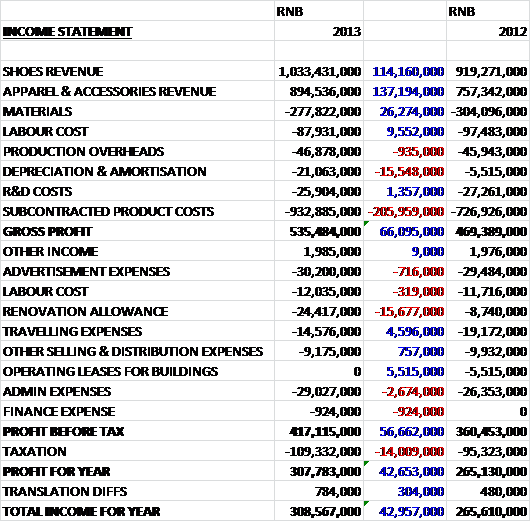
Revenue increased across both sectors, up £11.4M in shoes, driven by increased sales price per unit and £13.7M in apparel and accessories, achieved by increasing the number of outlets and increasing the display areas for clothes.  Material costs also fell due to the fact the group is making less shoes than it was last year, and similarly labour costs were down due to the closed lines in the factory.  Depreciation, at £2.1M increased by £1.6M but it was subcontractor costs that was the largest increase, up £20.6M due to the shoes that are now manufactured externally after the labour problems in the new factory.  The only real admin expense to increase considerably was the renovation allowance that was up £1.6M during the period.  The small finance expense relates to foreign exchange losses due to depreciation in the HK Dollar.  A higher tax rate then meant that the profit for the year was some £4.3M higher than in 2012 at £30.8M.

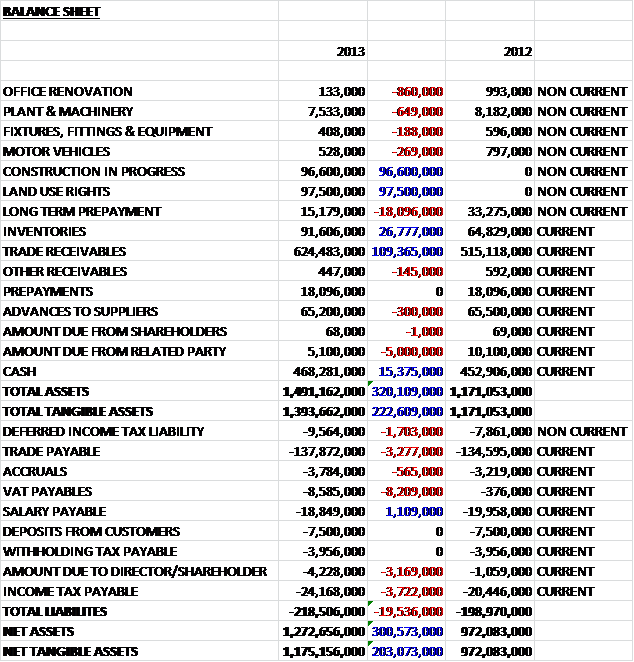
naibuassets2013#

Overall assets increased by £32M.  This increase was driven by a £10.9M growth in trade receivables, a £2.7M hike in inventories plus £9.8M and £9.7M worth of land use rights and construction in progress respectively(relating to the Quangang factory), only very slightly counteracted by a £1.8M fall in long term prepayments, relating to the amortisation of store renovation payments.  Liabilities also increased with the largest growth being a £821K increase in VAT payable.  Net assets at the year end point were some £30M higher at £127.3M which seems like good progress to me.

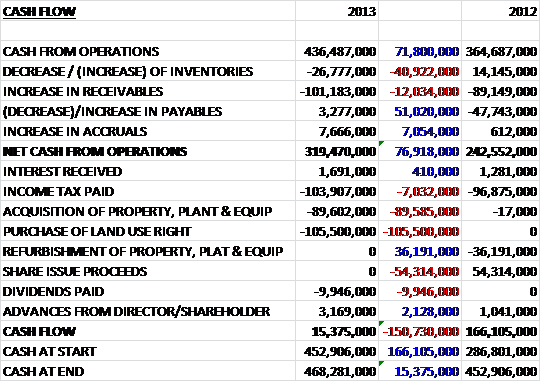
naibucash2013

Before movements in working capital, cash from operations was some £7.2M higher at £43.7M.  An increase in inventories and receivables, however, pushed the net cash from operations down to £31.9M, still some £7.7M better than last year.  Although the average trade receivable turnover days fell from 121 to 106 days, this still seems rather high. The group then spent quite a bit on capital expenditure, £9M on the acquisition of property, plant & equipment and £10.6M on the purchase of land use rights.  After dividend payments of just under £1M the cash flow for the year was a still respectable £1.5M but it was £15.1M lower than in 2012 due to the capital expenditure this year.

Profit in the shoes segment stood at £21.3M which was very similar to the profit recorded in the Apparel & Accessories segment, which was £21.2M.  Management expect competition to intensify in 2014 as other branded sportswear companies continue to push into tier three and four cities.  Having said that, the Chinese government is determined to restructure the economy, encouraging internal demand and continue the process of urbanisation which suggests the market does have good growth potential in the medium term.  The group plans to expand its market in Western China and seem to be making this a priority.  They have developed a new brand (Nibo) which is based on a European fashion concept and is due to be launched in 2015.

In September 2013 the group signed an agreement to purchase land use rights to develop a Naibu Industrial Zone.  This zone will include R&D, manufacturing and logistics facilities relating to the development of shoes, apparel and sports equipment and will be in Dazhu County, Sichuan Province.  The group will pay £6M for the rights, £800K having been already paid as a deposit.  It is expected that the total cost of the project will be in the region of £30M and there will also be a new factory with 12 production lines.

Operations in the new Quangang plant have not commenced as planned due to an unexpected shortage in labour pushing labour costs up.  If unsufficient workers can be found for six production lines to begin production by August the group will consider disposing of the new factory, which seems like a pretty ridiculous situation to be in.  In the meantime, the group is continuing to produce shoes at the Jinjiang facility but the majority of shoe production is being outsourced as there only seems to be two production lines at the plant.  The Dazhu factory, in the new Industrial zone is due to be operational in early 2016, although if they can’t find the staff for that one, who knows what will happen.

Overall then, profits were up in both product markets, net assets continued to rise and the group was cash generative even after the heavy capital expenditure.  The final dividend remains unchanged at 4p and at the current share price the dividend yield is a stonking 10.5%, rising to 11.4% on analyst forecasts next year.  The shares are arguably even more undervalued on the P/E ratio level as at the current price this stands at just 1.1. Niggling doubts remain about the legitimacy of the company, however, and the situation at the Quangang seems ridiculous – a new factory has been built but there are no staff to work in it!  The fact remains that this company is ridiculously undervalued if it is legitimate, however, and I still see this as a strong hold.

On the 5th August the group released a statement covering trading during the first half of the year.  Revenue grew by 8.4% when compared to the same period of last year but this was overshadowed by the news that they have failed to find enough workers for their newly acquired factory and because the shortage of labour is expected to continue for the forseeable future, they have put the factory up for sale.  In the interim, the shoes will be subcontracted to other companies.  In Dazhu, the group paid the second installment of £3M for land use rights, with the final tranche of £2.2M due when the land use certificate is granted, which is expected to be in October.  The factory should be operational by Q2 2016.  I have to say this is looking rather poor.  Why did Naibu not forsee a labour shortage?  Why will anyone else be interested in taking over a factory they can’t staff?  Why go to the expense of acquiring the factory if the shoes can be manufactured by OEMs at a similar cost?  What will happen to all the cash spent on the factory?  I have to say, that without answers to the above this is looking a more and more risky investment.

Shaft Sinkers Finance Blog – Full Year 2013

Shaft Sinkers have now released their full year results for the year ending 2013.

shaftincome2013]

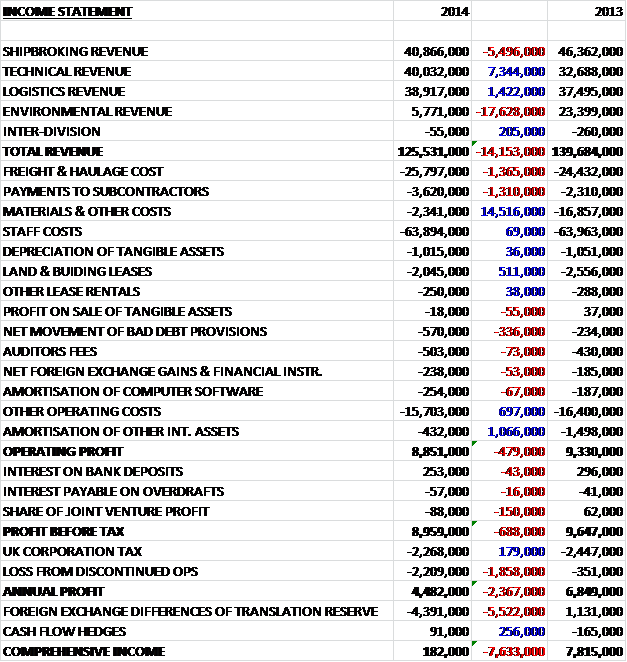
Revenues were substantially down on last year driven by a £66.5M fall in South African sales, somewhat mitigated by a £26.1M increase in revenue from the rest of the world.  There was some progress on staff costs, down by just under £41M with other direct expenses increasing slightly.  This lead to a gross profit some £2.6M lower than last year.  There was £1M less depreciation compared to 2012 and £1.4M was made on the sale of property relating to an office in South Africa which has been sold and leased back, but £2.7M less was made on foreign exchange conversion and at £3.9M legal fees were £2.8M higher than last year and starting to take their toll on results. Other operating costs were substantially lower, though, so operating profit was “just” £1.4M lower than in 2012 at £3.9M (there would have been an improvement on last year had the legal fees remained the same).  As far as financial costs were concerned, there was £479K less paid on loan interest and £411K less interest paid to revenue authorities.  A slightly lower tax bill then made the profit for the year £363K down on 2012 at £2.1M.

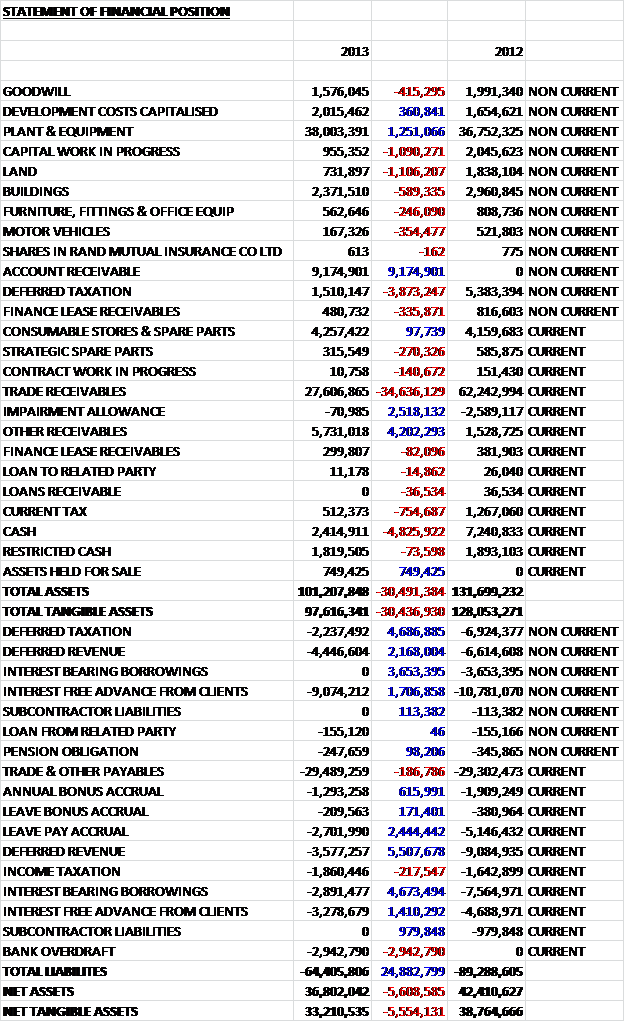
shaftassets2013

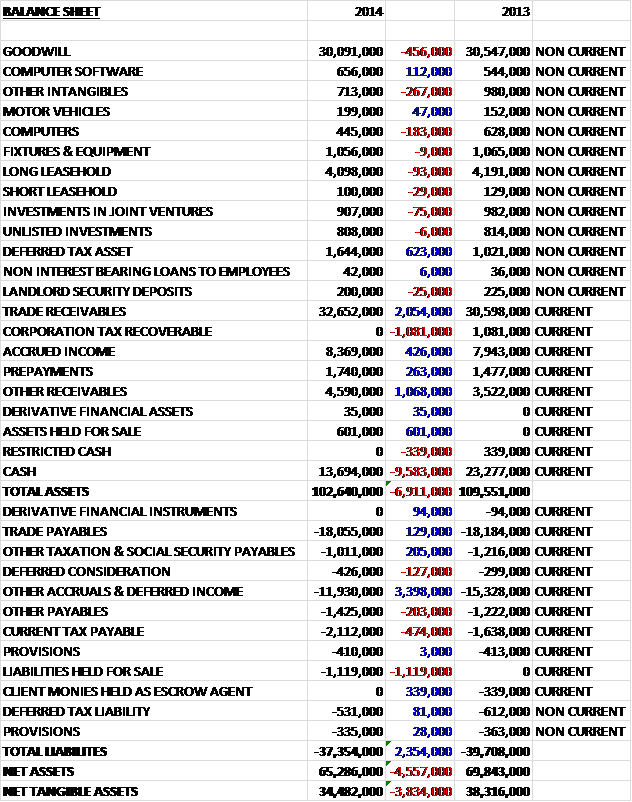
Overall assets fell by£30.5M when compared to the end point of last year.  The fall was predominantly driven by a £34.6M decline in the value of receivables but a £4.8M fall in cash and a £3.9M decline in deferred taxation assets did not help.  These were only partially mitigated by £9.2m of account receivable, relating to the quantity that the group is trying to claim from Eurochem (moved from receivables), and a £4.2M increase in other receivables.  The small increase in development costs capitalised relates to automated mine shaft inspection IP.  Total liabilities also fell during the year driven by a £5.5M fall deferred revenues, a £4.7M fall in deferred taxation, an £8.3M decline in borrowings, a £2.4M reduction in leave pay accrual and a £2.2M decline in deferred revenue, although the overdraft did increase by £2.9M.  The result of all this is that net tangible assets fell by £5.6M to £33.1M which is rather disappointing.

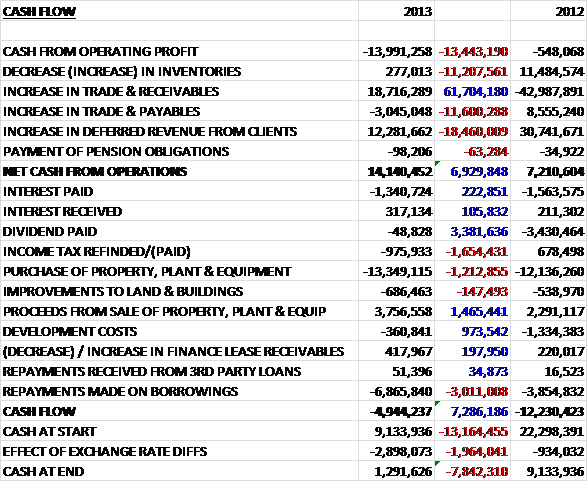
shaftcash2013

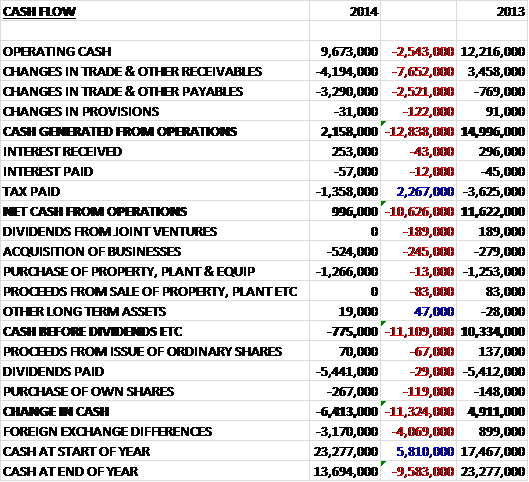
Before movements in working capital, there was a pretty terrible £14M cash outflow.  A huge swing in receivables and a £12.3M cash advance from clients meant that the net cash from operations was £14.1M, some £7M better than last year.  Sadly this did not quite cover the £13.3M spent on plant and equipment and £1.3M in interest.  The group did manage to claw £3.8M back from flogging a South African office and this helped to repay £6.9M of borrowings resulting in a £5M cash outflow.  This leaves the cash level at the end of the year at precarious £1.3M, although borrowings are now fairly negligible it is a bit of a concern that this cash flow includes quite a lot of deferred income.

The group is still feeling the effects of the legal proceedings with Eurochem with higher legal fees.  The outcome of the proceedings will only be of practical effect in early 2015 but the case is going to take its toll before then.

Shaft-Sinkers-specialises-in-deep-level-mine-construction

South African profit before tax was £1.2M, down from £4.5M in 2012.  The operations were significantly impacted by the difficult operating environment this year and some contracts were cancelled in response to declining commodity prices and rising operating costs in the country.  There were a number of contract extensions awarded, however, with Afplats, Lonmin and Impala agreeing to an additional £47.6M of work.  During the year, the group managed to reduce the level of outstanding variation orders during the first half of the year but unfortunately they began to grow again during the second half.

There have been a number of cost cutting initiatives such as removing one layer of operational management and the reduction of South Africa headcount but this was offset by significant underperformance from a number of operations with Impala 17 and Styldrift being particularly disappointing.  Styldrift suffered poor performance over the last two months of the year due to “poor planning”.  The Impala 17 project was severely impacted by safety stoppages and a generally poor safety record during the year.  A third party health and safety expert firm is performing an independent assessment and it found a number of issues that were not dealt with effectively and a number of recommendations have since been adopted in order to improve safety reporting.  As a result, the group lost £600K on the project during the year and a further £900K so far in the next year.  Some new financial terms have been agreed which should improve the financial performance of the project from April 2014 but Impala is retendering the project from September which is a real blow and reduces the order book, post balance sheet date, by another £13.9M.  The Moab project was terminated and the group has some unrecovered costs relating to that.

After the end of the year, a further strike was initiated affecting South Africa’s platinum producers which led to suspended operations at Impala 16 and Lonmin and the current situation seems to be deadlocked with little signs of movement.  Shaft’s employees are not on strike but they have been prevented from working at the affected sites.  There are contractual provisions to ensure the group can recover some costs on the event that clients are affected by strikes but the action will still affect profitability on those projects.

The METS division managed a project to design, engineer and supervise the manufacture of the head gears for the Hindustan Zinc project.  It also designed a new main sinking methodology that gives a safer and more cost effective sinking operation, particularly for shallower ventilation shafts.  This new method was used on the Hindustan Zinc project.

ROW profit before tax was £3.1M, up from £580K last year.  Work at the Kibali goldmines project in the DR Congo proceeded well, and the start of the main sinking phase proceeded in November.  The project has performed in line with budget and the shaft reached a depth of 483m ahead of schedule.  The Hindustan Zinc project progressed more slowly than expected due to problems with a civil engineering subcontractor during the first half of the year.  The group dismissed the contractor and took charge of the responsibilities themselves, however progress in the second half of the year continued to be poor which resulted in higher than expected costs and lower revenues as they are inked to the speed that the shaft is sunk.  Some mitigating measures have been undertaken and it is currently experiencing a much better performance.

During the year the group completed collaborations with China Nonferrous Metal Industry’s Foreign Engineering and Construction Co and India’s Tata Projects ltd which should improve market access to those two countries.  There was also an early stage collaboration with Laing O’Rourke in the UK.

The outlook for 2014 remains difficult and there is no clear sign of when sentiment will improve.  The situation with industrial action in South Africa is also very concerning, with no real prospect of it being resolved any time soon.  However, it could be argued that at times of less capital expenditure, mining companies may be tempted to focus on extending the life of existing mines with further shaft sinking opportunities.  The order book declined when compared to the end of last year but remained fairly significant at £238M but the group were not awarded any new contracts during the period, although there are outstanding tenders to the value of £970M.  The Kazchrome contract remains unallocated and I suspect it will not be awarded until the client knows Shaft can fight off the legal claims which will destroy the group should they be found guilty.  The group expect cash flow to be tight in the coming year, which does not bode well.

Although the group’s net debt position has improved to £1.6M, this is made up of £1.8M worth of restricted cash which is held by Standard Bank as a security for a performance guarantee issued in respect of a project and these funds remain restricted as long as this performance guarantee remains in place.  There is also a £2.9M payment on the loan due in December 2014.  At the current share price the P/E ratio is 1.7 but there don’t seem to be any forecasts for future earnings.  Due to the difficult year the board has sensibly not recommended a final dividend.  Things seem to be very hard for Shaft.  Until the end of the legal claims, I can’t see them winning any more contracts.  The HZC problems are a shame and the ongoing issues in South Africa are going to squeeze cash flow in the coming year.  I have very little value left here but if I did, I would sell.

On the 19th May the group released an interim statement covering the first quarter of the year.  Things are not going well.

The group experienced significantly lower margins as a result of operational underperformance and higher operational costs which lead to a loss before tax of £2.7M, some £700K worse than the same period of last year.  This means that the group is experiencing an increasingly tight cash position and is selling assets and trying to recover receivables – desperate stuff.

The Kibali project continues to be the one shining light, performing in line with expectations.  The progress at the HZL project showed improved progress due to measures implemented at the end of last year and the North ventilation shaft has now been started.  The main shaft sinking was still behind schedule, however, which resulted in reduced revenues.  Continued industrial action in South Africa resulted in the suspension of work at Lonmin and Impala 16 which impacted revenues and profits in those projects.  Operational underperformance continued at Impala 17, impacted by continued safety stoppages.  Performance at Styldrift was below expectations due to poor operational performance on the main and service shafts and subsequent delays in the construction of underground infrastructure.  The group experienced good performance at the Leeuwkop project as a number of issues that occurred at the end of last year were resolved.

The group’s net debt position is now at £3.3M and there were no significant developments relating to the Eurochem claim.  The arbitral hearings will take place in June and legal fees during the period were £1.2M.  Although things seem to be improving outside South Africa, there continue to be real issues within the country and with the increasingly tight cash position, things are not looking good for Shaft.

On the 10th July the group released a statement that should come to no surprise.  Since May their cash position has further deteriorated to the extent that it has engaged with various parties regarding the urgent provision of new financing to satisfy near-term liquidity requirements.  Negotiations are continuing with the objective of preserving value for shareholders whilst also enabling the company to continue trading.  Things sound very serious now and I would be quite surprised if shareholders come out of it with much value intact.

On the 23rd July the group announced additional work awarded by Afplats on its Leeuwkop project.  The work involves the continuation of sinking activities on the main shaft from a depth of 984m to 1,307m as well as the construction of two station breakaways for the establishment of horizontal tunnels to access the ore body at depths of 1,207m and 1,237m.  The work is scheduled to complete in the second half of 2015 and has a total value of £7M.  Clearly this is good news but in reality it is a drop in the ocean compared to the other woes that the group is experiencing.

On the 6th August the group announced that it had signed a contract worth £37M with Kazchrome which will entail the sinking of the Skipovaya vertical shaft to access the ferrochrome ore body which will be mined to supply the Donskoy processing plant in Kazakhstan.  The scope of the work will include the sinking and lining of an 8m diameter skip shaft to a depth of 1,453m.  The contract starts in September this year and is due to be complete in 2018.  It is good that the group has finally wrapped this up after many months of negotiations.  It is not a huge contract, but represents further diversification and potentially a much needed source of initial cash flow.

On the 22nd August the group announced that it had entered into a loan agreement wit Hillside Intl where they will loan the group £3.5M to provide Shaft with adequate working capital to secure a funding package appropriate to its longer term needs.  In that regard, the board has commenced preparations to raise up to £9.2M by way of an issue of convertible loan notes and at this time the loan from Hillside will be repaid and they will subscribe to £3.5M of the loan notes.  The Hillside loan is repayable on the 21st November when the group will pay Hillside a few of 2%.  should the loan not be paid back at this point, this will increase to 20%.  As part of the agreement Hillside will appoint two directors to the board, Mr. Robin Haller and Mr. Alexander Haller.  Current shareholders will be invited to subscribe to €5M of the loan notes by way of an open offer.  It is currently envisaged that the loan notes will be denominated in notes of £10,000 with an issue price of £7,200 per note and a redemption price of £10,000.  The notes will have a maturity date of three years.

The minimum amount raised on the notes will be £3.5M plus €2.4M and the maximum is anticipated to be £9.2M.  In the event that the maxim is raised and all notes are converted into ordinary shares, the percentage of voting rights represented by them will be 78%.  This is a pretty huge dilution for the current share holders.  The conversion price will be equal to 7.639p and the effective subscription price in the event of conversion is 5.5p.  Also announced at the same time, the Chairman, Stephen Oke and non-exec director Roger Williams resigned from the board with immediate effect.  Overall then, this represents a potential huge dilution for current share holders and at £7,200 per note, this is quite a gamble for a company that will not be in existence if it loses the court case.  I am reluctant to take these up.

On the 26th August, the group announced that it had replaced Stephen Oke with Marius Heyns as chairman.  Marius has long experience in civil engineering and before taking up the role spent ten years as CEO of South African engineering group Basil Read.

On the 1st October the group announced that it has increased the cash loaned from Hillside immediately to £5M, an increase of £1.5M.  This now means that Hillside will subscribe £5M for Convertable Loan Notes.  Also it was announced that they were unsuccessful in the retendered Impala 17 contract.  Whilst the loss of the contract itself is disappointing, it was not a bit earner for the group but this might affect the other Impala contract.  Also, the fact that Shaft need to find an extra £1.5M of cash immediately is a bit of a concern.  This is all looking like a bit too much of an ask to retain much value here so I have decided to sell out.  This has been a disaster really!


Braemar Shipping Finance Blog – Full Year Results 2014

Braemar have now released their full year results for the year ending 2014.

braemarincome2014

Overall revenues were down by a considerable £14.2M on last year.  This was driven by a £17.7M decline in Environmental revenue as the work on the Rena finished and a £5.5M fall in Shipbroking revenue due to a difficult market.  These falls were somewhat mitigated by a £7.3M increase in Technical Revenue and a small hike in Logistics revenues.   Costs have also decreased over the last year, predominantly driven by the £14.5M fall in Material costs relating to the Environmental division.  There was also a decrease in the amortisation of intangibles and other operating costs, somewhat counteracted by increases in freight and haulage costs, and subcontractor payments.  This all gives an operating profit some £480K lower than last year.  The group made a small loss on the joint venture compared to a small gain last year to give the profit from continuing operations £688K lower at just under £9M.  When the £2.2M loss from the discontinued operation (including the £800K loss on disposal) and the tax paid is taken into account, however, the annual profit for the year is £4.5M, £2.4M lower than in 2013.  Not really a bad performance given the end of the Environmental work and the loss making business that was sold.

braemarassets2014

Overall, total assets fell by just under £7M over last year.  This was driven by a £9.6M decline in cash levels and the lack of £1.1M in recoverable corporation tax.  These increases were partically mitigated by a £2.1M increase in trade receivables and a £1.1M growth in other receivables.  The small fall in Goodwill relates to goodwill associated with the sold Casbarian business.  Liabilities also fell when compared to last year, predominantly driven by a £3.4M reduction in accruals and deferred income.  The Deferred consideration represents the potential payment with regards to the Lawrence Holt acquisition. Overall these changes meant that net tangible assets were some £3.8M lower at £34.5M which is a little disappointing, although it should be noted that due to the strong Sterling, translation differences adversely affected the balance sheet to the tune of £4.4M.

braemarcash2014

Before the movement in working capital, cash profits were some £2.5M lower at £9.7M.  A large increase in receivables and decrease in payables, apparently due to a shift in the business mix towards the Technical division and the higher level of revenue in the final quarter of the year, meant that cash generated was just £2.2M, a huge £12.8M less than in 2013.  The group did pay less tax though, which meant that net cash from operations, at just £1M was down by £10.6M.  The group then spent £1.3M on capital expenditure and £500K on acquisitions so before any financing issues the group had a cash outflow of £775K.  The £5.4M spent on dividends then took the outflow to a rather unsustainable £6.4M, an £11.3M reverse when compared to last year, although the group did receive £2M from the LNG Engineering contract just after year end.

The discontinued operations referenced throughout the income statement relates to Casbarian, part of the Technical division.  It was decided that it did not align with the other businesses and was sold to the local management team in March, generating a loss on disposal of £800K.  The group also completed the sale of the Morrison Tours business from the Logistics division that provided on-shore excursions for passenger cruise ships in Scotland.  In October, the group acquired Lawrence Holt Ltd, based in Felixstowe, generating £278K of goodwill from an initial £200K cash consideration and deferred consideration of £426K.

The Shipbroking division had an operating profit of £2.6M, down by 51% on last year.  The shipping market continued to suffer from over capacity by some 25%, not helped by recent new builds as ship owners look to own cheaper, more efficient vessels, and therefore supply growth as continued to run ahead of demand, supressing charter rates.  The market for oil tankers is changing rapidly as US domestic crude oil from unconventional sources replaces their reliance on imports with the displaced tonnage now refined closer to source in the Middle East and India.  In addition, there have been some European refinery closures, meaning higher petroleum product imports from a variety of sources.  This has had the effect of reducing demand for crude oil tankers and increasing demand for product tankers.  An improvement in freight rates for Deep sea Tankers was apparent in the second half of the year, driven by a trend for slow steaming which helped spread the tonnage and some improvement is expected for next year.  For specialised tankers, results were similar to last year but the forward order book has grown substantially due to the conclusion of long term charter business exporting shale gas from the US to Europe, commencing in 2015.  There are also signs that revenue will improve next year from spot and contracts being renewed at a higher rate.  The group opened e new office in Oslo during the year which is also expected to contribute to revenues.

The dry cargo market is somewhat driven by the carriage of iron ore which is showing a slow recovery after bottoming out in 2012.  The group invested in the Singapore office which led to improved performance in the second half of the year and while freight rates have faltered at the start of the new year, the group expect another recovery in the second half of this year.  The container market has the most over capacity and due to the young age of the fleet, demand recovery is very slow and chartering rates also remained low but while the market remained poor in chartering, there have been opportunities for sale and purchase as older vessels are decommissioned.  The fortunes of container shipping are closely aligned with global GDP levels so should improve in the long term.  The group are optimistic that the markets are showing a recovering trend but do not think that the recovery will be strong for the foreseeable future.

As the search for oil and gas continues to grow, the demand for offshore services increases and management are expecting to see this area show growth in the foreseeable future.  The offshore sector delivered a strong performance with 20% more transactions being completed compared to last year and a record number of sale and purchase deals were concluded during the year.  Revenue from the sales and purchase team overall, which is mostly generated from the sale of second hand tankers and bulk carriers was lower this year than in 2013 though as ship owners concentrated on newer “eco” vessels.  The demolition desk had an active year, although the generally improving sentiment in freight markets led to owners delaying plans to scrap older vessels.

The Technical division had an operating profit of £6.8M, an 82% jump on the figure recorded in 2013.  The biggest contributor to the operating profit was Braemar Offshore, with Engineering also making a significant contribution and Adjusting reporting an improved performance.  Braemar Offshore had a very busy year with good performances from both the marine warranty survey and offshore engineering activities.  The increase was due to the higher number of offshore construction projects and rig movements in the Asia Pacific region.  Revenue from marine warranty work remained the core driver, contributing more than two thirds of the total.  The pace of revenue growth is likely to be slower in the year ahead but the business is apparently now well positioned for long term expansion.

Despite a quiet year for significant incidents in the energy sector, Braemar Adjusting still achieved higher revenues than last year.  An uneventful hurricane season affected the performance of the Houston office but the Rio and London offices performed as expected with the new office in Dubai finishing the year strongly after a slow start.  Braemar SA recorded an increase in activity and profits despite a reduced level of marine casualties being reported, indicating a growth in market share.  The largest increase in the number of cases came through the London insurance market with an increase in local cases won in the Far East also boosting the overall result and higher value work undertaken in America due to more complex cases.  The number of staff in this area have been increased in order to handle the greater work load and this year has started well as a result.

Braemar Engineering experienced the most successful year in its history with strong performances from both the UK and the US offices.  In the first half of the year, the team from the UK started work on a three year contract for the design and site supervision to build six new LNG carriers.  The design and planning stage has now been completed and construction oversight started in March of this year.  The Houston office is developing a large range of projects and is involved in a project to develop the world’s largest floating LNG production and export facility as well as developing several potential LNG export and bunkering facilities in the US.  Both offices are forecasting a higher level of activity for the next couple of years and have seen a strong start to the current financial year

Logistics profits of £2M were somewhat flat on last year, down by 1%.  The underlying trading at all UK ports remained consistent and the group expect to see some improvement in the coming year.  They also aim to grow their overseas presence with further hub agency operations.  Despite the challenging environment, the number of forwarding jobs increased during the year, although the container consolidation element of the business fell by 21% mainly due to economic weakness in Spain.  The liner business provided support for broadly the same number of calls as last year.  A new Reefer department was established to target the perishables logistics segment which should take effect this year.

Environmental profits collapsed from £2.7M to just £100K this year.  The work on the Rena was successfully completed in February 2013 and without a replacement project, the division’s activity returned to a more routine level.  Revenue from the UK operations remained at the same level as the previous year with work including tank cleaning and waste reduction measures, as well as ad hoc incident responses.  There was also flood prevention work available during the heavy rains in the UK and the overseas consultancy continued to grow in West and Central Africa.

rena1

It was announced that non-executive director John Denholm will step down after 12 years in the job.

Pre-tax profit has now fallen for the third consecutive year.  The final dividend remained unchanged over last year and the yield currently stands at 5.2%, which is clearly a very decent return.  It must be stated, however, that this payment is not fully covered by cash generated from operations.  At the current share price the P/E ratio stands at a rather demanding 24.3 but when the sold Casbarian business is taken out of the equation, this falls to a more fairly valued 16.3.  If one scratches the surface the results are better than they initially appear.  If the Rena business and Casbarian are discounted, profits were up, driven by a very strong Technical division performance.  Net assets would have increased had the exchange rates stayed the same and although the poor cash flow is a concern, it seems mainly due to the higher proportion of work in the technical division and a pick up of orders in the final quarter.  There does, however, seem to be no let up in the problems facing the shipbroking industry, which makes the acquisition of ACM (more on that later) a little surprising and the Technical division is not going to make the same gains that it has done this time.  I am happy to bank the dividend for now, though, and see how the acquisition progresses.

On the same date that the group released their results, they also announced the proposed acquisition of ACM Shipping Group, a publically listed shipbroking company.  Under the scheme, ACM shareholders will receive two new shares and 250p in cash for each share they own which will result in former ACM shareholders owning 28% of the enlarged group.  This merger values ACM at £55M, a 6.8% premium to the closing price on the announcement date.  ACM is predominantly a shipbroking business and it is hoped that the acquisition will strengthen Braemar’s core shipbroking business and enable to strengthen its service through better market coverage.

It is estimated that Braemar will pay £10.4M in cash for the acquisition to be funded by cash reserves and a new loan facility.  ACM reported a turnover of £24.1M and a pre-tax profit of £3.1M, not including amortisation and impairment of intangibles and net assets of £8.3M in 2013. Following the merger the board will include the current chairman, ceo and finance director of Braemar in those positions of the englarged group with the executive chairman becoming an executive director and the non-execs being taken from the board of both groups

On the 4th July the group released an interim statement covering the first three months of the year.  Shipbroking performance was slightly ahead of the same period of last year and the division has experienced an improvement in the total forward order book with the Offshore and Sale & Purchase departments performing particularly well.  There was a significantly improved performance from the Dry Cargo department but weaker freight rates have affected the income for the Tanker department.

In Technical, Braemar Adjusting and SA both started the year well and Engineering has continued to work on a number of LNG projects with the site supervision work on the construction of six LNG carriers commencing on schedule.  Braemar Offshore remained busy across all offices in the Far East and is pursuing new projects to replace the high levels delivered last year.  In Logistics, the group focused on growing market share in the UK and Singapore and announced a new office in Houston – no indication of current trading levels though.  The Environmental division continued its routine levels of business with now new significant project work.  Overall then, the expectations for the year remain unchanged and I remain a holder.

President Energy Finance Blog – Full Year Ending 2013

President have now released their full year results for the year ending 2013.

presidentincome

When compared to last year, revenues were up across both territories, with Argentinian sales up $300K and US sales increasing by $1.8M.  An increase in depreciation was broadly counteracted by a fall in well operating costs, due to a reduction in the workover programme in Argentina, to give a gross profit some $2M higher than in 2012.  Staff costs ticked up $800K and share based payments increased by $600K but these were counteracted by a $2.3M fall in other admin charges, due to the capitalisation of overhead costs following  greater activity in Paraguay, and when a one-off impairment charge of $400K, relating to the relinquishment of the PEL132 license in Australia, is taken into account, the operating loss this year was $2.8M, some $2.5M better than the situation last year.  Other costs included a loss on foreign translation of nearly $1M due to a weak Argentinian Peso and a loan fee of $700K (actually $600K lower than in 2012) before a $2M hike in tax credits meant that the loss for the year was just $1.7M compared to a loss of $5.4M last year.

presidentassets

When compared to last year, total assets in 2013 were higher to the tune of $12M.  This increase was predominantly due to a $7.3M increase in exploration assets, a $10.9M growth in the value of property, plant & equipment as $11M of intangible assets in Argentina were transferred there, and a $2.3M increase in deferred tax assets as the work programme extended the lives of the US fields which gave rise to a projected future profit that the deferred tax could be set against.  These increases were partially mitigated by a $7.5M reduction in cash levels.  Liabilities also increased, driven by a $2.6M hike in trade payables and a $900K increase in other payables, somewhat mitigated by a $432K decrease in tax liabilities due to the fall in the value of the Argentinian peso.  Overall then, net assets of $95.7M were up by $8.8M but net tangible assets were up by just $1.5M to $37M.  Of the intangible assets, $12.5M relate to the exploration assets in Australia which could end up being written off.

presidentcash

Before movements in working capital, the operating cash flow was $1.8M compared to an outflow of $1.2M last year.  There was a decrease in receivables and an increase in payables which helped contribute to a cash inflow from operations of $6.3M, an improvement of £10.8M over 2012.  The group then spent $24.7M on exploration and evaluation of the Paraguay asset and a further $3.3M on development and production.  In order to pay for this, the group received $14.8M from the issue of new shares to the International Finance Corp which reduced the cash outflow to $7.8M for the year which left the group with $10M left in cash reserves – this is getting to the stage where President may have to think about raising some more cash.

Argentina is edging towards breaking even at the operating level, making a loss of just $462K compared to a $2.5M loss last year.  During the year a well stimulation campaign was concluded, targeting two old wells and one current producing well.  This campaign proved successful and at an oil price of $77 per barrel and $1M in stimulation costs, the carbonate and A6 intervals in Dos Puntitas and Pozo Escondido are commercial.  Beam pumps have also been installed to increase production as the wells decline and average daily production rates increased by 7% over last year and oil prices held firm at $74 per barrel.  It is thought that Argentina has the potential to deliver future production and reserve growth.

The US assets are the only ones that are profitable, making an operating profit of $4M this year, an improvement of $1.1M over 2012.  Production was up 29% to 236 boepd with current production standing at 204 boepd.  Oil prices remained strong and new exploration leads were identified.  There is currently no production taking place in Australia but work continues to explore the potential of the PEL 82 license and the group has commissioned an independent geological consultancy to undertake seismic reprocessing of the existing 3D data.  A report on their findings has indicated a new unconventional play in the block with significant prospective resource of 904 bcf.  The license was then extended for a further year and now expires in September 2015.

Although Paraguay does not yet make any revenue, this is clearly where the group is targeting the majority of its exploration.  They have now acquired both 3D and 2D seismic data and completed some geological and geophysical studies with a view to commencing the three exploration well drill in 2014.  After the balance sheet date President were offered an 80% participating interest in the Hernandarias block in the Chaco region of Paraguay as operator.  President will fund the first $17M of a work programme, including one well to be drilled to test the Devonian at any time within the next three years.  The block is located immediately north of the existing Pirity and Demattei concessions.

The new seismic data identified two structural play fairways each containing two petroleum systems.  The first is the Cretaceous petroleum system, identified from old 2D seismic data and it is an extention of the Palmar Largo trend in Argentina.  The second is a newly identified Paleozoic petroleum system that has charged the large condensate producing fields in southern Bolivia and NW Argentina.  In order to prepare for the drilling campaign, President has entered into a contract with Schlumberger for the provision of project management of the site and entered into a drilling contract with Queiroz Galvao Oleo e Gas, a Brazilian company with a view to spud the first well in May 2014.

An independent review of the prospective resources identified three areas that are estimated to have unrisked prospective resources of 1,093 mmboe with net risked for President of 647 mmboe and net risked prospective resources of 130 mmboe.  These figures are based on the assumption that all eight prospects become discoveries and not the mean expectation for the drilling campaign.

So far, The International Finance Corp invested $24M in President shares and have a right to appoint a non-executive director.  The funds from this investment are to be used for the 2014 Paraguay drilling campaign and to finance environmental and socially responsible operations.  This is a good new shareholder with a lot of clout but may hold President to task over some of its demands.

During the year, the group appointed two new directors.  Miles Biggins is the new Commercial Director.  He is a petroleum engineer and worked for Shell for 15 years and then as Business Development Manager at Northern Petroleum.  Dr. Richard Hubbard is the new Chief Operating Officer with 40 years’ experience in the E&P business and worked for BP as Chief Geologist and on the executive board for Statoil.

2539_Website_Paraguay_map_P1_KM.indd

Going forward, the group is committed to funding a three year exploration programme on the Matorras and Ocultar license areas in Argentina at a cost of $2M each.  After these three years are up, the group needs to decide whether to drill or drop the licenses.  In Paraguay the group intends to drill up to three exploration wells in the Pirity Concession at an anticipated cost of $50M.  Other items that occurred after the balance sheet date was the raising of $50.8M through the issue of new shares.

It does seem that President is making some progress with its concessions.  Whilst a positive cash flow is still some way off, the US assets are profitable at the operating level and the Argentinian assets are creeping towards profitability following successful well rejuvenation programmes.  The focus of the group this year, however, is Paraguay.  There are three exploration wells targeting a huge potential reservoir.  The performance of the shares both in the short term and longer term really does hinge on results here.  Although clearly risky, I am happy to be invested for the ride.

On the 29th May the group announced that it has achieved its full participating interest in the Pirity Concession with the company now having a 59% interest.  The drilling rig has now arrived at the Jacaranda well site, which is the first location for the programme.  Rigging up is in progress and the well should spud within the next two weeks.

On the 10th June the group announced the acquisition of LCH, a Paraguayan company that held a 5% interest in the Pirity concession.  As a result of the acquisition, President now owns a 64% interest.  The group paid just over 10M shares with an aggregated value of $5M and further warrants over 4.3M shares with a value of $2.5M that can be exercised a price of 47p.  Additionally, LCH had a potential right to a 5% interest in the Demattei concession and in the event that the right is granted, the LCH shareholders will receive  further President shares with an aggregate value $4M.

On the 16th June the group announced the spudding of the Jacaranda 1 well.  The well will drill multiple independent reservoir targets with total gross mean prospective resources of 624 mmboe.  It will be drilled to a depth of 4,200m and is expected to take approximately 70 days to drill with a further update given when it has reached this depth.

On the 16th June the group announced the results of the audit of new significant prospective resources.  This involves the Lapacho system, an independent, newly identified prospect.  A third lower Devonian/Silurian petroleum system was identified basin-wide.  To date some 11 large structural prospects and leads have been identified in the Santa Rosa play in the Pirity and Demattei concessions which offer giant gas condensate potential.  Combined with the 25 prospects and leads identified previously in the shallower plays. There are now 36 potentially drillable features in the Pirity basin.  The largest prospect is the Santa Rosa (otherwise known as Lapacho) with estimated gross mean unrisked prospective resources of 5.2 Tcf gas and 157 MMbbls condensate.  Due to this, the group now anticipate the inclusion of a Lapacho x-1 well on the Pirity concession within the initial three well exploration programme.  The Tapit x-1 well may also be deepened  to test the Santa Rosa at that location.  To make way for this new well, the group have postponed the Yacare well.   Overall then, this is a very interesting new potential discovery.

On the 30th July the group announced the purchase of the 50% of Puesto Guardian Field not already owned by President.  Puesto Guardian is located in the Noroeste Basin in NW Argentina.  There are five fields in the concession, where maximum production of 9,000 bopd was reached in the early 1980s.  President farmed into 50% of the concession in 2011 on a non-operated basis and it currently has gross production of 300 bopd at a price of $77.2 per barrel.  The concession borders other exploration blocks owned by President.  There are many shut in wells in the concession and a three well frac campaign demonstrated proof of concept that many historically shut in wells, properly worked over and stimulated could generate an increase in oil production and good payback.

The purchase came about because the other partner in the concession, Tripetrol Petroleum are looking to raise funds for other campaigns outside South America.  The group will pay an initial $5M in cash from existing cash reserves with further cash payments of $880K due in 2015 and $1M due in 2016.  The group have also agreed a waiver of long outstanding debt owed by the sellers of $1.6M and will pay a consulting fee of $20K a month for six months to effect a smooth transition.  Additionally, should production attain 1,000 bbls/day, the group will pay royalties of 5% on proceeds, capped at $11M to the sellers.  The current $84K a month operating fee that President pays will also cease.

This concession seems to have been somewhat neglected to date but this seems to be about to change now that President have taken over operations.  They will spend the next few months considering the next steps, minimising costs and maximising profit with a new independent CPR due to be comissioned before the end of 2014.  This seems to be a decent acquisition that has not cost much in cash.  I guess the main driver on this was that the sellers were unable to make the investments needed so this is probably a good result.  The timing does make me worry that there is some hedging going on just before the first Paraguay results are announced, however.

On the 13th August the group released the results of the Jacaranda well.  The announcement certainly came with a lot of spin and unlike President, I am going to say it how it is from the off.  It is disappointing that commercial levels of hydrocarbons were not found during the drill.  There, not too hard to say I would have thought!  Anyway, it is actually not all bad news.  The well was drilled to a depth of 4500m, 300m deeper than planned and under budget.  The well confirmed that the Devonian petroleum system of Bolivia and Argentina extends in the Pirity basin of Paraguay.  Over 800m thickness of the source rock was found (it was still present at TD) which indicated that hydrocarbons were present at some point and maturity levels above 4200m are within the oil window and below this level they are in the gas condensate window.

The hydrocarbon shows comprised of Methane and Pentane which apparently indicated liquid hydrocarbons.  The basic issue was the fact that the carboniferous sandstone was not sealed and hydrocarbons have migrated away.  There is an indication that there may be reservoir sand below the Devonian source rock, only some 150m below the current TD.  It is a little infuriating that the drill could not go that little bit extra to test it but the well have been suspended to allow deepening at a later date.  The next target is now the Lapacho well which will target a discrete well defined fault block trap to target gas and condensate, and the well should be spudded before mid September.  The Tapir well will be drilled after this one.  This is certainly a disappointing result but it is only the first of three wells so I am still in for the duration.

On the 14th August, the group confirmed the farm in of the Hernandarias block in Paraguay.  The concession is believed to contain the same Paleozoic play system that has been confirmed at Jacaranda .  Three high graded prospect areas were identified from recently acquired and historic 2D seismic data.  The structures are present at drill depths from 2000m downwards and well costs will be lower in this concession than in the Pirity concession.  At this time, the group has acquired a 40% interest and will earn a further 40% upon fulfilment of the remaining commitment under a $17M work programme, which is defined to include seismic acquisition and one well over the next three years.  So far, $1.6M has been spent with $15.4M remaining to be spent over the next three years.  The sole partner in the concession is Hidrocarburos Chaco, a locally owned company.

On the 4th September the group released an update. The Lapacho well was spudded ahead of schedule on the 2nd September with the estimated time to target depth given as 70 days.  Seismic data indicated the presence of a 400m section predicted to contain thick reservoir Santa Rosa Formation sands lying at a depth of 4,300m, immediately below the Devonian source rock.  The greater Lapacho area is considered to contain gross mean unrisked resources of 5.2 Tcf and 157 mmbbls of condensate.  The well itself will target gross mean unrisked resources estimated at 1Tcf of gas and 30 mmbbls of condensate.

The group also updated on the Jacaranda well.  Having consulted independent experts, the view is that the Devonian rock formation encountered is most closely analogous to the Cretaceous Mancos formation in the US.  This formation holds 100 to 140 Bcfe /Km2 in shale and associated formations.  The Jacaranda area is now estimated to hold 20 to 28 Tcf gas in place in shale on the basis of the Mancos data.  Mapping suggests this formation shallows to the North which may place it into the oil window.  The group reckon that the potential for commercialisation of gas in Paraguay is good as there is no domestic production and incentive tariffs unique to Paraguay make the monetisaion of this type of resource tangible.  I have decided to add a few more shares as they seem to have stabilised.

On the 11th September, the group announce that the Eagle Crest exploration well established a gross initial production in August of 492 bopd and 2,312 mcf of gas per day, a total of approximately 875 boepd.  It is expected that the well will be brought on normalised production in the near future and additional exploration prospects at East Lake Verret and East White Lake are being evaluated.  Prior to this well, Louisiana net production was running at 230 boepd.  In Argentina with production at Puesto Guardian running at 300 bopd, the group is taking steps to rationalise the cost structure of the field and it is currently contributing $150K per month in cash to the group.

TT Electronics Finance Blog – Full Year Ending 2013

TT Electronics have now released their full year results for the year ending 2013.  After a review, the group has changed their reporting structure.  The divisions are now Sensing & Control (sensors, covert physical variables and controls that input from the sensor and instruct systems); Components (specialist resistive and magnetic components and microcircuits, connectors and interconnection systems) and Integrated Manufacturing Services (the provision of electronics manufacturing capability with logistics and integrated solutions).  The sensing and control products can be found in a number of different applications.  In vehicles, the group has 4 to 6 steering and throttle products in electronic power steering control, position and torque sensors and intelligent throttle control.  There are 8 to 10 applications in the engine, including an electronic pump control, cam and crank speed and position, temperature and pressure.  There are 3 to 5 products in Transmission including smart gear detection and control, bearing wear, fluid pressure, level and temperature and transmission control.  The 6 to 8 applications in braking and suspension include ABS speed, smart chassis height and position, and brake fluid level and pressure.  The 8 to 12 applications in the exhaust system include as temperature and pressure, NOx sensing and Urea/ad blue level and condition. Industry is a market that the group is targeting for growth with 10 to 50 applications in compressors, 25 to 40 applications in CNC machines, 10 to 50 applications in conveyors, 5 to 10 applications in motors/speed drives and 5 to 10 applications in power supply. ttincome Revenues were up overall but within this a £25.6M increase in sensing and control sales, and a £38.9M increase in Integrated Manufacturing Services revenue were slightly counteracted by a £9.2M fall in Components Revenue.  As far as costs were concerned, staff costs were up £9.2M and other cost of sales increased by £37.3M. This meant that gross profit was £8M higher than last year.   Distribution costs increased by £1M and Admin expenses were up by £5M but there were a number of one-off costs that increased over last year, including £3.1M relating to the S&C Improvement plan and an extra £4.8M of other restructuring costs.  These restructuring costs contributed to an operating profit some £6.4M lower than in 2012.  After this, there were a number of improvements in finance income/costs.  There was a net £1.4M gain due to foreign exchange, £600K less due to the amortisation of arrangement fees and the lack of £700K due to the unwinding of a finance liability.  Despite a lower tax change, profit from continuing operations was still some £2.3M lower than last year, more than accounted for by the one-off charges.  When the profit from discontinued operations are added on, profit this year of £13M was £9.4M worse than in 2012. ttassets Overall total assets increased by £15.1M.  This increase was driven by an £11.8M hike in inventories and a £7.7M increase in trade receivables, somewhat counteracted by £5.8M fall in deferred tax assets and a £4.6M fall in cash levels.  Total liabilities were also up slightly as a £15.2M increase in borrowings and an £11.9M hike in trade payables were mitigated by a £16.3M reduction in pension liabilities and a £7.7M fall in the liability set aside to settle a minority interest.  The provisions are predominantly expected restructuring costs and certain claims. Overall then, net assets increased by £12.2M whereas net tangible assets increased by a slightly more modest £8.6M to £121.3M – all in all, a decent increase. ttcash Before movements in working capital, cash profits increased by £3.3M.  A large increase in inventories and receivables due to an increase in customer orders in the IMS division in the final quarter was only partially counteracted by an increase in payables so the operating cash flow before exceptionals was £42.8M, £2.6M less than in 2012.  Last year there was an £8.5M cash outflow from discontinued operations which did not re-occur in 2013 but there was a £2M increase in exceptional costs and nearly £4M in special payments to the pension fund, with three similar payments expected in the next three years, so the net cash income from operations was £3.5M higher than last year at £30.3M.  The bulk of this, £20.3M, was spent on the purchase of property, plant and equipment and when compared to last year more was also spent on intangible assets.  The group also spent £8.3M on acquisitions (relating to the purchase of the minority interest in Padmini in India and deferred consideration on last year’s acquisition of ACW), which was higher than last year and had a cash outflow of £4.1M disposing of subsidiaries, relating to 2012’s disposal of Ottomotores and the completion balance sheet agreement, compared to an income of £43.9M in 2012.  The other major expense was an £8M cash outflow on dividends and in order to pay for all this expense, the group had to increase borrowings by £17.4M and there was still a £3.8M cash outflow overall, which I have to say is a little disappointing. During the year the group completed the acquisition of the 49% minority interest in Padmini TT Electronics for £8.3M in cash with a further £500K of deferred consideration.   Last year the group disposed of Ottomotores Do Brasil Energia for £29M.  During this year the completion balance sheet, including net debt, was agreed with the buyer and £4.1M was settled by the group. As can be seen from the income statement and cash flow statement, there were once again quite a large number of one-off items relating to the restructuring.  These include items under the S&C Operational Improvement plan relating to the Sensing and control division: the closure of the facility at Fullerton, USA and transfer of production to Mexico at a cost of £300K; the closure of sales offices in France, Italy and Japan at a cost of £2.3M; and consultancy costs of £500K.  Other restructuring costs included the closure of the loss making connectors business in the US at a cost of £2M; the closure and relocation of the ACW Technology facilities from Southampton to Wales at a cost of £1.1M; the transfer of production lines from Germany and Austria, and start-up costs in Romania at a cost of £1.3M; the relocation of production facilities in Malaysia at a cost of £500K; £600K relating to the creation of the new organisational structure; and £400K incurred in securing certain supply chain activities.  This is quite a list but the group have been quite transparent about the costs so I am satisfied they are genuine exceptional items.  Over three years the plan is expected to have an exceptional cost of £30M and will hopefully eventually provide savings of £8M per annum from the second half of 2015. Underlying operating profit for the Sensing and Control sector was up by £700K to £17.3M and the group saw a high level of order bookings, especially during the second half of the year.  Revenue growth was experienced in all key markets and sales in China increased substantially as TT focused on this region but margins in the division overall were affected by the transfer of product lines to Romania, the investment in the engineering centre in India and some higher demand for lower margin products, along with some supplier volatility and price competition which, despite some cost control, gave the short impact margin decrease seen above.  During the year the segment made a number of new business wins for products such as new speed sensor products, pedal throttle controls, high temperature sensors, industrial position sensors and intelligent power modules with particular new opportunities in China, India, Korea and Germany.  In the division the group is increasing investment in R&D, new product availability and sales capabilities in Germany. As part of the cost reduction exercise the group has transferred 22 product lines so far to the new Romanian factory and going forward current production in California will be moved to Mexico and production lines in Werne, Germany will also be moved, most likely to Romania.  Despite contraction in the market, the truck business experienced a 15% increase and after a slow start to the year, industrial demand improved and a return to growth is predicted next year.  Going forward the group expect modest growth from the top three German car OEMs as demand in emerging regions slows slightly.  In the industrial business, the generally improving global outlook is expected to filter through to a slightly increased demand, although any revenue growth will be partially offset by reductions in low margin business.  Due to the transfer of several lines to lower cost geographies next year, there will be a period where production takes place in both locations, leading to exceptional operational inefficiencies. Underlying operating profit for Components fell by £1.8M to £4.1M.    The division was affected by lower demand in the first half of the year, particularly for industrial resistors and connectors for the military markets but conditions improved in the second half, which, when combined with some cost cutting measures meant that performance was much improved.  In the Resistors business, the group opened a new R&D facility in the US which increases the capacity to develop and test new resistor products, the first of which will be launched in 2014.  The Power and Hybrid business is focused on aerospace and defence markets and following a difficult start to the year, a new management structure improved performance in the second half of the year. During the year the division was offered a major new defence contract and was awarded supplier of the year by a Rolls Royce division.  The connectors business underwent a significant restructuring during the year and has increased focus on the military, rail and certain industrial markets and a facility in North America was closed down.  The group also established a new Magnetics business which should lead to some interesting contracts going forward.  Next year management expect to deliver growth and improved profitability due to the measures taken this year to cut costs, as well as the improvement in the market for these products that was seen during the second half of this year. Underlying operating profit for the Integrated Manufacturing Services business increased by £2.6M to £8.8M.  New business growth of £30M was good despite difficult market conditions with additional growth achieved due to the acquisition of ACW with key wins in the Aerospace market.  The cable harness offerings were consolidated from the two sites in the UK and the US to increase competitive position in the market.  The consolidation of the ACW acquisition continued during the period with the planned exit of the Southampton facility and the closure of the Malaysian factory to consolidate operations in China.  A facility was also established in Romania to further expand the best cost footprint in Europe.  During the period the target markets remained challenging, although there were signs of marked improvement as the year finished.  The division experienced particular success in the aerospace and defence markets.  Going forward, the group will ramp up production in Romania and continue to strengthen competitive position in key markets. tt Overall the slow orders that were experienced in the second half of last year continued into the first half of this year.  Throughout the year orders improved, however, and the second half was much stronger and the order book showed a positive trend, providing encouragement for 2014. The resistors business expanded its portfolio of fusing resistor products recognised by the safety agency UL.  These components are for use in the safety function of a fuse used in applications for preventing fire and smoke in air conditioning systems in conjunction with Belimo.  The IMS division secured new business with the Shanghai Avionics Corp in the aerospace market.  The Sensing and Control division has developed new products to bring efficiency and comfort to a range of pedal gear assemblies for e-bikes and has been providing products for GE Healthcare for patient monitoring equipment in anaesthesia, respiratory data and hemodynamics. The Sensing and Control division has strengthened its team in Asia to drive growth in the region and in particular in South Korea.  As such, Hyundai has now signed a mutual cooperation agreement for future collaboration in sensors and pedal products.  The group will also be supporting Hyundai on a global basis, not just in Korea.  Another project that the division has been working on is to provide the IR and custom assembly to detect the presence of an ID badge for the Datacard group. Having completed the acquisition of the Indian joint venture, the board are looking for further targets, particularly those that would broaden their Sensing & Control product offering and expand market presence in the Truck, Off road, Industrial and Aerospace areas and whilst the board were close to agreeing terms for one acquisition, this failed to materialise in the end. After the end of the balance sheet date the group announced that it is planning to relocate manufacturing operations in Werne, Germany to lower cost regions.  At the same time they will be increasing investment in its R&D facility there. During the period the CEO, Geraint Anderson, announced that he was moving on and will be replaced by Richard Tyson who joins from Cobham where he was a member of the executive committee and president of its aerospace and security division.  The positive trend in the order bookings in the second half of the year continued into Q1 of 2014 and due to the cost controls being implemented, the group are targeting gross margins in the double digits next year. The group is currently in the midst of a reorganisation and as such, in the short term it will continue to incur one-off charges at least for the next two years.  Sales were up across all segments except Components, which saw an improvement in the second half of the year but operating profit was down due to the increased restructuring costs.  Net Assets improved due to the higher working capital levels and a reduction in the pension liability whilst cash flow was affected by the previously mentioned working capital flows and higher capital expenditure costs which meant there was a cash outflow during the period.  Improved working capital flows in the last quarter resulted in a net cash position of £26.9M at the end of the year.  At the current share price, including the one-off items, the P/E ratio is a hefty 24.9, although this is expected to reduce to 14.3 next year.  The dividend yield is currently 2.6%, which represents an increase of 8% over last year, rising to 2.8% in 2014.  I feel this share is currently probably correctly priced so will not take a position just yet. On the 9th May the group released a statement covering the first four months of the year.  Sales were in line with expectations and ahead of last year by 3% on a constant currency basis (although sales were flat on current exchange rates.  Implementation of the improvement plan continued to progress with moves taking place from the Fullerton, USA facility to Mexico and  consultation was initiated regarding the proposed transfer of manufacturing from Werne in Germany to Romania.  The consolidation and closure of some sales offices is on course to be completed during the second half of the year.  In the Sensing and Control business, the group is launching its latest range of intelligent optical sensors using Complementary Metal Oxide Semiconductor technology of the next few months.  The Resistors business is on track to launch a new series of thin chip resistors and the IMS business secured a contract with Shanghai Avionics to provide manufacturing services to support its avionics system.  Not a bad update but it is not enough to prompt me to buy.

On the 14th July the group announced the acquisition of Roxspur Measurement & Control ltd.  They are a UK supplier of temperature, flow, pressure and level sensors, together with calibration services for critical applications serving customers in oil & gas, power generation, water management and materials processing.  An initial consideration of £7.5M was paid in cash with a further contingent consideration of £2.5M payable in 2016 based on the performance of the business.  Last year the acquired group had an operating profit of £900K.