Tower Resources Finance Blog – Full Year 2013

Tower resources have now released their results for the year end 2013.

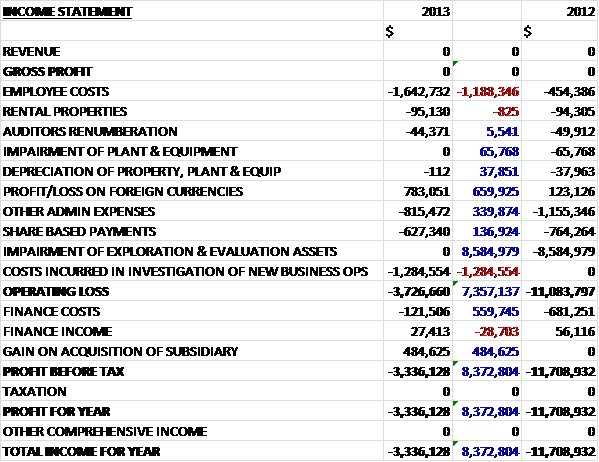
towerincome

As the group makes no revenue there is no gross profit.  Employee costs increased by nearly $1.2M, partly because $729K of these costs were capitalised as exploration and evaluation assets in 2012, and subsequently impaired.  These costs now make up the largest expense and the only major one to increase over last year.  There was the lack of a $66K impairment charge for equipment, and also a lack of a $8.6M impairment of exploration assets following the Ugandan dry well.   Other reductions in costs were a fall in share based payments and other admin expenses.  The group also benefited from a profit of $783K on foreign currencies.  Finance cots were $560K lower, with the only cost being associated with the SEDA and related loan agreement with YA Global Master. Tower also made a $480K gain on the acquisition of a subsidiary so that the loss for the year was $3.3M, a whole $8.4M better than in 2012.

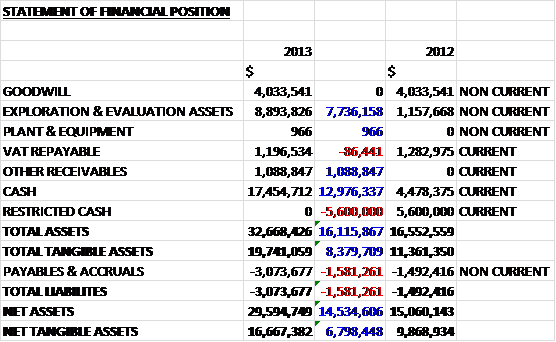
towerassets

Overall, assets were up substantially over last year.  The largest increase was a $13M hike in the cash level following successful share placings.  The other substantial increases were a $7.7M increase in exploration and evaluation assets, relating to the Namibian licence, and a $1.1M growth in the value of receivables relating to the Ugandan VAT repayment, somewhat mitigated by the loss of $5.6M in restricted cash.  The only liability was payables and accruals which increased by $1.6M, again related to withheld Ugandan tax.  Overall then, net assets were up by $14.5M to $29.6M, mainly due to the cash that was received when the group made the placings.

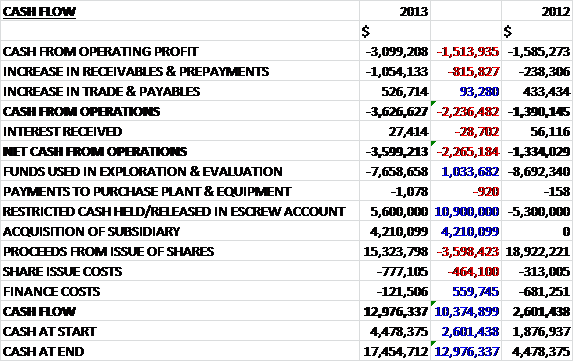
towercash

The cash outflow before movements in working capital was $3.1M, this was nearly double the outflow last year.  An increase in receivables was somewhat counteracted by an increase in payables and the net cash outflow from operations was $3.6M, worse by the tune of $2.3M.  The group did use about $1M less in exploration activities and the $5.6M of restricted cash was released into an escrew account.  The group also benefited from a £4.2M cash inflow from the acquisition of Wilton Petroleum and received a net $14.5M from the issue of new shares, nearly $4M less than last year.  Finance costs were kept under control, though, and the cash inflow for the year was just under $13M, some $10.4M more than in 2012.

As part of the Namibian licence there are a number of exploration commitments for the group.  The second exploration period concludes on 22 August of this year with an optional third renewal exploration period up to 22 August 2016 which would require another exploration well to be drilled as part of the license.  Drilling of the first exploration well has a budgeted net cost of $27M and other net license costs of $3M.  As of the end of 2013 the group paid a total of £3M in cash towards these costs and since this date has so far paid another $3.4M.  The cash balance of the group at the moment stands at $44M, so enough to cover the rest of the costs relating to the current drill.  During the year as a whole there have been a lot of placings and the shares have become very diluted.  Earlier in the year $13.9M was raised to pay for some of the Namibia costs and after the end of the balance sheet date the group raised another $32M via a second placing.

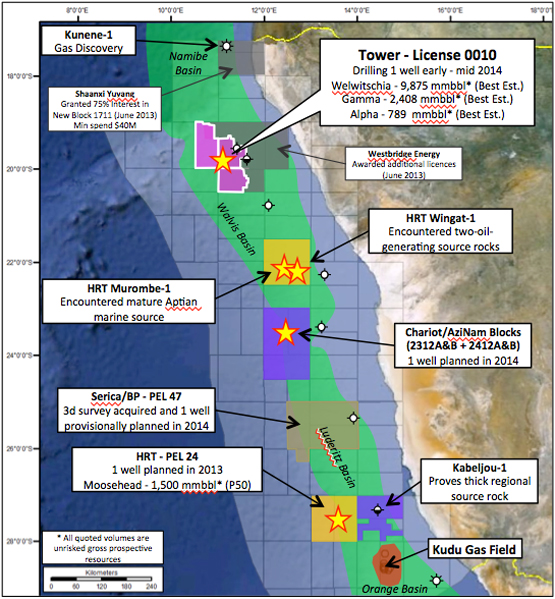
Clearly Namibia is the current focus for the group.  The drillship arrived at the well site location in mid-March 2014 where it underwent tests before drilling commenced.  Elsewhere in the country HRT drilled the Wingat-1 and Murombe-1 wells and although both failed to find commercial quantities of hydrocarbons, some oil was found at Wingat-1.  Tullow Oil farmed in to Pancontinental’s license, PEL37 to the South East in the Walvis Basin and have subsequently undertaken 3D seismic, showing that industry interest in the country continues.  The Welwitischia-1 well being drilled by Repsol in which Tower has a stake will target multiple reservoirs within a simple structural closure.  The prospects extend from primary targets in the Maastrichtiean and Palaeocene to secondary targets in the Albian carbonate sequences.  They are situated on a regional high and are the focus for migration and change from the proven source rocks within the Walvis Basin to the South and the Doplhin Graben to the East.  The well is targeting net risked recoverable resources of 496mmboe and will intersect five different reservoir targets to a depth of 3000m.  The best chance seems to be the Maastrichtian with a 31% chance of success, followed by the huge Palocean reservoir with a 19% chance.  On completion of the Welwitschia-1 drill, there is considerable follow up potential with two new leads – Alpha and Gamma targeting another 91 mmboe risked and have a 12% and 9% chance of success respectively.

Namibia_ops-0813

The group holds a 50% interest in the offshore Guelta and Imlili, and onshore Bojador blocks in the Western Sahara.  Due to the sovereignty disputes with Morocco over the territory, there is little that can be done to advance exploration on these blocks but the cost of holding them is minimal so Tower is just sitting on them for now.  Morocco has actually granted some licenses within the territory to Kosmos Energy who are planning a drill this year.

In April the group acquired a 15% interest in Block 2B in Kenya from Taipan Resources who retain a 30% stake and are the operators with the remainder of the interest owned by Premier Oil.  Tower paid Taipan $4.5M in cash, 9M Tower shares and a contingent payment of $1M on spud of a second well.  The total estimated mean gross unrisked prospective resources is 1,593 mmboe and the Badada-1 prospect is planned to be drilled during Q4 2014.

The group is currently in advanced negotiations with the government of Cameroon having submitted the preferred bid for 100% of the shallow water Dissoni Block in the most recent licencing round.  The block is located offshore Cameroon and is the Eastern extension of the Niger Delta Basin.  If the bid is eventually successful they expect a 3D seismic survey to take place in 2015.  The block is close to current producing fields and next to the Glencore operated Oak discovery and there is also deep gas condensate potential here.

The group are looking to start negotiations on a new license in the Marovoay Block 2102 onshore Madagascar after presidential elections were held in December 2013.  The block was relinquished by Ophir Energy and has multiple prospectivity in the Jurassic and Cretaceous sequences.  Tower are also negotiating for two blocks (AB3 and AB6) in a frontier basin in Ethiopia after the El Kuran-3 discovery was made in 2013.  The country as attracted other oil companies too, with Tullow due to drill this year nearby.  The group are also interested in bidding in a new round of Ugandan licenses.

In October the group acquired Wilton Petroleum and with this acquisition came with cash to the tune of $4.3M after the cash used to pay for Wilton is taken into account.  Granted the group also issued $2.6M worth of shares for the acquisition but there was still a $485K gain recorded.  The other main acquisition, which occurred after the balance sheet date, was that of Rift Petroleum.  The group purchased Rift in exchange for 550M Tower shares (50% of which are subject to a lock-in period of one year) , worth the equivalent of about $32M.  The acquisition gave Tower exposure to a 50% interest in the Algoa-Gamtoos licence in South Africa, alongside New Age Energy.  The block is between two others that have recently been farmed in by Exxon and Total and contains three prospective basins – Algoa, Gamtoos and Outeniqua.  New 3D seismic is expected to be available by Q3 of this year whilst mapping of the 2D seismic is underway.  A formal farm-out process for the license will resume once the 3D seismic has been interpreted.  Rift also came with rights to acquire a 50% interest in any exploration right granted to New African Global Energy over the SW Orange Basin covering three blocks.  Finally, there is also an 80% interest in two blocks onshore Zambia with a farm out here expected from late 2014.

These are interesting times for Tower.  They are currently drilling the most important drill of their existence in Nambibia with a higher than 30% chance of success.  They have also diversified into other regions, notably Kenya and South Africa.  In order to do this, however, they have issued a lot of shares and they are far more diluted than at this time last year.  At the end of the day this is still a bet on whether oil will be found in Nambia and I am happy with my small stake that I have here and will wait with baited breath for some news about the current drill.

On the 21st May the group announced that there had been a delay to the Namibia drilling schedule and that they do not expect operations to recommence until the end of the month.  Following the spud of Welwitschia-1 and installation of the drill casing it was noticed that the wellhead housing had slumped and a decision to plug and abandon the well was made and to re-spud the well as Welwitschia-1A 50m away.  This new spud occurred on the 1st May with no recurrence of the problem.  A further operational delay was caused by a fault with part of the Blow Out Preventer (BOP) control system.  Drilling has been suspended whilst Repsol, the operator and Rowan take measures to rectify the problem so that drilling can be continued safely which is likely to occur towards the end of the month.  The well had been drilled to a depth of 1,879m and drilling into the primary target section should occur shortly after the restart of operations.  Despite these delays, the well is still likely to be completed within budget.  This delay is a little frustrating but apparently not uncommon with the use of new equipment as we have on the Rowan Renaissance.  It sounds as though it is not likely to impact on the budget and has no bearing on the outcome of the well so not much has changed really.

On the 27th May the group released a corporate update.  In Namibia, they expect the fault in the BOP control system to be resolved shortly and drilling should now recommence in the first week of June and be completed within budget.  In Kenya, the group has received consent from Premier Energy regarding the 15% farm-in to the Block 2B in Kenya.  Preparations for the first well, Badada-1, are underway with spud expected towards the end of 2014 or early 2015.  In Zambia the group have met with the Ministry of Mines and Energy, the Zambian Environmental Management Agency and the Zambian Geological Survey Department and is now in the process of preparing for geological fieldwork in August 2014.  In South Africa the processing and interpretation of 3D seismic acquired over the Algoa-Gamtoos license is currently underway and expected to be completed in Q3 2014.  Total are to spud a well adjacent to this block in June which could give some clues as to the quality of this licence.  In Cameroon, negotiations with the government over the preferred bid on the Dissoni block are continuing.

On the 3rd June the group announced the completion of its farm-in to block 2B onshore Kenya as mentioned previously.  The recently acquired 2D seismic data is being used to determine the drilling location of the first well, Badada-1 which is expected to spud at the end of 2014 or early 2015.  It will target gross mean unrisked prospective resources of 251 mmboe.

On the 4th June the group announced that Repsol had recommenced drilling on that morning.

On the 16th June the group released a statement that basically said the well was dry. The evaluations suggest that the Palaeocene, Maastrichtian and Upper Campanian section reservoirs were less well developed than thought and no hydrocarbons were encountered.  Also, current expectations from the operator are that costs will now be around 10% higher than the gross budget, which is new news.  The cost of continuing the well into the deeper targets would apparently added another $40M gross to the costs so the decision has been made to plug and abandon the well and study the current data to determine whether to drill a second well to test these deeper reservoirs.  The group say that the prospectivity of the deeper section remains unchanged but reading between the lines I think the group will focus on some of its other licenses now.  Damn.  Worth a punt, but this time it hasn’t paid off (as was the likelyhood given the 35% cos.

Compass Finance Blog- Half Year 2014

Compass has now released their half year results for the year ending 2014.

compassinterim2014income

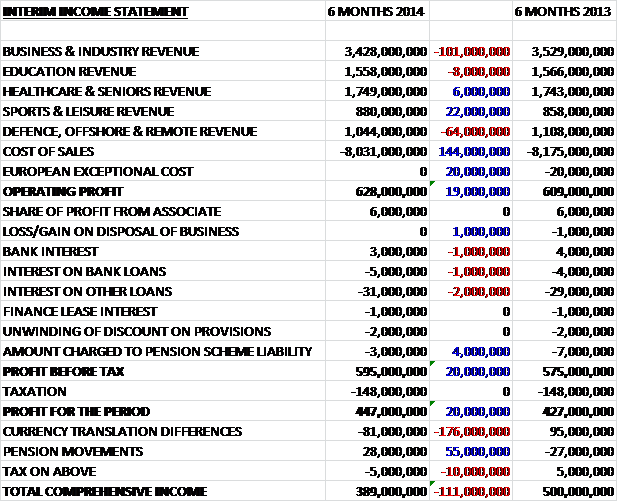
During the first half of the year there were varying fortunes for the revenues of each sector as a £101M fall in business & industry and a £64M decline in defence were partially mitigated by a £22M increase in sport & leisure with education and healthcare broadly flat.  These revenues included the positive impact of Easter but were down by 1.6% overall entirely due to adverse currency movements.  On a constant currency basis, they were actually up by 4.2%.  This overall fall in revenue was more than counteracted by a £144M reduction in the cost of sales and the lack of a £20M exceptional cost.  Overall then, operating profit increased by £19M during the period but underlying operating profit was down by £3M to £647M.  There was not much in the way of changes in financial costs and taxation was exactly the same as last year so the profit for the half year finished £20M up on the same period of 2013 despite the negative currency issues and stood at £447M.

compassinterim2014assets

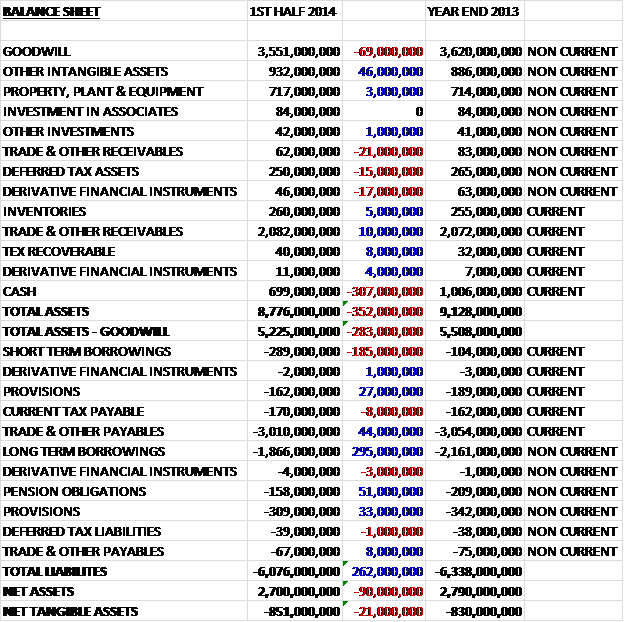
When compared to the end point of last year, asset levels at the end of the first half of the year were some £352M lower.  This decrease was predominantly driven by a £307M fall in cash levels and a £69M decrease in goodwill.  There were also a few substantial increases in assets with the largest being a £46M hike in other intangibles.  Likewise, liabilities also fell, driven by a £110M fall in borrowings, a £51M decrease in pension obligations and a £60M reduction in provisions which all meant that, discounting the goodwill, net assets fell by £21M to -£851M which is actually not that great.

compassinterim2014cash

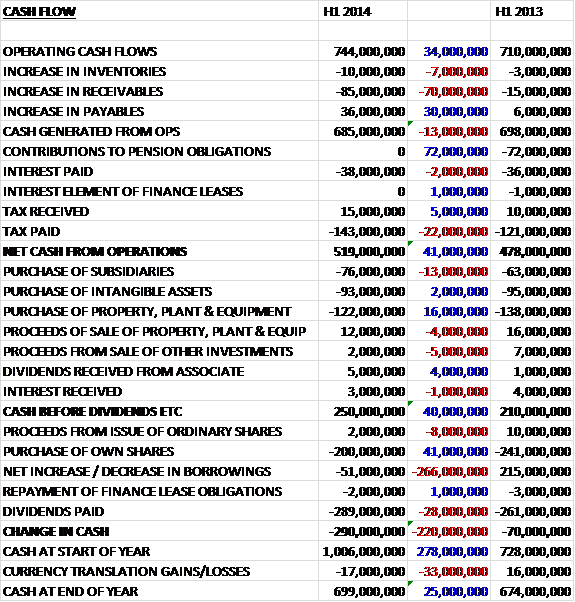
Before movements in working capital, the operating cash flow was up £34M on the first half of last year.  An increase in receivables was not entirely mitigated by an increase in payables, due to the seasonality of the business, so the cash generated from operations was down by £13M at £685M.  When compared to last year, there was the lack of a one-off £72M payment to the pension scheme, interest was flat at £38M and the group paid out £22M more in tax so the net cash from operations stood at £519M, up by £41M due to the pension payment the group paid last year.  The group spent a bit more on the purchase of subsidiaries (£63M on infill acquisitions and £13M of previous contingent consideration) but a bit less on property, plant and equipment so the cash flow after investments was up by £40M. The group then spent £200M on share buybacks (£41M less than in the first half of last year), £289M on dividends ( £28M more than in the first half of 2013) and paid back a net £51M of borrowings, compared to the £215M receipt of new loans last time.  Overall then, the cash outflow was £290M compared to an outflow of £70M in H1 2013.  This is not bad when the share buy backs are stripped out but it seems that the current dividends are not quite sustainable long term on this cash flow and underlying free cash flow was down by £41M to £345M.


On a constant currency basis, organic revenues were up 6.6% in North America, driven by high levels of business wins across all sectors and some very good retention rates.  Continued progress on operational efficiencies helped to deliver an 8% operating profit growth in the region.  The business and industry sector grew well, underpinned by net new business and like for like revenue growth with new contract wins including L’Oreal, PDI Dreamworks, Nomura and Canada Post.  There was good organic revenue in Healthcare and new business wins included food service contracts with the Baptist Memorial Hospital System, Yale New Haven Hospital and Jackson Madison County General Hospital, as well as the provision of laundry services to Sutter Health and Presence Health.

The Education sector saw good levels of new business, including additional support services contracts under the Texas A&M umbrella, as well as the Virginia Commonwealth University and food service contracts at Trent University and Montclair State University.  There was also good organic growth in the Sports & Leisure sector with good new business wins and high attendance at sporting events.  New contract wins here included the Indianapolis Motor Speedway and the FedEx Field, home to the Washington Redskins.  The ESS business delivered good levels of organic growth with new contracts for Cliffs Natural Resources and the DeBeers Gahcho Kue Diamond project.

Overall, revenues in Europe and Japan were down but operating profit remained flat.  Although economic conditions started to improve, like for like volumes remained negative during the first half of the year.  Despite this there have been some good levels of new business in the UK, Ireland, France, Spain, Netherlands and the Nordics with underlying retention improving.  The retention rate was affected by the planned exit of some of the more uneconomic contracts. Some new food service contracts included Continental and Societe Generale in France, Google in Ireland and the 2014 Ryder Cup in Scotland.  New multi-service contracts included Shell in Germany and the Royal Navy in the UK.  In Japan the group won a food service contract with Bosch and the Metropolitan Police Academy.  In North and East Europe, volumes were broadly flat; in the UK, France, Germany and Japan volumes were slightly negative and in Southern Europe volumes were negative but at a reduced rate when compared to the second half of last year.

Despite reduced revenues in Emerging Markets, on a constant currency basis operating profit increased by £2M to £110M.  During the second half of last year, a new management structure was bedded in throughout the region and the costs for this change flowed through to the first half of this year which management expect to largely reverse in the second half.  Organic revenue growth in Australia slowed due to the slowdown in the offshore and remote sector which began towards the end of last year.  Despite this, the group retained contracts with Conoco Phillips, AngloGold Ashanti and Melbourne Zoo.  Outside Australia, emerging markets saw good double digit organic revenue growth due to strong levels of new business, particularly in China and India.  In India, the group won new business with HN Hospitals and in China, with Nike.  The UAE also delivered above average growth with new wins including the Cleveland Clinic and a food service contract at the New York University.  Brazil and Turkey also performed strongly and new contracts in Brazil included Carrefour, Agropalma and Anglo American whilst Turkey saw new contracts for Med Star Memorial Hospital and BSH Logistic.

The board’s expectations for the second half of the year remain unchanged, notwithstanding the translation impact of the strong pound.  The pipeline for new contracts is encouraging and the focus on efficiencies gives confidence going forward. If the current spot currency rates continued as they are the group would expect a negative currency impact of about £86M on full year underlying operating profit.

The group announced the appointment of a new non-executive director, Carol Arrowsmith who will become chairman of the remuneration committee.  She is currently a partner in Deloitte and Vice Chairman of the UK business, although she is retiring at the end of the month.  For many years she led the executive remuneration practice at Deloitte so she seems to be more than qualified for the role.

During the period the group completed the £400M share buyback programme and begun a new £500M scheme and they are now £95M through that new programme.  Although the group plans to continue this scheme, it will be suspended until payment of the special dividend on 29th July and this programme is now expected to be completed in 2015.  Compass is intending to distribute another £1Bn to shareholders in the form of a special dividend and share consolidation.  The special dividend will be 56p and the share consolidation will turn every 17 shares into 16 new ones.

Overall then, this update was fairly decent if a bit mixed.  The group is clearly suffering from the stronger sterling this year and there seems little prospect of a let up in that regard.  We saw profits increase, but only because there was no European exceptional cost this year; net assets fell due to a decline in the cash levels and the operating cash flow was better last year only because of the payment to the pension scheme last year.  Like many companies of this size, they do not seem to have enough operating cash for all the returns to investors.  They do have a large cash pile but this will be completely driven down after the special dividend, which although nice, I don’t really see the business case for it.  Trading looks likely to improve in the second half as they investment in emerging market management structure works its way through and Australia notwithstanding, that region does look exciting.  Europe also seems to be slowly improving and North America remains strong.

Net debt at the six month point stood at £1.405BN, an increase from the £1.310BN at the same point of last year.  The board announced an increase in the interim dividend to 8.8p, which, when combined with the final dividend gives an annual yield of 2.5% at the current share price but when combined with the special dividend, the yield is a very impressive 8%.  Steady as she goes here really.  I am happy to hold for the income and the safety at the moment.

On the 12th June the group confirmed that shareholders had approved the return of capital.  The consolidation of the shares is expected to occur on the 7th July.

On the 30th July the group released a statement covering Q3 trading. Overall performance was good with organic revenue up 4%.  North America experienced a strong performance with organic revenue up 6.5% with good levels of new business experienced. Margin also improved by about 10 basis points.  The decline in organic revenue in Japan and Europe slowed somewhat and was down 1.2% compared to the same period of last year. The exit of poor contracts was largely finished during this quarter an although still negative, volumes showed some signs of improvement. Double digit organic revenue growth in emerging markets was counteracted by an acceleration in the slowdown of the Australian offshore and remote sector, resulting in organic revenue growth of 6.5%.  The return of cash to shareholders has now been finished and the share buy back programme has been resumed.  Sterling continued to strengthen during the quarter and should the current exchange rates continue through the final quarter there would be a negative translational currency impact of £92M on operating profits.  Overall expectations remain positive and unchanged and the pipeline of new contracts is apparently pretty decent.  Overall, this is a good update, currency challenges not withstanding and I am happy to hold.

On the 29th September the group released a trading update covering the final quarter of the year.  There was another good performance with further strong growth in North American and Emerging markets along with an improvement in Europe and Japan.  The full year saw a 4% organic revenue growth.  In North America the strong organic revenue growth seen in the first half of the year accelerated in the second half with high levels of business wins and good retention rates.  There was good growth in Healthcare and Sports & Leisure and the sales pipeline is good.  Overall in the region, organic revenues are expected to be about 6.5% higher for the full year with a modest improvement in margins.

Conditions in Europe and Japan improved throughout the year and there was a healthy pipeline of work, reflecting the investments made in the sales teams.  The contract exits previously announced have now been completed and volumes declined at a slower rate than in last year.  Overall, sales are expected to fall by 1.5% but there is expected to be a decent margin growth.  In Emerging markets there was a good organic revenue increase, expected to improve by 8% for the full year.  Most countries in the region enjoyed strong levels of new business driven by an increased desire to outsource but as hinted at previously, there was a slowdown in the Australian offshore and remote sector.  The profit margin benefited from the investments made at the end of last year and after reduced margins in the first half, an increase in the second half leaves them flat over the whole year.

The group has spent £115M on acquisitions over the year and received £23M following the disposal of a support services business in North America.  The company has been battling a strong Sterling throughout the year and at the current spot price there is a negative affect of £1.176B on revenue and £89M on operating profit, the effect is in translation only.  The outlook for the full year remains unchanged and going forward the improvement in Europe, the continued strengthening in North America and the margin improvement in Emerging markets points to a positive outlook, offset somewhat by the potential of continued sterling strength and a further slow down in the Australian business.  I have topped up with a few more shares.

Havelock Europa Finance Blog – Full Year ending 2013

Havelock Europa has now released their full year results for the year ending 2013.

havelockincome2013

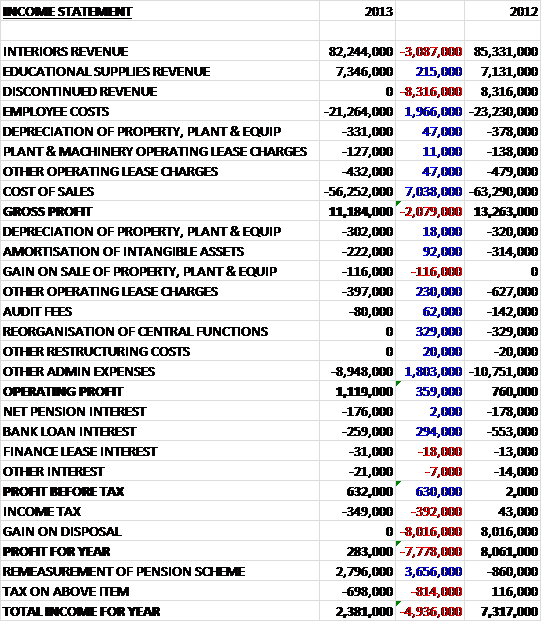
Revenues for the year fell when compared to 2012, driven by a £3.1M reduction in interiors (due to reduced fit-out business for education clients) and an 8.3M fall in discontinued revenue.  Employee costs were nearly £2M lower than last year and cost of sales fell by £7M, presumably partially due to the disposal, so gross profits were only down by the tune of £2.1M.  This was reversed by a decline in admin expenses, including the lack of £349K worth of reorganisation and restructuring costs which gave an operating profit some £359K higher at £1.1M.  Financial costs were reduced due to lower interest costs on borrowings to give a profit before tax and the disposal of £632K compared to close to zero last year.  A tax refund was reversed to a £349K tax charge so the profit for the year was £283K, lower by £7.8M due to the £8M gain on disposal of the Showcard business achieved last year.

havelockassets2013

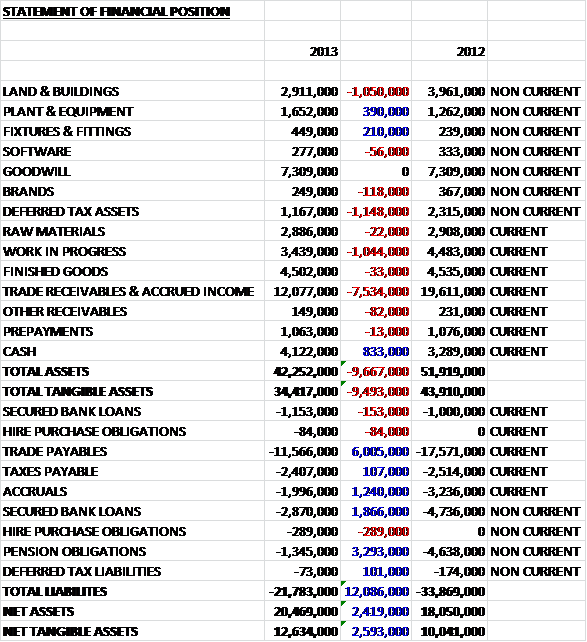
When compared to last year, total assets were down by nearly £10M.  This was predominantly driven by a £7.5M fall in receivables, along with just over £1M less in the value of land/buildings, deferred tax assets (due to some losses being brought forward and put against this year’s tax bill) and inventories.  The only major increase was a £833K hike in cash levels.  Similarly, liabilities also fell during the year, down £12.1M driven by a £6M reduction in payables, a £3.3M fall in pension obligations due to a strong performance in the pension investments, a £1.9M fall in bank loans and a £1.2M reduction in accruals.  This all meant that net tangible assets were some £2.6M higher at £12.6M, which seems a pretty decent outcome.

havelockcash2013

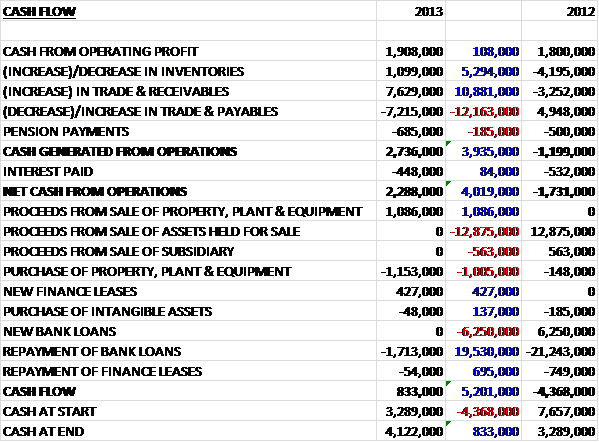
Before movements in working capital, cash profits were fairly flat on last year, up by just £100K.  A favourable swing in inventory levels and receivables, however, meant that net cash generated from operations was up by some £4M to £2.3M despite a large decrease in payables due to shorter payment times, and significantly is now positive.  We then see that the £1.1M gained from the sale of property, relating to Fontana House that previously housed the Showcard business, was spent on a £1.2M purchase of different plant and equipment, including the £700K purchase of new laser cutting equipment which has given rise to productivity improvements and represented a spend of £1M more than in 2012.  The group then gained £427K from new finance leases before paying off £1.7M in bank loans which left the cash flow positive at 833K compared to an outflow of £4.4M last year.  This looks pretty good actually, with a positive cash flow despite the repayment of loans.

The group made the vast majority of sales in the UK with only 6% coming from exports.  They are very heavily reliant on one client, though, as Lloyds Banking makes up 38% of all revenue during the past year.  Currently financial services overall make up 43% of their customers with retail making up 20% of revenue and education making up 37%.  Going forward, the group are looking to diversify into healthcare and overseas retail to try and make up for a slight decline in the education market.  Another risk is the banking covenants that the group still has to test against.  A lot of progress has been made to reduce debt in recent years but EBITDA and EBIT to interest and cash performance are all tested quarterly.

Operating profit at the interiors division was £2.1M, up from just under £500K last year.  During the year activity in the educational sector reduced as projects completed and new funding was put in place.  This reduction in revenue was counteracted by an increase in financial services revenue, both from branch projects and work on offices – I would have thought a lot of this would have come from the LloydsTSB split and rebrand.  Activity in the retail sector was flat and included the completion of projects for a major supermarket chain and out of town retailer, both of which were new areas of activity for the group.  Overseas revenue grew and a contract to support the Far East activities of a major retailer was won.  The increased profit from the division, despite lower revenues was due to increased efficiencies, including the acquisition of a new laser cutting machine.  An investment was also made in new drawing office software that should further improve efficiency and provide benefits to customers going forward.  The group are also looking to replace their ageing IT systems which in the long term should make them more efficient but would necessitate some capital expenditure.

Operating profit at the educational supplies division was down from £472K last year to just £258K in 2013.  The reduction in Educational supplies profit was primarily due to Stage Systems.  At Teacherboards, direct to school sales remained steady and there was good growth in web based sales.  Both businesses work closely with the Interiors business and a lot of their work stems from that.  After becoming the largest shareholder, Andrew Burgess has now got a place on the board and does seem to be driving some positive changes.

The group expect the improving UK economy to offer further opportunities for new business but the potential for destabilisation should Scotland gain independence should be considered considering the group is based there – it is something that management are keeping an eye on.  As well as the improvement to the retail economy, the government has also made announcements for more education spending, which should filter through to new projects for the group by 2015 but next year work in the educational sector to reduce again.  The reduced educational work volume should be taken up by new business wins in other areas and as long as the work with Lloyds continues, the more modern equipment the group invested in this year should give rise to further efficiencies next year.

Net debt at the end of the year stood at £300K, a big improvement on the £2.4M of debt at the end of last year.  At the current share price the P/E ratio is a staggering 31.8 but the market is forecasting earnings growth for the group and next year this falls to a more normal 14.3.  It still seems pretty high for what is still a bit of a risk though.  Due to the slightly precarious nature of the profit levels the board have not proposed a dividend for this year which is probably prudent.

Overall then, this is a pretty decent update.  I am particularly pleased to see further debt repayments and an increase in net tangible assets.  The group do have a tendency in their reports to put a positive spin on things, however (there was no mention of falling profit in educational supplies in the write-up for example), so it can sometimes be forgotten than this is still a very tentative improvement.  The markets Hevelock operate in are still difficulty and we already know that education volumes will be lower next year.  Given the end of the Lloyds bank rebrand I would have thought it might be difficult to maintain financial service revenues too.  I guess the question is whether the foray into healthcare and an improving market in retail can negate these issues.  I am still holding the shares but as I am now finally breaking even I may consider an exit if there are any signs of problems.

On the 14th May the group announced that the Finance Director, Grant Findlay had resigned.  Although this was unexpected for me, it clearly wasn’t for Havelock as they already have a replacement in Ciaran Kennedy who will join in mid-June.  Previously Ciaran was operations director at Kier’s Scottish utilities business and was previously finance director at May Gurney before they were acquired by Kier.  It always worries me when a finance director leaves unannounced but one could argue that Grant’s nine years in the role were not exactly successful and the new man looks to be a decent appointment.

On the 2nd June the group released a statement at the AGM and indicated that the first half is proving to be quiet, however, discussions with clients suggest that work may pick up in the second half.  The group still expect education to be subdued this year but they have given a number of quotations for work starting in 2015 that they can hopefully convert into some new business.  This update doesn’t say much but I find the tone a little worrying.

On the 23rd June the group announced that Ciaran Kennedy had started as Finance Director and Company Secretary as announced previously.

Interserve Finance Blog – Full Year Results 2013

Interserve has now released its full year results for the year ending 2013.

interserveincome2013

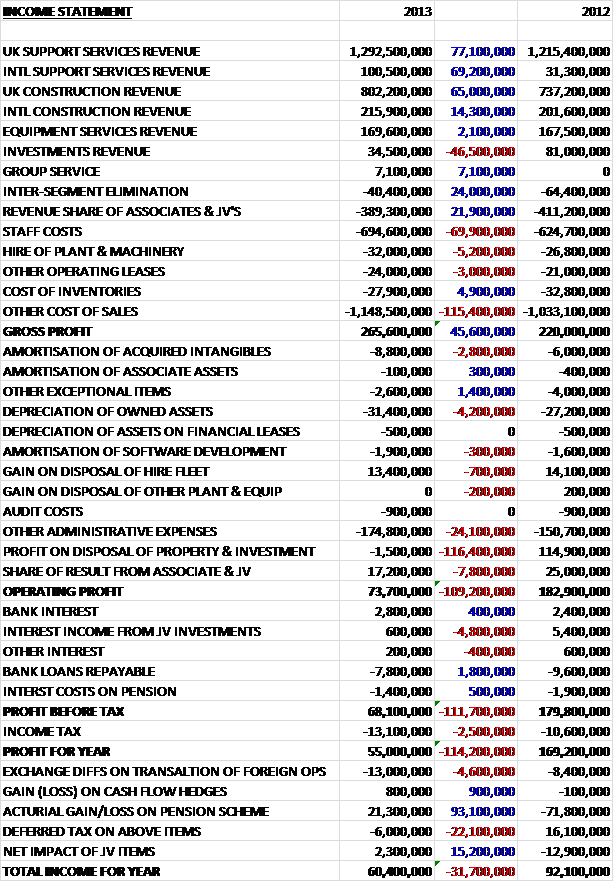
Revenues were up across most sectors and geographic markets, with a £77.1M increase in UK Support Services; a £69.2M increase in international support services, up from just £31.3M last year and a £65M hike in UK construction.  Equipment Services were pretty much flat and investments showed a £46.5M reduction in revenue due to the sale of the bulk of the PFI frameworks to the pension scheme.  Geographically, the only region to show a decline in revenue was Oceania with the UK, Africa and the Middle East showing the most growth.   Cost of sales were also up, but to a lesser degree and gross profit was some £45.6M higher than last year.  Admin expenses were also up but the bulk of the difference came from the one-off profit on disposal of investments (£116.4M) that occurred last year and were not repeated in 2013 where a write-down of an investment in the Indian associate actually gave a negative figure, and there was also £7.8M less received from joint ventures, again related to the sale of the PFI frameworks.  The “other” exceptional items in 2013 related to bonuses to staff triggered by the exceptional profits on the disposals of the PFI investments.  Overall then, due to these one-off costs, operation profit was £109.2M lower at £73.7M.

The main difference in financial income, again came from interest from the joint venture investments being lower (after the PFI disposals) and this, combined with the higher tax rate meant that the profit for the year was £55M, £114.2M lower than in 2012.  As the profit on the disposal of investments was £116.4M last year, the difference can be entirely attributed to this and the underlying performance looks rather good, and profit for the year not included exceptional items was £66.1M, £4.1M higher than last year.

interserveassets2013

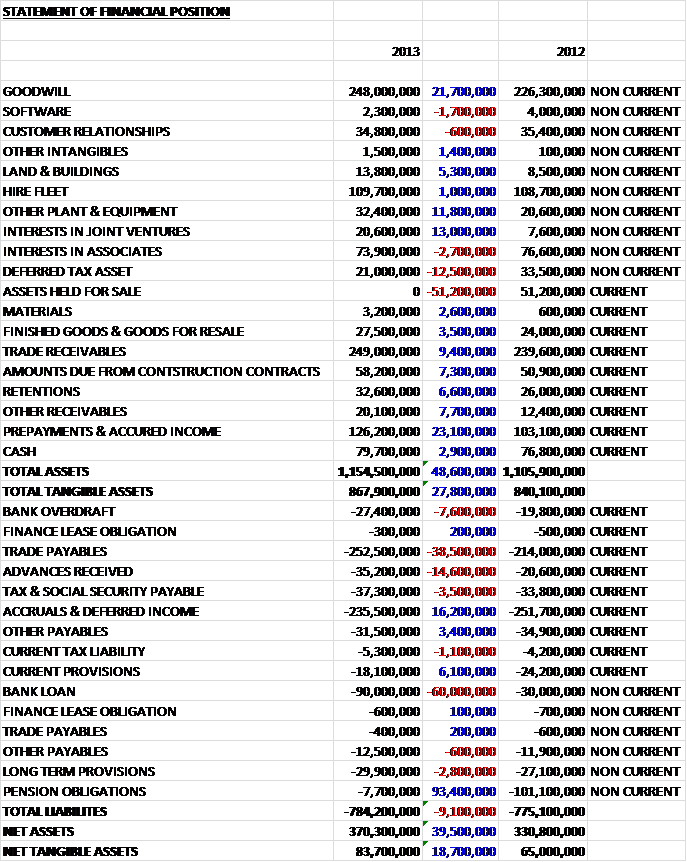
Overall total assets were up by £48.6M.  The largest increases were a £23.1M increase in accrued income and a £21.7M hike in the value of goodwill.  Other hefty increases included plant and equipment, up £11.8; the value of joint venture interests, up £13M and trade receivables, increasing by 9.4M.  These were mitigated somewhat by a £51.2M fall in the value of assets held for sale, relating to the PFIs and a £12.5M reduction in the value of the deferred tax asset.  Liabilities also increased during the period, driven by a £60M increase in the bank loan, a £38.5M hike in trade payables and a £14.6M increase in advances received.  These are counteracted by a massive £93.4M reduction in the pension obligations and a £16.2M fall in deferred income.  Overall then, net assets were some £39.5M higher at £370.3M but when goodwill is taken off, this falls to £122.3M, still £17.8M better than at the end point of 2012.

interservecash2013

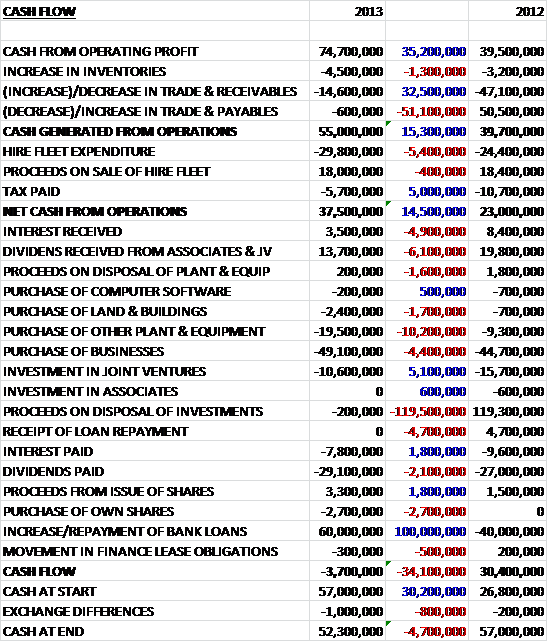
Before the movements in working capital, the cash profits were a remarkable £35.2M higher than last year at £74.7M but an increase in receivables and a small decrease in payables, due to the growth of the business and pressure on payment terms, meant that cash generated from operations was some 15.3M up on 2012.  An increase in the cash paid for the hire fleet was counteracted by a decrease in the tax paid so the net cash from operations was still an impressive £14.5M up from last year at £37.5M.  Due to the sale of most of the PFI frameworks, both interest received and dividends from joint ventures fell and the group spent another £10.2M on capital expenditure due to investments in back office and refreshing the fleet of the newly acquired businesses.  There was also a £49.1M acquisition and a £2.1M increase in dividends.  The cash to pay for all of this was received with £60M of new bank loans but despite this the cash flow was still negative to the tune of £3.7M compared to a £30.4M inflow last year.  Even if the acquisition was discounted, the group would still have needed further borrowing to remain cash flow positive.


The largest source of profits come from UK support services with equipment services at £20.1M making up the second most important segment.  UK construction contributed £14.7M with international construction contributing £13.1M, although profits here did fall when compared to last year.  International support services only contributed £4.1M but this total is growing year on year.

During the year the group made a number of acquisitions.  Willbros (TOCO) was acquired in January for £25.7M.  That group has an 85% interest in two oil and gas businesses, the main one being based in Oman.  Paragon Management was acquired in May for £3M.  They are a specialist interiors and property refurbishment business.  Topaz Oil and Gas was acquired in September for £27.6M.  They provide oil field maintenance, fabrication and construction services in the Middle East.  The three businesses are already profitable at the operating level with Toco contributing £1.2M, Paragon adding £1.2M and Topaz contributing £300K in the short time it has been part of the group.  Given the outlay, Paragon in particular looks like a good buy.

Support service profits in the UK were up 26% to £56M.  The group signed a number of new contracts with various customers during the year, including Dixons, the University of Sussex, the BBC, the MOD, Nottingham University NHS Trust, Southwark borough, the Home Office, Magnox and Meggit.  One of the larger contract wins was a five year £150M facilities management contract with the BBC.  The services span over 150 locations and include critical broadcast engineering and business continuity services.  Another contract was a three year deal valued at £15M to provide back office and facilities management services to five Royal Navy establishments in the South West.  Services on this contract include logistics, motor transport, HR, payroll and travel.

The group also had some success in extending existing contracts with a home office contract being extended for a further two years and an extension to include support services to British embassies and consulates across Spain.  The joint venture, Landmarc, was awarded a contract extension with the MOD worth £110M to manage military training facilities across their estate.  The group are targeting healthcare as an area for growth and last year’s acquisition of Advantage Healthcare have enabled them to extend their service range into community healthcare.  Going forward management expects the business to continue its strong progress with particular focus on the UK’s Defence Infrastructure Organisation as they are bidding on six new contracts, two of which they are incumbent.

International support service profits are still fairly minor but they increased by nearly 11% to £4.1M.  The main business suffered from subdued market activity, competitive pressure and the re-tendering of the significant Ras Laffan contract in Qatar although performance has been better later on during the period.  The profit levels were flattered by the contribution from the newly acquired businesses, although the Oman business was temporarily affected by deferred client expenditure at Mukhaizner.  The group is making good progress with the integration of both TOCO and Topaz but there have been some delays on some work, pushing it out into 2014.  Adyard, the renamed Topaz business won a contract worth £10.8M for the fabrication of an offshore platform for the Zora Field development on behalf of Dana Gas.  Other new contracts included facilities management for Habib Bank in Dubai (already a long standing customer of the construction business) and for estate management services at the Monte Carlo Beach club in Abu Dhabi.

The UK construction business had profits that were fairly flat year on year, being less than 1% up on last year at £14.7M.  During the year major infrastructure activity was subdued and the group undertook greater diversification to account for this.  An example was the construction of Energy from Waste plants.  The £146M scheme in Glasgow, on behalf of Viridor is now underway and the group also have a joint venture with Babcock and Wilcox to design and build another plant in Peterborough, a contract that is worth £15M.  The group considerably extended their capabilities in the fit-out market by buying Paragon, a specialist refurb business based in London and have won contracts with HM Courts and Tribunal service so far.  During the year various NHS framework projects were undertaken, including completions at Frome Medical Centre, Kettering General Hospital and Langdon Hospital in Dawlish with new awards including Mid-Cheshire Hospitals NHS trust and Hywel Dda Health board in Wales.

In education the group redeveloped the Charter Academy in Portsmouth and were confirmed as selected contractor in the Priority School Building Programme to deliver eight schools in the West Midlands.  The group also completed a University Technical college next to the Silverstone race circuit.  Towards the end of the year the group was awarded a place on the £250M DIO framework for the East Midlands and Eastern England region.  This four year framework has the option of being extended for another three years and will be used to deliver a number of projects each valued at up to £12M.  It is not just public sector work that Interserve has been picking up.  They have a good relationship with Jaguar Land Rover and the group have started work on a new engine manufacturing centre near Wolverhampton.  This was supplemented by two additional contracts awarded during the year and will provide work through to the end of 2014.  Going forward, the board see some improvements in the UK for 2014.

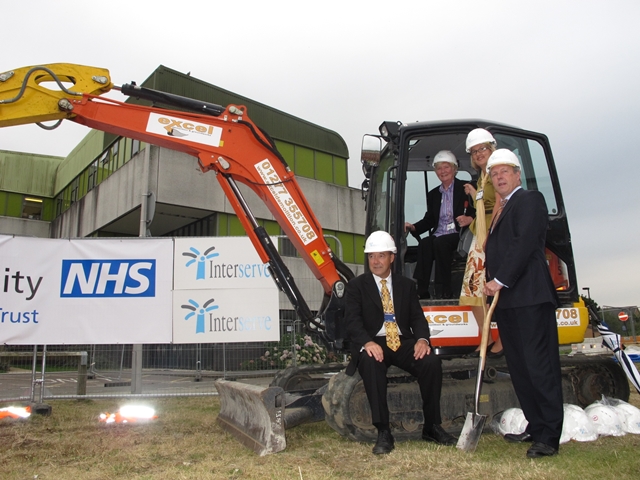
1347345254_interserve-25m-colchester-nhs-radiotherapy-unit-groundbreaking-02

International Construction profits fell by 8.4% to £13.1M.  The market in the Middle East, where much of Interserve’s clients are based, experienced increased levels of competition and therefore lower margins were achieved.  During the year the group won a £110M contract for the redevelopment, expansion and upgrading of the Mall of the Emirates in the UAE on behalf of their long standing client, Majid Al Futtaim.  Market conditions in the UAE as a whole started to show signs of improvement and the group also secured work for the office of the Crown Prince of Dubai, EMAAR Boulevard restaurants, Chalhoub Group (retail), the government of Fujairah (roads) and Dubai Festival City (retail).  In addition, they were awarded a contract from General Electric to construct the new engine maintenance centre in Dubai, a contract to carry out extensive fit out work for the Four Seasons Hotel and road and infrastructure work for Meraas.

In Qatar market conditions were more subdued but the group were awarded a contract for the construction of the Lusail Tower and civil engineering in connection with a new desalinisation plant at the Ras Abu Fontas power and water station.  They were also awarded work by Siemens to provide civil and building works in the energy sector and by Doha Festival city for sire enabling, which may be a gateway to more contracts at that major development scheme.  In Oman, work was completed for Daewoo on the Sur Independent Power Project, including civil engineering works on the largest seawater intake structure in the country.  Further work was secured with a range of clients including HSBC, the Wave Muscat and Petroleum Development Oman.  During the year the group exited their Indian business as they seemed unable to make it work.  This incurred a loss on disposal of £5.1M. Going forward, the board see some early signs of recovery in UAE and Qatar and the group have broadened their range through joint ventures.

Profits in Equipment Services increased by more than 25% to £20.1M due to increased activity in global infrastructure markets.  In anticipation of improved market conditions the group increased their capital expenditure here to facilitate growth, a trend that management expect to continue into 2014.  There are also plans to expand into new territories such as Singapore, Kurdistan and Colombia and to also grow their presence in Chile, Panama, South Africa and the US.  In the Middle East and Africa, performance was good as increased demand in Saudi Arabia in particular drove sales.  For example the group supplied more than 15,000 tonnes of equipment to Roots Group for the expansion of the Grand Haram Mosque in Makah.  In Oman, equipment was supplied for the construction of a technical college for armed forces in Muscat and for the new Salalah international airport.  After restructuring last year, performance in South Africa also showed a big improvement.

In Australia, demand for equipment services weakened somewhat during the year reflecting the reigning back of a number of large natural resources projects.  Elsewhere in Asia Pacific, there was an increase in demand with notable projects in the region including the application for the group’s Airodek system in a redevelopment programme for the Channel Court shopping centre in Hobart, Tasmania where the operational efficiencies of this system helped accelerate the project.  In Hong Kong, growth was driven by increased government expenditure on major transport projects, on which the group supplied shoring equipment for the widening of the Tolo highway.  They also provided equipment on a project to connect a new underground railway to the West Kowloon Terminus.

In the UK, the equipment services business performed well with much of the success down to providing a major formwork and falsework to a casino, hotel and cinema complex being built near Birmingham.  Across the rest of Europe, the market remained slow and the group took steps to cut costs in Ireland and Spain to manage their cost base in those markets.  In the US the construction market showed signs of growth which contributed to a much improved performance and the group extended their West coast operations around San Francisco and Los Angeles.  In Chile the group supplied a large scale framework and shoring project to create walls and slabs for the new hydroelectric plant in Laja.  Going forward, management see further improvement in the sector as the business improves margins and benefits from global economic trends.  To support the expected growth they will be investing in their equipment fleet to facilitate further geographic expansion.

Investment profit was just £800K compared to £6.6M last year due to the transfer of much of the assets to the group’s pension scheme.  Financial close was achieved on the Alder Hey Children’s NHS foundation trust project and phase of the Help for Heroes accommodation on the Armada PFI project in Plymouth was successfully integrated into the existing contract.  Facilities at the St Helens Building Schools for the Future project became fully operational during the year.  Group services costs were up by £1M on last year.  This was due to an increase in investment in back office capabilities such as IT, training and communications and the group expect this level of investment to continue in the medium term.

Going forward, it seems that aggregate market conditions are improving.  Management expect further progress in revenues and profit growth in 2014, along with the successful integration of a number of acquisitions offsetting slightly weaker near term performance in international construction.  The group is somewhat exposed to currency changes with the Qatari Rial and the Australian Dollar the most important, so the current strong pound may have some adverse effects.  In the last year the impact of currency changes led to a reduction in net assets of some £13M.

After the balance sheet end the group announced the proposed acquisition of Initial Facilities Services for £250M.  In order to pay for the purchase, the group are issuing new shares representing 10% of the share capital to institutional investors.  Going forward, the group are targeting both organic and further acquisitions and they seem bullish for 2014.

Overall then, this was a good update from Interserve, profits are up across most businesses with the exception of International Construction and there is a very good cash from operations, albeit it did not cover capital expenditure.  The group is still fairly reliant on the public sector but there seems to be some work done on diversifying, which brings me on to the Initial acquisition.  The client base of Initial is much more skewed to the private sector and it really does seem like a good fit.  However, £250M is a lot of cash to spend on the business and the increased borrowings do bring somewhat increased risk.  Net debt for the year stood at £38.6M in 2013, compared to a net cash position of £25.8M the year before reflecting continuing investments in acquisitions and capital expenditure.  The dividends have increased each year over the last five years, with a further 5% increase this year.  At the current share price they represent a 3.2% yield, rising to 3.4% next year.  The underlying P/E ratio is 14.5, and according to consensus this will fall to an undemanding 12.5 in 2014.  This seems pretty cheap to me and had I not recently purchased some shares I would probably be buying.

On the 12th May the group announced an extension and addition to the MOD support services contract to manage the National Training Estate, running until 2019 with an option to extend for a further five years.  The contract is worth £322M and is one that the Interserve have been involved in since 2003.  The new contract also includes over 30 extra sites and services include booking, accommodation, feeding and refuelling of the military units, along with office duties, site maintenance, catering, cleaning, vehicle maintenance, logistics and a range of specialist rural estate and land management services.

On the 13th May the group released a statement covering the first quarter of the year.  They stated that conditions in most of their markets had improved, work winning during the period was good and the integration of Initial was making some early progress and was on-track.  During the quarter, work was won with the Department for Education, Christie NHS Foundation, Foreign and Commonwealth office, Mercedez-Benz, CBRE, Haribo, Centre for Process Innovation, University of Birmingham, Scottish National Blood Transfusion Service and Southampton City Council, along with the National Training Estate contract mentioned above – still fairly skewed to the public sector but it is good to see a few private companies on that list too.  Internationally, the group won contracts in Oman, UAE and Qatar including the Doha Festival Cit and the Al Jazeera News Network.  Equipment services continued to show good growth with new projects including the Abu Dhabi International Airport and motorway upgrade works in the UK.

On the 9th July the group released a statement covering some board changes.  Nick Salmon and Russell King will be joining as non-exec directors in 2014.  Nick is the senior independent director at United Utilities and was previously CEO of Cookson from 2004 to 2012.  Russell is the senior independent director at Aggreko, has been Chairman of GeoProMining and held various management roles in ICI and Anglo American.  At the same time, non-executive director David Thorpe will retire to devote more time to his private equity roles after serving five and a half years as a director at Interserve.  On the same day the group announced that trading in the first half of the year performance has been strong with further development of future workload.  The integration of the acquired support services business is progressing as planned and following the completion of a $350M private placement loan note, they remain well placed to continue investment – that is quite a chunk of debt and I hope they don’t spend it all at once!  I remain a holder.

On the 29th October the group announced that a partnership led by Interserve has been named as preferred bidder to provide probation and rehabilitation services in Manchester, Cheshire, Merseyside, West Yorkshire, Humberside, Lincolnshire and Hampshire as part of the Ministry of Justice’s Transforming Rehabilitation programme.  The contract is expected to be worth about £600M over seven years and the other partners are Shelter, Addaction, P3 and 3SC.  The partnership will take over the delivery of all probation and rehab services to low and medium risk offenders who are released after serving prison sentences of less than 12 months.

GVC Holdings Finance Blog – Full Year Ending 2013

GVC has now released their full year results for the year ending 2013.

GVCincome

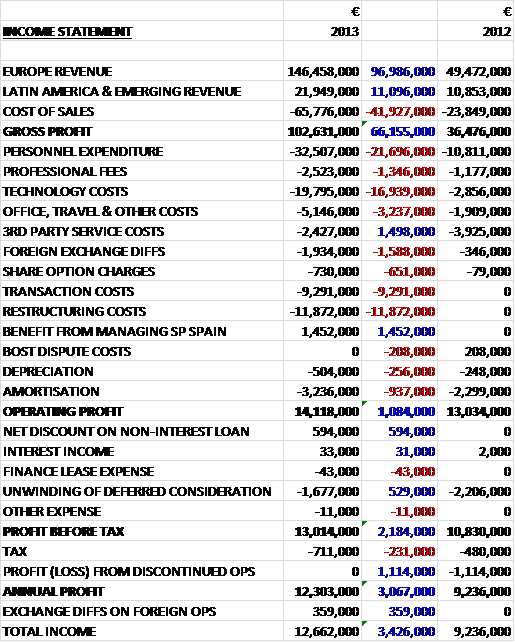
Revenues across both geographical areas increased, with European revenue, making up the bulk of sales, up by €97M and rest of world revenue up by €11.1M. Sports gaming and casino now makes up a similar amount of sales, with sports revenues more than doubling during the year. As would be expected, cost of sales was also up, by the tune of €41.9M to give a gross profit some €66.2M higher than last year. As far as other costs are concerned, we can see that personnel expenditure was up €21.7M and technology costs increased by €16.9M whilst the only cost to reduce was third party service costs, down by €1.5M. There were then a number of one off costs, the largest of which was €11.9M of restructuring costs, €9M of which were redundancy costs, followed by €9.3M of transaction costs mainly relating to legal and other advice. The only one-off gain was the €1.5M received for looking after the Spanish division of the acquisition before William Hill took it over.

So, including all the one-off costs the operating profit for this year was €14.1M, €1.1M higher than in 2012. After this we saw a €594K gain on the net discount on the non-interest loan, actually it is imputed interest which is a concept I find a little hard to grasp. The unwinding of the deferred consideration was €529K less than last year to give a profit before tax some €2.2M better than in 2012 before a slightly higher tax bill was counteracted by the lack of a loss from the disposed business (Betaland) to give the total profit for the year some €3.1M higher than in 2012 at €12.3M.

gvcassets

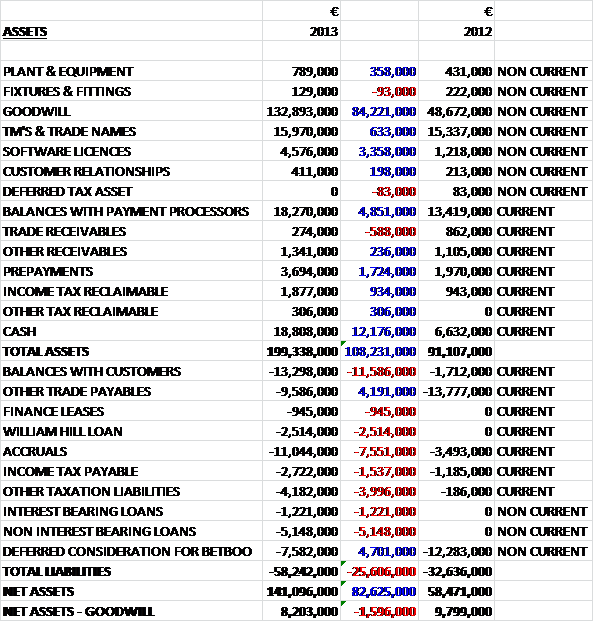
Overall total assets more than doubled to just under €200M. The vast bulk of the increase in total assets was in Goodwill, which increased by €84.2M. There was also a €12.2M increase in cash levels, €3.4M more in software licences and an increase of €4.9M in balances with payment processors, which are funds held by third parties subject to collection after one month or used to make refunds to players. Liabilities also increased, with the largest increases seen in balances with customers, up €11.6M; accruals, up €7.6M; non-interest bearing loans, up €7.6M and taxation liabilities, higher by the tune of €4M. These increases were somewhat mitigated by a €4.7M fall in the deferred consideration to pay on the acquisition of Betboo and a €4.2M reduction in trade payables. This all meant that net assets increased by a huge €82.6M when compared to last year but the vast majority of the increases in assets were intangible so if we take off goodwill, which I don’t consider to be that helpful to the balance sheet, the net asset level is just €8.2M, which was actually €1.6M lower than last year.

gvc cash

Compared to last year the group made far more cash from its customers but also paid out more. Overall, there was an operational cash outflow of €7.7M, which is €16.9M worse than in last year, and a little disappointing. After operations, the group spent another €6.4M in deferred consideration relating to the Betboo acquisition but received a huge amount of cash with the most recent acquisition, along with €8M of loan from William Hill to help complete the acquisition. The bulk of the cash acquired was involved in the repayment of borrowings and the cash spent on dividends jumped €6.8M to €15M. Overall the group had a positive cash flow of €12.2M for the year entirely related to the cash received when the group purchased Sportingbet.
Clearly the Sportingbet acquisition was the most important event to happen during the year. The acquisition did not include the Australian business that went to William Hill and as part of the agreement, a call option was granted to William Hill over Sportinbet’s Spanish assets. Until the 16th September the group was entitled to receive the economic benefit of these assets after which William Hill took them over. As part of the acquisition the group also received a non-interest bearing loan from William Hill. The first instalment of €2.3M is due before the end of 2014, with another due before the end of 2015 and the last repayment due by the end of June 2016. If GVC declare dividends of more than 58c then there is an acceleration in the repayment of the loan. The acquisition was paid for by the issuance of over 29M new shares to the value of €83.9M.
The acquisition of Sportingbet was done to mitigate the earn-out payments arising from the 2011 Superbahis transaction with Sporting bet – one solution, just acquire the company you are paying! The group have also acquired software and additional customers in over 20 additional markets. On acquisition Sportingbet was in quite a bad way, it has a €50M deficit in working capital, was loss making, had fully drawn down on its banking facilities, relied heavily on finance leases and was burning cash. Since the acquisition, the group has turned its performance around and it generated €3.8M of clean EBITDA in Q4. The acquisition was part paid for by William Hill, part by the issuance of new shares to the existing shareholders of Sportingbet and part by a small loan from William Hill.
As can be seen from the results, the group is still paying deferred consideration relating to the Betboo acquisition and higher earnings from the business has meant that this consideration has increased. The agreed payment terms are now four consecutive monthly payments starting in October 2013 of 25% of the NGR for the period commencing January 2013 to the end of September. From October there will also be nine monthly payments of €228K with the final payment taking place in June of this year. There is also an earn-out dependent on certain revenue shares with a floor of €200K per month for the 40 months ending January 2017. In all total deferred consideration is capped at €18.5M but it still seems rather substantial with the payment in 2014 expected to be €4.4M.

gvc
The group seems to have made very food progress with debtor days, halving from 82 days to 40 days. There also seems to be a fairly decent diversity of contribution by market as in Q4 the largest origin was Turkey, at 30%; followed by Eastern Europe at 22%, Central Europe at 20%, CasinoClub at 18%. Latin America at 5% and the UK makes up 4% of profit. The group has been working on its mobile offering and has seen a 19% increase in mobile sportsbook NGR and in-play betting now accounts for about 70% of total sports wages placed. Football, tennis and basketball make up the vast majority of sports bets. During the year the group has suffered considerable headwind in the form of the strengthening Euro and during the past year has impacted the group to the tune of €25K a day which makes the underlying sales performance even more impressive.
As mentioned, the group do have an exposure to currency movements. The loss during the year due to foreign exchange was €1.9M, although €1.1M was a one-off translation of the Sportingbet ledgers from Sterling to Euros. In Turkey and Brazil currency conversions are handled by intermediaries so they do not handle these currencies, however these weak currencies are likely to impact profits by about €5M this year.
In the next year the group is looking to achieve further synergies following the acquisition, improving the product offering and looking for new acquisition targets, but they are not currently considering any that will undermine the maintenance of the shareholder dividend. They are also looking to capitalise on the upcoming world cup that is taking place this year by making significant investments in marketing and they are confident that they will meet current market expectations in the coming year. The group is continuing dialogue with regulators in the markets that they operate in but there remains some regulatory risk, particularly in Turkey where the group earns a lot of its revenue and the authorities have made motions to outlaw gambling.
At the current share price the P/E ratio is 18 but next year consensus expects this to fall to a rather cheap 7. The group now pays a dividend every quarter and have announced an 11.5c dividend this time with a special dividend of 4.5c. The yield is 8.2% currently which is pretty spectacular and likely to get even higher during the coming year and I believe is ample reward to put up with the regulatory risk and the slightly confusing annual report!

Overall then, the group has made remarkable progress in turning around Sportingbet, which by all accounts was failing and it will be interesting to see the profits they make now it is contributing to the bottom line. The group is clearly not risk free as they have operations in regions where in some cases, the government has openly stated it is not happy with gambling taking place and it might just be me but I find the language used in the annual report quite difficult to understand. I still don’t get what the agreement with Superbahis is for example. Aside from these issues, however, the shares look cheap. The future P/E ratio is very low the yield seems pretty much the best I have seen from a company growing at the rate of GVC. I am holding at the moment, having topped up fairly recently and will probably hold off until I see some evidence of positive cash flow at the operating level before adding more.

On the 14th May the group released an AGM trading statement covering some of Q2.  Net Gaming Revenue was on average 8% higher than last quarter and 11% up on that of the same quarter last year.  This includes the adverse currency movements and on the constant currency level, the increase was even higher.  The mobile product fared even better with revenues per day double that of last year.  The board is encouraged with the strong trading so far this year and are confident that current market expectations will be met for the full year.  Decent progress seems to have been made.

Also on the 14th May the group announced that it was entering into a joint venture agreement with Betit.  The initial commitment is €3.5M which will be taken from cash flow and will give GVC a 15% share in the joint venture.  The group has a call option to acquire the outstanding shares which much take place between July and the end of September 2017.  The minimum call option price is €70M with the actual price determined by certain revenue targets and other multiples.  If GVC is unable to find the funds for this purchase, then Betit would acquire GVC’s shares at a nominal value.  So, basically it seems that the group has deferred some €70M of this acquisition for three years.  Betit is an opportunity to enter the lucrative Nordic gaming market and it is already generating daily revenues in excess of €40K.  Whilst this is a great opportunity to enter a good new market, I am not sure if the deal is structured in the best possible way – could the group not purchased a higher stake in the business now in order to reduce higher payments later when the joint venture is making more money?

On the 15th July the group released a statement covering the first half of the year, including the World Cup period.  A quarterly dividend of 12.5c was announced, which was higher than both last quarter and the same quarter of last year and including the special dividend announced last quarter, represents a dividend yield of a staggering 11.6%.  Total NGR in the quarter was €54.8M, up 9% on last quarter and total revenues for the first half of the year were €105.1M, up 45% on the same period of last year despite adverse movements in exchange rates during the period.  The results were boosted by the World Cup which also contributed to more customers and greater market penetration, with over 81,000 customers added during the quarter.  Overall, all positive stuff and I remain a holder.

Laura Ashley Finance Blog – Full Year 2014

Laura Ashley has now released their full year results for the year ending 2014.

lauraashleyincome2014

Retail revenue was down when compared to last year with store revenue falling by £3.3M and E-commerce/mail revenue down by a disappointing £1.5M. This was somewhat mitigated by a £400K increase in non-retail revenue, driven by increased franchise income. Staff costs increased somewhat but the cost of inventories was down by £7M. This all meant that gross profit was down by £800K. Looking at other costs, we can see that a £1.7M adverse swing in exchange gains/losses was counteracted by small falls in depreciation and store operating leases. Overall, operating profit was nearly flat, down by just £200K to £19.1M. There was a disappointing £900K fall in the share of profits from associates, relating to the Japanese business, but the big moves were a one-off £3.2M gain on the sale of investments, relating to the Moss Bros shares, somewhat mitigated by £2M worth of store closure costs. A lower tax bill meant that the profit for the year was actually up by £1M to £15.7M but when the sale of the Moss Bros shares are ignored, there was a small reduction in profits compared to last year.

laurashleybalance2014

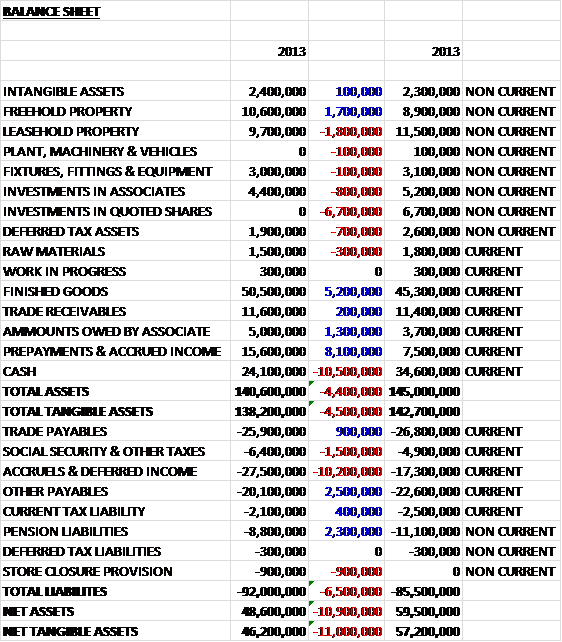
At the end of the year, total assets were £4.4M lower than in 2013. The fall was driven by a £10.5M reduction in cash and a £6.7M fall in the investment in quotes shares relating to the sale of the Moss Bros shares. This was somewhat mitigated by an £8.1M increase in prepayments, including £8M to be received regarding the sale of the shares, and a £4.9M hike in the value of inventory. When compared to the previous year total liabilities increased by £6.5M, driven almost entirely by a £10.2M hike in the value of accruals, mostly relating to £7.3M paid in dividends after the balance sheet date. This was only slightly counteracted by a £2.5M reduction in payables and a £2.3M fall in the pension liabilities. This all meant that net assets were some £10.9M lower at £48.6M.

lauraashleycash2014

Before movements in working capital, cash profits were down by £1.5M on last year. As we have seen from the balance sheet there was a fairly large increase in the level of inventories which meant that at £16.8M, the net cash from operations was some £5.6m lower than in 2013. This cash did not cover the dividends, however, as at £18.1M they do not seem that sustainable at this level. The dividend also dwarfed capital expenditure, which at £3.2M was £1.3M up on last year and included investment in IT and the purchase of a property for the development to enhance facilities offered by the hotel (clear as mud, then). Overall, the cash outflow was £10.5M, some £10.1M worse than in 2013 and nowhere near enough to cover the huge dividends. At the end of the year, however, the group still has £24.1M of cash so there is plenty of room for manoeuvre.
Although the contribution from total retail was down slightly, the slack was taken up by non-retail profits including franchising, licensing & manufacturing, and at this point the non-retail profits make up more than 1/3 of the total profit. Total furniture sales decreased by 1.4% and in response the group has increased the breadth of their offering in beds and cabinet furniture with some success achieved with some of the newer ranges. Sales of Home Accessories increased by 0.8%, with the ranges also proving popular with the group’s franchise customers. Decorating sales were up an encouraging 1.9% with significant growth seen in ready-made curtains and paint. The poorest performer was Fashion, where sales decreased by 6.5% this year. Within the year, the second half did perform better than the first half however, and Q4 actually saw a 1.5% growth which indicates that the group may have turned the fashion division around – the figure for the first half of the new year will be important.
During the year the group opened two new stores and closed 5 resulting in a 2% fall in total selling space. The number of franchise stores increased by 20 during the year with new stores in Japan, Australia, Hong kong, Singapore and UAE. Revenues for the franchise stores increased by 4.2% and this is clearly the growth driver for the group. Conversely licencing income collapsed by 21% which was mainly due to the one-off promotional licensing that occurred last year, giving a difficult comparison. New licenses were awarded for new branded kitchens and beauty products. The hotel has now been fully refurbished and launched as a Laura Ashley boutique hotel at the end of July. Revenues for the hotel are expected to grow significantly in the coming year.
As well as the UK, Ireland and France, the group also sells a full product range via online portals to Germany, Austria, Italy and Switzerland and they plan to offer fully translated French and German websites in the coming year which should give a boost to these territories. In the UK, Ireland and France the group also provide the Design service which provides bespoke interior design solutions, the use of which has been growing this year.
Trading conditions do seem to be improving overall. After a difficult first half to the year, the group saw a like for like sales growth in the second half and the first two months of the new year have seen like for like sales growth of 2%, which is an encouraging start that the board believe will be maintained.
The group is still in a net cash position of £24.1M, albeit down from £34.6M last year. At the current share price the P/E ratio is 12.1, which is not too expensive given the cash pile. During the year the group announced two special dividends along with the interims and finals. At the current share price the yield, including the special dividends is a huge 13.5% and even without the special dividends the yield is 7.7%. Operationally the group seems to be making slow progress but the turn-around in fortunes for the fashion division at the start of the current year is encouraging. The franchise income also seems to be improving well and I will be holding on to my shares at this time, for the amazing income level if nothing else.

On the 12th June the group released a statement covering trading in the first 19 weeks of the year.  In all, total retail sales were down by neatly 1% but like for like sales increased by 0.7% with Fashion and Home Furnishings recording growth.  Two stores were opened and three closed during the year whilst 5 franchise stores were opened in Japan and another 4 in South Korea, although three franchise stores were closed.  During the period the group also launched a French language website with a German one to follow shortly (not before time!).  Overall, not has changed with this update.  Growth levels seem a little disappointing but this was no disaster.

On the 4th August, the group announced that non-executive directors Ms. Ho Kuan Lai and Ms. Frances Boon Wah Ling had resigned with immediate effect.  No indication was made of any possible replacements.

Matchtech Finance Blog – Interim Results 2014

Matchtech has now released their half year results for the year ending 2014.

matchtechinterim2014income

Revenues for the group were up across the board.  Engineering revenue was up £11.4M, Professional services revenue increased by £6.6M and the group received some “other” revenue that did not occur last year, relating to the results from the acquired group Provanis, and going forward these revenues will be included in Professional Services.  Costs of sales were also up, however, and gross profit was £3.7M higher than in the first half of last year.  Admin expenses were up slightly and operating profit was better by the tune of £2M at £6.2M.  There was no finance income, and finance costs increased by £123K due to a loss of £200K on the revaluation of foreign assets, before a £277K increase in tax meant that overall profit for the half year was some £1.5M higher at £4.4M, which is a pretty decent performance.

matchtechinterim2014assets

Overall assets fell by £2.4M when compared to the end point of last year.  This fall was almost entirely driven by a £6.8M decrease in trade receivables, somewhat counteracted by smaller increases in goodwill, acquired intangibles and other receivables.  It can be seen that liabilities also fell.  The large decreases were a £6.5M fall in payables and a £2.1M reduction in the bank loan.  The resulting net asset value was £38.4M, a £6.1M improvement from the end point of last year.  A lot of these increases were due to the intangible assets, however, and net tangible assets increased more modestly, up £2.9M to £34.6M.

matchtechinterim2014cash

Before movements in working capital, operating cash flows increased by £2.1M.  A decrease in receivables was broadly mitigated by a similar decrease in payables, however it should be noted that last year benefited by more opportune movements in working capital.  A higher tax payment also contributed to a net cash from operations some £4M lower than the first half of last year at £5.3M.  After operations, the issue of more share capital paid for the acquisition before an increased dividend payment of £3.2M gave a cash flow for the year of £2M, £4.7M lower than the first half of 2013.  This seems disappointing on the surface but is broadly due to favourable working capital movements last year.

Engineering recruitment still represents the most important sector to the group with profits of £4.7M during the half year. The total division NFI fees of £13.3M were up by 16% with contract NFI up 16% to £11M and permanent fees up 15% to £2.3M.  Infrastructure NFI was up 37% to £3.7M as substantially increased demand for contractors was seen in highways, rail and utilities.  These fees were boosted by the managed service contract with UK Power Networks.  Energy NFI increased by 9% to £2.4M as record investment levels in oil and gas projects increased demand for onshore engineering rolls that the group supplies.  Automotive NFI increased by 12% to £1.9M as the prestige automotive market that the group supplies benefited from increased demand and exports.

Marine NFI was up a substantial 20% to £1.8M.  This increase was driven by long term work on the mysteriously titled “Type 26 project” and the Successor Submarine programme requiring multiple engineers over various sites.  Also in the marine sector commercial and leisure both showed signs of growth and the shipping sector saw a rise in demand for shore-based personnel.  Aerospace NFI was down by 6% to £1.6M but growth is expected as OEMs move programmes onto a new production stage.  Science NFI was flat at £500K with higher average permanent fees seen due to the placement of higher level candidates.  Internationally the group placed candidates in 33 different countries from their UK office but the German business continued to be challenging and once again underperformed during the period.

Professional Services contributed £1.1M of profit and like engineering, showed increased profits when compared to the same period of last year.  NFI was up 26% to £8.8M but this increase included £800K from the Provanis acquisition.  Underlying NFI was up 14% with contract NFI up 11% to £4.1M and permanent fees increasing by 18% to £3.9M. Barclay Meade NFI increased by 5% to £2.2M with increased demand seen in London and candidate interviews were at an all-time high.  Alderwood NFI soared by 80% to £900K as the business won exclusive accounts with major vocational training providers and the group have also won higher margin work with contingency clients.  Connectus NFI grew by 11% to £4.9M as demand in IT staff was driven by cloud services, cyber security, big data, digital media and next generation ecommerce.  Provanis provided NFI of £800K in the first five months after the acquisition and 60% of these fees came from international customers.

Houlder-LP

During the period there was a continued strong demand for contractors across most of the disciplines with the number of contractors on assignment at the same level as at the end point of last year despite the reduction of about 300 contractors at the group’s largest client and underlying contract margins increased to 7.2%.  During the period the group had one client that generated revenues of £18.9M which is a fairly substantial chunk.  The group does seem to be successfully diversifying revenue streams, however, as this client brought in £26.9M of revenue during the same period of 2013.

During the half year the group acquired Application Services Ltd, trading as Provanis for a total cash consideration of £4.3M.  Provanis is a technology recruitment business with a niche expertise within the Oracle applications marketplace which will broaden the group’s capability within this market.  The group paid goodwill totalling £1.4M for the acquisition and received a £415K operating profit for the period that it owned Provanis.  In order to pay for this acquisition the group issued about 1M new shares, raising £4.1M.

Going forward, the group has increased sales force headcount and investment in support services as the board considers that the market is now firmly in recovery mode.  The skills shortage in Engineering will continue to increase demand for contractors and this, along with a recovering permanent market should further improve margins.  The integration of the acquisition is also progressing well and trading is good at the start of the next quarter which has prompted the board to suggest that results for the full year are likely to be slightly ahead of previous expectations.

Net debt for the half year stood at £8.6M, this was an improvement from the £10.6M net debt at the end point of last year but slightly worse than the £8M recorded this time last year.  The board declared an interim dividend of 5.41p, a 5% increase from the interim dividend last year.  When added to the final dividend at the end of last year, the group yields 2.9% at the current share price, which is not too shabby.  The prospects look pretty good for Matchtech for the moment and revenues are up across all sectors, although it sounds like the German office is still struggling.  The acquisition seems a sensible one to me and I am more than happy to be holding these shares.

On 16th June it was announced that Andy White has resigned as non-executive director of the group.  Andy has been with the group since 1990 so it is quite big news and no reason was given for his resignation.

On the 7th August, the group released a pre-close statement for the trading during the year.  Business has continued to be strong and results are now expected to be slightly ahead of current expectations.  Specifically, the group enjoyed an 18% increase in Net Fee Income; an increase in margins and contractor wage inflation; heightened placement activity across the UK as the economy recovers; improved cost control and a strong cash conversion with net debt improving to £3M.  Due to the expected further recovery in the UK economy the group is investing in their consultant headcount which will probably increase costs going forward.  All in all, a good update and I’m tempted to add to my position.

Glaxosmithkline Finance Blog – Full Year Results 2013

Glaxo have now released their full year results for the year ending 2013.

glaxo2013income


Overall, revenues were up £74M to 26.505BN.  The main drivers for the increased revenue were respiratory, oncology, vaccines and immune-inflamatory products which were all up by about £100M or more.  These were mitigated by falls in cardiovascular & urogenital, down £192M; central nervous system, down £187M and total wellness consumer products, down £122M.  Cost of sales also increased, with a £439M hike in the cost of inventories to give a gross profit down by some £586M.  Overall, Admin costs fell slightly despite a large increase in staff costs.  Impairment costs increased, mainly as a result of impairments to Lovaza due to increased generic competition.   We also saw a £106M decrease in R&D costs and an £81M increase in royalty income.  When compared to last year there was £752M more allocated to gains on the disposal of businesses, driven by a £1.057BN gain on the sale of Lucozade and Ribena; and a £274M gain on the disposal of the anti-coagulant business, somewhat mitigated by the lack of a £349M gain on the acquisition of a joint venture and a £233M gain on the settlement of collaborations on acquisition.  In total, these gave rise to an operating profit of £7.028BN, £272M less than in 2012.  This was reversed, however, by a £282M profit on the disposal of an interest in an associate which, along with some other minor differences from last year, gave rise to a profit before tax just £47M higher than in 2012.  A far lower tax bill, due in part to the recognition of US R&D tax credits, however, meant that the total profit for the year was up £950M to £5.628BN.  A decent headline figure, but clearly not indicative of underlying trading.

glaxo2013assets


By the end of 2013, total assets increased by £605M over the figure last year.  There were a number of drivers of this asset growth, the largest being a £1.35BN increase in cash levels.   Other large increases included £575M more of assets under construction; £415M extra included in “other” investments, relating predominantly to an £83M further investment in Theravance Inc and a £212M increase in the fair value of current investments in the group; £349M more of other receivables which is money due in from Aspen relating to inventory and the manufacturing site; and a £206M bonus in the pension scheme surplus after a restructuring of the US post-retirement medical obligations.   Not all assets increased however, and we see a £877M reduction in the value of licences and patents and a £345M fall in the value of plant and equipment due to the disposals; a £307M fall in deferred tax assets and a £256M reduction in investments in associates relating to the sale of part of their holding in Aspen.

As well as assets increasing in value, we also saw liabilities falling.  The main drivers for this fall were the £932M improvement in pension liabilities and a £311M fall in deferred tax liabilities.  The only major increase in liabilities was a £244M hike in “other” payables, which includes £620M to be paid to shareholders in GSK Pharmaceuticals in India when they buy them out and £253M in contingent consideration relating to the purchase of the 50% share of Shinonogi ViiV Healthcare joint venture.   A smaller increase in provisions due to product liability cases involving Paxil, Poligrip and a few others was also recorded.  This all meant that net assets, not including goodwill movements, were higher by the tune of £1.229BN at £3.607BN.

glaxo2013cash


Before movements in working capital, operating cash flows were some £2.732BN higher than in 2012.  An increase in receivables and inventories were counteracted by an increase in payables which meant that cash from operations was £2.451BN higher at just under £8.5BN, a pretty impressive performance.  After tax, this figure came down to £7.222BN.  The group spent slightly more on capital expenditure than last year and the lack of a disposal of intangible assets was counteracted by a £1.851BN cash injection from the sale of a business and the £429M proceeds from the sale of a subsidiary.  An increase in loans was almost entirely mitigated by the payment of other loans but the largest cash expenses was a £919M net purchase of their own shares and £3.68BN paid out in dividends, which was slightly lower than in 2012 due to there being less shares in circulation.  There was also a £749M interest bill and £588M spent on the purchase of non-controlling interests.  All in all there was a cash inflow of £1.473BN compared to an outflow of £1.607BN last time.  This cash flow, although pleasing, was entirely attributable to the business disposals.

The group is continuing with major restructuring, particularly after the acquisitions of Human Genome Sciences and Stiefel Labs.  In total £517M of restructuring costs were included, including restructuring the European pharmaceuticals business with staff reductions in the sales force and admin; projects to simplify processes in the core business services, leading to staff reductions in support functions; the transformation of the manufacturing and vaccines business to improve productivity and costs; and the rationalisation of the consumer healthcare business.  So far, the restructuring programme has made annual savings of a remarkable £3BN (in one case the group had 360 different packs of certain drug which has now been simplified).  By 2016, the group expect to make a further £900M of annual savings.  The integration of the Genome Sciences business has produced annual savings of £130M. The pension scheme is also getting some attention and the group has reached an agreement to make additional payments to bring the deficit down.

As usual, there were a number of acquisitions during the year.  These businesses included Akairos AG, a European based biopharmaceutical company focused on the development of vaccine technology.  The total purchase price was £255M, including £1M of contingent consideration and this included £53M of Goodwill paid.  The group came with early stage assets for respiratory syncytial virus, hepatitis C, malaria, TB, ebola and HIV.  There were also a number of disposals during the year.  Lucozade and Ribena, including the manufacturing site and inventory were sold to Suntory Beverage and Food for a cash consideration of £1.352M.  The Anti-coagulant business, including the IP rights of Fraxiparine and Arixtra, together with inventory and the manufacturing site was sold for £732M, of which £499M was received in cash with the rest being deferred to 2014.  The group also sold 1/3 of its holding in Aspen (an associate), representing 6.2% of the share capital for £429M in cash.  The group also increased its shareholding of joint ventures.  The shareholding in GSK Consumer Healthcare India was increased from 43.2% to 72.5% for £588M and the holding in GSK Pharmaceuticals India was increased from 50.7% to 75% for £620M.

As would be expected, the group is involved in a number of legal proceedings, including intellectual property proceedings; product liabilities, mainly involving Adandia, Paxil and Poligrip; sales and marketing regulation, with the ongoing Chinese investigation having a big effect on business there, the third party payer litigation in the States where a number of US healthcare insurers filed a suit against the group seeking compensation for drugs they allege were adulterated and illegally marketed and an OFT investigation relating to a potential lack of competition in the industry.  The Chinese problem I think is one that has worried the group as this is a key emerging market for them.  As such, they have implemented their own legal investigation of the Chinese operations to root out any issues.  The legal charges this year came to £252M, a reduction from the £436M that occurred in 2012.  The charges were principally related to existing product liability matters.

Five new medicines were approved during the year.  Those include Breo Ellipta, that was approved in the US for the treatment of COPD and Asthma in Japan; Anoro, which was also approved to treat COPD in the US; Tafinlar, in the US and Europe and Mekinist in the US for melanoma; and Tivicay for HIV in Europe and the US.  Another medicine, Albiglutide, is due for a decision in the first half of 2014.  The group also launched a new flu vaccine, Flulaval in the US and Fluarix in Europe.  Files were submitted in the US and Europe for Albiglutide, a treatment for type 2 diabetes; a single tablet combination of Tivicay and Kivexa for the treatment of HIV; Arzerra as a first line treatment for chronic lymphocytic leukemia; and Umeclidinium, a component of Anoro for COPD.  In the US on its own, the group submitted files for Fluticasone fuorate as a monotherapy for Asthma and in Europe, files were submitted Votrient for Ovarian cancer.  The group are also expecting decisions in Europe in 2014 on Anoro Ellipta, Incruse, Mekinist and Mekinist/Tafinlar.

Phase 3 data was produced for a number of medicines.  Data for the new malaria vaccine showed that it almost halved the number of children who developed the disease and the group are intending to submit a file in 2014.  Data for darapladib in chronic coronary heart disease and mage-a3 in melanoma showed that the primary end points were not met in both cases and the group is looking to see whether either can be useful to any sub-groups of patients.  They are still waiting for the results of darapladib in acute coronary syndrome and mage-a3 in lung cancer.  Rights were handed back to partner companies for four assets during the year.  IPX066 for Parkinson’s was handed back to Impax due to delays in regulatory approval and launch dates; migalastat in Fabry disease was handed back to Amicus, vercirnon in Crohn’s disease to Chemocentryx and drisapersen in Duchenne muscular dystrophy to Prosensa, all for disappointing phase 3 data.  The group also decided not to pursue development of Tykerb in head and neck cancer and gastric cancer after studies failed to meet primary end points.  During 2014/2015 the group is expecting to receive phase 3 data for six assets and phase 3 will start in 10 more.

An assembly line of pill bottles

In consumer healthcare, the group launched NiQuitin Strips, the only oral stop smoking aid in the form of strips and is designed for light smokers.  Studies showed it relieved the urge to smoke within 50 seconds and the product has already been launched in 3 markets.  In the US, the group introduced Sensodyne Repair and Protect.  The product builds a layer over the vulnerable areas of teeth to help protect from pain and has not been used previously because of stability issues in water, which have now been overcome.  Women’s Horlicks was launched in the Indian subcontinent and is the first health drink for women in the region that provides 100% of the macronutrients recommended by the WHO.

India seems to be a country that the group is investing in heavily, having increased its stake in the subsidiary and announcing plans to build a new manufacturing facility there.  The US has recently enacted legislation designed to speed up development and approval of novel medicines for high priority conditions.  Also in the US, rebates that are paid by pharmaceutical companies have been increased, and it is thought this will increase access to prescribed medicines in the country.  Similarly in Europe, there is a potential new legislation coming into effect in 2016 that should simplify the regulation and approval process but austerity programmes in many European governments continue to put pressure in prices.  In Japan, a roadmap has been produced that tries to align their governing body more closely to other regulators around the world, which again, should simplify processes.  In emerging markets the focus is on allowing greater access to medicines which will improve demand but could also impact pricing.  The BRIC countries for example are all looking at managing costs through pricing controls.

Respiratory is the group’s most important segment.  Overall sales grew by 4% with the US up 7%, Europe down 3%, emerging markets up 4% (9% not including China) and Japan increasing by 9%.  Sales of Seretide/Advair were up 4%, largely due to the strong US performance; sales of flixotide/flovent were up 2%, Ventolin up 2% and Xyzal, with sales mostly made in Japan, up 26% to £137M.  The launch of Breo Ellipta in Q4 gave sales of £5M.  The hit to European turnover was due to increased competition in many of the markets with Serevent sales the worst hit, down 17%.  In Japan, the growth was driven by Xyzal and Veramyst whilst Relvar Ellipta, launched in December, had revenues of £3M.

Sales of anti-virals declined by 6%, mainly due to lower sales of Zeffix and Hepsera in China.  It was not a good year for CNS sales.  Seroxat/Paxil revenue fell 16% due to generic competition in Europe and Japan, Requip sales fell 18% due to generic competition in Europe and the US and Lamical turnover fell by 7%.  Cardiovascular sales fell by 8%, primarily due to the impact of the conclusion of the Vesicare co-promotion agreement.  Discounting this, sales fell by just 1% as increased Avodart sales were counteracted by reduced Lovaza and Arixtra sales.  The increase in metabolic revenue was driven by higher sales of Prolia in Europe and Emerging markets.  In anti-bacterials, Augmentin revenue increased by 5% to £630M with strong growth in emerging markets partly driven by the comparison with the supply issues in 2012.

The increase in Oncology revenue was very strong.  US sales were up 17% with a strong performance from Votrient (up 56%), Promacta and Arzerra and also benefited from the launch of Tafinlar and Mekinist for Melanoma in Q2 which contributed £21M.  Revenues in Europe grew by 28% and emerging market sales increased by 18% with Votrient up by an incredible 80% to £331M as it continued to build market share in many markets and a number of others increased slightly but were somewhat counteracted by a fall in Tykerb/Tyverb sales due to increased competition.  Revolade received approval in Europe for use in thrombocytopenia associated with Hepatitis C and Tafinlar was launched in Q3 in certain markets and has experienced strong up take.

Dermatology revenues fell by 8% due to US sales falling by 40% as many of the treatments there continued to suffer from generic competition and the disposal of a number of brands took effect.  Emerging market sales were up 6% reflecting growth in Bactroban, Dermovate and Duac, particularly in the Middle East, Africa and Latin America.  European sales increased by 5%.  Rare Diseases increased by 7%, driven by hikes in the sales of Volibris (21%) and Merpon (8%).  Counteracting those increases was a 16% fall in Flolan due to the biennial price reduction in Japan and continued generic competition in the US and Europe.  ViiV healthcare revenues were flat year on year as an increase in US sales was counteracted by falls in Europe and emerging markets.  Epzicom/Kivexa sales were up 14% to £763M and Selzentry was up 10% during the year.  Tivcay recorded sales of £19M from the early stages of its launch in the US, which started in August.  Tivcay was approved in Europe at the start of 2014 and launches are planned in several markets through the year.  The growth in these drugs was mitigated by declines in Combivir, which was down 36%.

Although vaccine sales were only up 2%, the performance improved towards the end of the year with a significant increase in tender sales in Q4.  The growth is attributable to the increased sales of Infanrix, Fluarix/Flulaval and Boostrix which were counteracted by the decline of Cervarix in Japan (down 37%), reflecting the suspension of the recommendations for the use of HPV vaccines in the country and a strong performance in 2012.  Infanrix sales were up 9% to £862M, with the growth reflecting stronger tender shipments in Europe and emerging markets plus the benefit in the US of a competitor supply shortage.  Boostrix also benefited from this supply shortage and increased sales by 19% to £288M.  Sales of hepatitis vaccines fell 4% to £629M reflecting lower sales in the US as a result of the return of competing vaccines to the market in the second half of the year.  Synflorix increased by 2% to £405M aided by strong tender sales in the Middle East, Africa and Latin America.  Rotarix sales increased by 5% with strong growth in the Middle East, Africa and Europe partially offset by the impact of increased competition in Japan.  Fluarix/Flulaval sales grew by 25% following the launch of the Quadrivalent formulation in the US.

In consumer healthcare, total wellness sales, excluding the disposed brands, grew by 1% as increased sales of alli in the US and Europe, along with a severe cold and flu season was partially offset by a 57% fall of Contac in China, due to new shelving requirements, and Fenbid, down 31% in advance of mandatory price reductions.  The strong growth in oral care was led by Sensodyne Sensitivity and Acid erosion, up 15% and denture care brands, up 9% which was only partially counteracted by a 12% decline in Aquafresh sales.  Nutrition sales grew by 7% with strong growth in emerging markets, particularly for Horlicks which was up 14% and Boost in the Indian Subcontinent. Skin health sales were up 5%, led by Abreva in the US.  Geographically US sales were up 2% with strong performances by alli, Abreva and the oral health brands counteracted by declines in Gastro-intestinal products due to increased competition, and smoking control products which were impacted by supply disruptions.  In Europe sales grew 3% due to a strong performance from alli and respiratory health and pain products.  Rest of the world markets grew by 6% as a strong performance from India was offset by a 23% reduction of sales in China.

One interesting project that the group is involved in is work with the Biomedical Advanced Research and Development Authority to tackle the threat of bioterrorism in the US.  They have supplied their inhalation anthrax treatment, raxibacumab to the Department of Health and Human Services.  The contract is worth $196M over four years.

Overall this has been a pretty decent year operationally.  Although profits before tax were broadly flat, eps has increased due to the share buy-back campaign.  Operational cash flows were very strong and the group is building its presence in India, which seems a good move.  The issues in China seem to be ongoing but other emerging markets are picking up the slack.  There were a good number of new treatments developed during the year, with a smaller number still to receive approval this year.  Net debt at the end of 2013 stood at £12.645BN which was an improvement of £1.392 over the end point of last year and can be explained by the receipts from the disposals.  At the current share price, the P/E ratio is 14.2 but this is expected to increase slightly to 14.7 next year as analysts expect a small reduction in income.  The dividend yield is now 4.8%, which is a decent income and is covered about 1.5 times by earnings.  I am happy to continue holding here.

On 20th February the group announced that the European Medicines Agency issued a positive opinion regarding umecidinium (under the brand name Incruse) as a once daily maintenance treatment to relieve symptoms in adult patients with COPD. This is not a final decision from the European commission but a good step in the right direction. The EC are expected to make their final decision in Q2 2014. GSK also submitted a similar drug for consideration by the Food and Drug Administration in the US and are still waiting for a decision.
Also on the 20th February the group announced that the EMA had also issued a positive opinion recommending marketing authorisation for uneclidinium/vilanterol under the brand name Anoro, a once daily maintenance bronchodilator treatment to relieve symptoms in adult patients with COPD.
On the 10th March the group announced that it has increased its stake in its Indian subsidiary from 51% to 75%, although it will remain publically listed. The shares were acquired for the price of £625M.
On the 12th March the group announced that a phase 3 study of Mepolizumab met its primary end point of reduction in the frequency of exacerbations in patients with severe eosinophilic asthma. This is the first potential non-inhaled treatment for severe asthma and the group will be progressing towards global filings at the end of the year. This is a new drug, not approved anywhere in the world so has some good potential.
On the 20th March the group announced that a phase 3 trial for MAGE-A3, a cancer immunotherapeutic in non-small cell lung cancer, did not meets its first or second endpoints as it did not significantly extend disease-free survival when compared to a placebo. For now, the trial will be continued I order to assess the third potential endpoint, that there may be a sub-population of patients who may benefit but the results will not be released until 2015.
On the 26th March the group announced that it has withdrawn its application to the EMA for the use of Mekinist in combination with the previously approved Tafinlar for the treatment of adults with metastatic melanoma with a specific mutation. The panel concluded that the data provided by GSK did not show a conclusive positive benefit-risk balance. The phase three study is still ongoing and the group plan to resubmit when more data is revealed. Interestingly the combination is already approved in the US and Australia, and also on its own in Canada. Mekinist as a single treatment is still under consideration by the EMA. This was quite disappointing news but does sound like just a blip rather than anything else.
On the 26th March the group announced that the European commission has granted authorisation for its once-weekly diabetes treatment Eperzan. The drug is indicated for the treatment of type 2 diabetes in adults to improve glucose control. The group expects to launch the product in several European countries in Q3 or Q4 2014 with additional launches to follow. The drug is also currently under review by the US FDA.
On the 30th March the group revealed data from a stage 3 study of darapladib in patients with coronary heart disease. The trials did not meet the specified end point but the group seem to be intent on finding patients who may benefit from treatment and more studies seem to be ongoing.
On the 2nd April the group announced its decision to stop the phase 3 trial of its MAGE-A3 cancer immunotherapeutic after it was established that there was no sub-population of patients that would benefit from the treatment. The group is continuing a phase 3 clinical study to determine whether a sub-population of melanoma patients that would benefit from the treatment, with the outcome expected in 2015. Given the failure of this particular drug in the past, I am not too hopeful.
On the 15th April the group announced that the FDA has approved Tanzeum as a once-weekly treatment for type 2 diabetes. Following the approval, GSK are planning to launch the product in the US in Q3 2014. The same drug was approved in Europe in March under the brand name Eperzan.
On the 17th April the group announced that Incruse Ellipta has received market authorisation in Canada for the long-term once-daily maintenance bronchodilator treatment of airflow obstruction in patients with COPD. This is the first market authorisation of this drug anywhere in the world and GSK are looking to push through into other markets.
On 22 April the group announced a tie up with Swiss pharma company Novartis. The crux of the deal involves a new joint venture consumer healthcare business involving the brands from both companies whereby Glaxo will retain a 63.5% stake. GSK will acquire Novartis’ vaccine business, excluding the flu vaccines for some reason, for an initial cash consideration of $5.25BN with a potential for subsequent milestone payments up to $1.8BN and ongoing royalties. GSK will sell their Oncology business to Novartis for a cash consideration of $16BN, $1.5BN of which depends on the results of the COMBI-d trial. GSK shareholders will receive $4BN capital return funded by the net cash transaction proceeds to be delivered by a B share scheme. This transaction is expected to be completed during the first half of 2015 subject to the relevant approvals.
The new joint venture will trade under the GSK Consumer Healthcare name and be active in all territories except Nigeria and India where GSK will continue to hold directly its interests in its listed subsidiaries. It should be noted that there have been issues as Novartis’ facility in Nebraska, that will be part of the assets owned by the joint venture. There have been manufacturing issues and at this time it is apparently not possible to determine when the site will resume full operation.
The acquisition of the vaccines business will benefit the group with the addition of Bexsero, a new vaccine for the prevention of Meningitis B and will also strengthen the manufacturing network and improve supply costs. Novartis has traditionally been fairly week in emerging markets, so GSK’s expertise here should open up new markets for their vaccines. There are a number of different vaccines in the pipeline, including ones for hospital infections and TB. Of the supply and chain and manufacturing sites included in the transaction are packaging facilities in Italy and Germany, along with manufacturing sites in India and China. As part of the acquisition there are a number of contingent payments relating to certain milestones. $450M is payable upon FDA regulatory approval for the MenABCWY vaccine, $450M is payable in the event that Bexsero achieves an egreed net sales threshold (not idea what that threshold might be), $450M upon an agreed milestone relating to ACIP regulatory recommendations in respect of MenABCWY or Bexsero, and $450M upon achievement of an agreed milestone relating to ACIP regulatory recommendations for the Group B Streptococcus vaccine. There are also 10% annual royalty payments on certain net sales of the above products.
The proposed transaction will fundamentally change the revenue structure and increase revenues by $1.3BN a year with 70% of revenues received from either respiratory, HIV, Vaccines or consumer healthcare. The board also expect to find £1BN of cost savings per annum by 2020 which will cost about £2BN to achieve, with only half that being cash costs. GSK’s late stage pipeline will receive four new candidate medicines from Novartis. The Consumer Healthcare combinations seems complimentary with regards to geographical presence with Novartis currently under exposed to emerging markets but strong in Central and Eastern Europe, in contrast to GSK. The board of the new group will consist of Novartis and GSK executives with Sir Andrew Witty becoming chairman.
All of these deals are dependent on each other for the go-ahead and none will happen if one of them does not as things currently stand. The group expects the general meeting to discuss the deal to go ahead in Q4 2014 with the transaction being anticipated to take place in H1 2015. In all, this seems like a decent deal for GSK. The extra revenues and cost savings do look good, although the royalty payments and any other payments should some of Novartis’ drugs be successful look a little steep. The Oncology business does seem to have been struggling of late and I think it will probably be a good thing for GSK to focus on its more successful areas going forward.
On the 28th April the group announced that the European Commission has granted marketing authorisation for Incruse as a once-daily bronchodilator treatment to relieve symptoms in adults with COPD. It is now licensed across all EU states and it is expected that the first launch will take place in Europe by the end of 2014. This particular drug is also licensed in Canada and is currently under review in the US and several other countries.
On the 30th April the group announced that the US FDA has approved Ellipta as an anticholinergic for the long-term maintenance treatment of COPD. It is thought that the drug will be launched in the US during Q4 2014. So, this is now approved in the EU, the US and Canada. There are still a number of other countries still considering the drug.
GSK have now released their results for Q1 2014.

gskincomeq12014

In Q1 revenues fell pretty much across the board with European sales the only one not to show a decline. US revenues fell by £212M, consumer healthcare fell by £124M and there was the lack of £216M of discontinued revenue. Cost of sales also fell, however, and were some £233M lower. General costs were also some £109M lower and a lower R&D cost, due to the end of some large projects was counteracted by a similar fall in royalty income after the conclusion of a number of agreements. Share of profits from associates fell to just £1M due to the reduction in the shareholding in Aspen. This meant that the operating profit for the first quarter of the year was down by nearly half a billion pounds. A smaller tax bill, however, meant that profit for the period was £310M lower than in Q1 2013 at £719M.
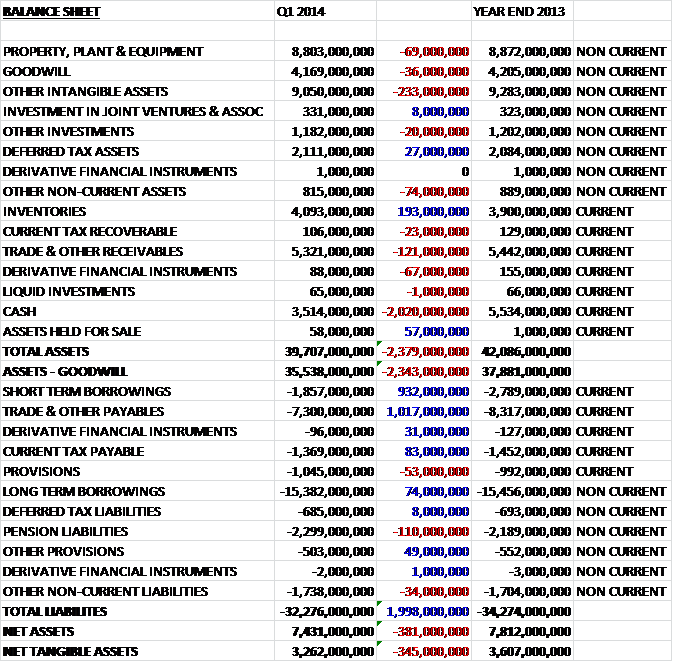
gskassetsq12014

When compared to the end point of last year, assets at the end of Q1 were £2.379BN lower. This was predominantly driven by a £2.020BN reduction in the cash levels. Other reductions included intangible assets, down £233M due to the increased amortisation of Lovaza and some minor R&D write-offs; and receivables, down £121M. These were only partially mitigated by a £193M increase in inventories. Likewise, liabilities were also lower, driven by a £1BN fall in payables and a similar £1BN fall in borrowings, only partially mitigated by a £110M increase in pension liabilities due to a decrease in the rates use to discount pension liabilities. Net assets were £381M lower and once the big chunk of goodwill is taken off, net assets were lower by £345M at £3.262BN which was a little disappointing.

gskcashq12014

Before movements in working capital, cash profits in Q1 were £391M lower than in Q1 last year. This was predominantly put down to adverse currency movements. Working capital increased at a smaller rate than in 2013 and after tax, net cash from operations was £927M, down some £320M. The group then spent £201M on tangible assets and £148M on intangibles, up by £66M which meant that cash before financing was £593M, down by £356M. The bulk of the rest of the cash was then spent on the purchase of shares in their associate, relating to the Indian and Indonesian subsidiaries (£669M), the repayment of loans (£894M) and dividends (£910M). After all this, the group had a cash outflow of nearly £2BN, which meant that the group had £3.233BN of cash at the end of the period.
Seretide/Advair is still the most important drug, contributing just over £1BN in sales, and over a fifth of the total with the next most important a distant second – the vaccine infanrix contributed just over £200M in revenues.
The Chinese authorities are continuing to investigate the claims made previously against GSK in that country but it is not yet possible to make any estimates on the potential outcome. Legal charges as a whole increased to £108M this quarter compared to £66M in Q1 2013 due to the settlement of existing anti-trust matters and higher litigation costs.
In Q1 respiratory sales fell by 11% as Seretide was down 15%, Flixotide down 2% and a 13% decline in Xyzal sales were only slightly counteracted by a 15% increase in Ventolin revenues. In the US turnover was down 20% due to increased competition in the Advair and Breo market. Underlying sales in the country were down by 11% as a slight increase in price was counteracted by declining volumes. Breo Ellipta for COPD was launched in Q4 and sold £1M so far this year, which was lower than expected due to delays in payer coverage which has now been resolved. European respiratory sales fell by 3% due to increased competition driven by a 3% decline in seretide sales. Revlar Ellipta was approved in Europe for COPD and Asthma and recorded £2M of revenues after being launched in Q1 of this year. Respiratory sales in Emerging Markets grew by 3% despite a 12% fall in Chinese sales. Veramyst sales grew by 25% to £17M. Japanese respiratory revenues were down 3% despite a 29% increase in Adoair sales. This growth was more than offset by lower sales from the rest of the portfolio, driven by a weaker allergy season.
Oncology sales grew by an impressive 27% during the quarter. Votrient sales were up 31% and Promacta revenues were up 30% but Arzerra and Tykerb sales both fell. In the US sales grew 31% as Mekinist and Taflinar were launched in Q3 of last year. In Europe, Oncology sales were up 23% led by increased sales of Votrient. Cardiovascular revenues were up 4% as Avodart sales were up 7% and Duodart/Jalyn increased by 21%. Geographically the main drivers for growth were Japan, up 52%; Europe, up 14% and Emerging markets, increasing by 29% were somewhat mitigated by a fall in US revenue. Immuno-inflamation revenue increased by 69% with Benlystsa up 33%. Other pharmaceuticals were up 7% due to government stockpiling of Relenza in Japan, which was counteracted by a decline in Augmentin sales due to higher generic competition.
ViiV Healthcare sales increased by 4% with the US up 3%, Emerging Markets increasing by 22%, Japan up 28% and Europe falling by 2%. Epzicom/Kivexa sales increased by 12% and Tivcay was launched in the US during Q3 last year and in Europe during Q1 of this year. This growth was counteracted by a 5% fall in Selzentry sales and huge falls in Combivir and Trizivir due to generic competition. Established product turnover fell by 11% with declines across all regions led by a 17% fall in US sales. Sales of Lovaza fell by 25% due to a decline in the market and generic competition caused Seroxat to fall 15% and Malarone by 34%.
Vaccine sales were up 3% when compared to the same quarter last year. Sales in the US were up 25%, Europe turnover was up 3% and Emerging markets sales were down 8%. The increase in US sales were predominantly due to a poor Q1 2013 comparison due to CDC stockpile movements and the decrease seen in emerging markets was mainly because of the phasing of Synflorix sales. Infanrix/Perdiarix sales increased by 20% due to the US, Boostrix sales increased 41% across all markets but particularly in the US due in part to competitor supply issues. Rotarix sales were up 16% with growth driven by tender shipments in Europe and Emerging Markets. Synflorix turnover fell by 29% reflecting the phasing of tenders in Emerging Markets.
Consumer Healthcare sales were flat on Q1 last year. Sales in Europe and the US were down 4% and 10% respectively, reflecting supply issues that impacted by sales of products for smokers health and Alli. Growth in the rest of the world markets was 6% reflecting strong growth across most categories with Horlicks particularly strong in India, partly offset by a reduction in Chinese sales and a 42% fall in the sales of smoker’s health products due in part to temporary supply issues. Wellness sales were down 8% as an increase in Panadol sales was offset by the previously mentioned supply issues in smoker’s health products. Oral health sales were up 5% as strong sales in Sensodyne and denture care brands were mitigated by a decline in Aquafresh sales, partly due to more supply issues. Nutrition revenue was up 13% led by strong growth of Horlicks and Boost. Sales of Skin Care products were down 4% due to lower sales of Bactroban in China.
There are currently six new respiratory products in late stage development, including Mepoluzimab, a new treatment for severe asthma. Following positive phase 3 results the group are planning on filing the drug for approval before the end of the year. In addition, it is being investigated for use with COPD. Elsewhere, new drug Tivicay continued to show rapid prescription uptake for HIV. In vaccines, further sales growth from the new flu vaccine is expected during the second half of the year. In Oncology the newly launched MEK and BRAF mono therapies now have around a 70% combined share of prescriptions in the melanoma v600 targeted therapy in the US market. Additionally Tanzeum, a new product for type 2 diabetes is now approved in the US and Europe and it is on track to be launched in Q3 in both regions. There are also a large number of drugs due to enter phase three shortly.
The group purchased 1.7M shares during the quarter and issued a further 6.3M under employee share schemes – not sure what the point of the repurchase was in this case. Overall then, the group seemed to be struggling against a strengthening sterling during the quarter. Respiratory sales dragged down other better performing sectors and it is a bit disappointing to see that Oncology was one of the best performing sectors considering this is being sold to Novartis. It is good to see the group further pay down debt with some of the spare cash but the reduction in net assets is disappointing. Net debt at the end of the quarter stood at £13.66B which was an increase of just over £1BN when compared to the start of the year. The group declared the first interim dividend of 19p per share, an increase of 6% and at the current share price represents a decent 4.8% yield. I am happy to hold the share for income.
On the 8th May the group informed the market that they had received marketing authorisation from the EU for Anoro, a once daily treatment to relieve symptoms of COPD in adults. The first launch in Europe is expected to take place in Q2 or Q3 2014 with additional launches following afterwards. This drug has also been licensed for use in several other countries such as the US and Canada, and regulatory applications have been submitted in other countries where they are currently undergoing assessment such as Japan.

On the 13th May the group announced that in the phase 3 study with Darapladib for use with adults with acute coronary syndrome, the drug did not achieve the primary endpoint of a reduction of major coronary events verses a placibo.  This is clearly disappointing that it has taken this long do discover that Darapladib is not of much use.

On the 27th May the group released a rather terse statement that it had been informed by the UK’s Serious Fraud Office that it has opened a formal criminal investigation into the group’s commercial practices.  There is no further information than this, but it seems concerning.

On the 11th June the group announced positive phase 3 studies regarding the use of Incruse Ellipta or Umeclidinium in addition to Relvar/Breo Ellipta for patients with COPD and that patients had a significantly improved lung function when compared to placebo patients.  This is a good bonus but is just a combination of two other drugs really.

On the 27th June the group released a statement that the CHMP issued a positive opinion recommending marketing authorisation for Triumeq for the treatment of HIV in people over 12 years old.  The drug is not currently approved in any country and is the first once daily single-tablet drug for HIV.

On the 30th June, the group released a statement announcing that they have susmitted an application to the US FDA for a fixed dose combination of the inhaled corticosteroid, fluticasone furoate and the long acting beta agonist, vilanterol as a once daily treatment for asthma patients aged over 12 years under the brand name Breo Ellipta.  One of the dosages has already been approved by the FDA for the long term once-daily treatment of COPD so it seems to be an application for an additional usage.

Asian Citrus Finance Blog – Half Year Results 2014

Asian citrus has now released their half year results for the year ending 2014.

asiancitrusinterimincome


Overall revenues were down by £14.4M due almost entirely to a £13.1M reduction in the revenue from the sales of oranges, with the rest due to a smaller fall in the sales of processed fruit.  The cost of the agricultural products sold increased by £4.4M which meant that Gross profit was down by £19.1M.  There were also small falls in selling and general expenses but the big hit was the non-cash £56M of reductions in the value of biological assets.  This drove the profit for the year down by £76.2M, resulting in a £54.4M loss.  If it wasn’t for the loss on the value of assets, there would have been a very small profit, but it is still a poor result.

asiancitrusinterimassets


Total assets at the half year point were £57.7M lower than at the end point of last year.  This fall was driven by the aforementioned £65.2M reduction in the value of biological assets.  The other large falls were a £24.1M reduction in the value of assets under construction and an £8.2M fall in the value of deposits.  These were only slightly mitigated by a £35.7M increase in the value of property, plant and equipment (£8.4m of which was moved from non-current deposits), and a £6.2M rise in the value of receivables.  The group has very little liabilities with the only real one being £9M worth of payables, which reduced by £1.4M compared to the end point of last year.

asiancitrusinterimcash


Before working capital movements operating cash flow collapsed from £30.7M last year to £11.8M in the first half of this year.  After working capital was taken into consideration, the cash generated from operations was £16.5M, £25.2M worse than in the same period of last year.   The majority of the cash was spent on additions to construction in progress (although this was £8.2M less than last year), with the remainder used on additions to biological assets.  The group then paid out £3.9M in dividends which meant that the group had a cash outflow of £3.3M compared to a £569K income last time.

Much of the poor performance this year has been blamed on bad weather.  The persistent heavy rainfall has caused nutrients to leach from the soil, resulting in the higher usage of fertilizer and pesticide in an attempt to maintain output volume.  In addition there was also negative media coverage relating to dyed oranges being sold in Gannan.  Despite Asian Citrus not being implicated in the scandal, this still had the effect of reducing the average selling price for oranges as customers looked abroad due to the lack of confidence in the domestic market.   Another source of rising costs is the general wage inflation that is taking place in China.

During the first six months of the year, the production yield at the Hepu plantation decreased by 25%, mainly due to the replanting programme replacing some of the existing winter orange trees with banana trees.  The first banana harvest from the plantation is likely to be ready by September 2014.  The selling price of oranges from the plantation also fell slightly, down by 4%.  The production yield at the Xinfeng plantation decreased by 4% with the profit margin collapsing due to the poor weather, higher usage of chemicals and the dyed oranges scandal – combined with the fall in volumes, the selling price of the oranges fell by 17%.

As well as the Xinfeng Plantation, fully planted with orange trees and the Hepu Plantation, with oranges and bananas, the group also has the Hunan Plantation, which so far has not produced any fruit.  There are currently over 1M orange trees and 500K grapefruit trees and a further 250K grapefruit trees are expected to be completed by 2014.

asianorange

As briefly mentioned, not only are production volumes down but average selling prices are down too.  As well as all the other problems, the group are experiencing higher competition because of the increase in the average maturity of trees belonging to competitors.  This is not something that was mentioned before and it seems strange that these competitors suddenly have high yielding trees given the problems with the weather that Asian Citrus has been experiencing.  Another reason for the fall in selling prices is the fact that the bad weather affected the quality of the oranges which meant that the proportion taken by supermarkets, as opposed to wholesale or corporate, reduced.

During the period the processed fruits segment made a £4.8M profit but the agricultural produce segment made a £57.6M loss, mainly due to the loss of value of the biological assets.  The group will be increasing capacity at the fruit processing business in 2014 after the new plant completed trial production.  Apparently it takes up to five years for new factories to be up to full capacity so the contribution from the new one will be modest to start with.  Like for like sales of processed fruit was slightly ahead of the same period of last year as sales of processed Pineapple juice collapsed during the period from £7.3M to £5M due in part to the effect on prices due to destocking activities by Thai and Phillipine producers was counteracted by increases in some other juices such as lychee.

This was also a period of upheaval for the board as directors Peregrine Moncreiffe and MrMa Chiu Cheung both resigned, to be relaced by Mr. Chung Koon Yan and Mr. Ho Wai Leung.  More importantly, however, the founder, current ceo and chairman, Tony Tong is also standing down.  He has been in charge for 14 years and speaks volumes.

Due to the performance this half the board have not recommended an interim dividend.  Going by just the final dividend last year, the shares trade on a yield of 3.7% but given this performance, I doubt there is much chance of this being maintained at the end of the year.  Going forward, the board expect the second half of the year to continue to incur higher costs as they try to replace the nutrients washed away in the heavy rain and typhoons.

There is no doubt this has been a terrible half year for Asian Citrus.  The bad weather has reduced the yield and quality of oranges as well as increasing costs as the nutrients that are washed away need to be replaced.  There was no mention of the canker outbreak so it is hard to see if that is still a major issue and the group are also facing greater competition from other plantations with maturing trees.  In addition, the mass resignation of most of the board is certainly not a sign of confidence.  Having said that, the share price has taken a battering, the group are diversifying away from oranges, there is a whole new plantation due to come on stream soon and another juicing plant is also starting up.  These shares are very risky, but I am quite tempted to pick some up at these prices.

On the 24th March the group announced that they had signed supplier agreements to supply a total of 57,000 tonnes of summer oranges in the first half of 2014.  This is close to the tonnage recorded in the same period of 2013 and the production from the Hepu plantation has not yet returned to that of before the canker infection last year.  The selling prices of the oranges are broadly flat when compared to last year, falling by about 1%.

On the 20th June the group announced the summer orange crop yield from the Hepu plantation came in at 49,540 tonnes.  This is considerably below the 57,000 achieved last year and that the group signed supplier agreements for (above).  The plantation is still being affected by the Canker outbreak and this year was also impacted by frosts earlier in the year.  The annual production volume came in at about 197,467 tonnes, nearly 10% lower than last year.  The processed fruits business had volumes in line with last year but continued margin pressure.  Turnover and net profit are expected to be in line with market expectations, but lower than last year.  Asian Citrus can’t seem to get back on track, the Canker is still a concern, the lower margins at the processing plant is a worry and now we have frost to contend with.  The shares took a dive after this update but they seem to be trading at a rate that probably undervalues the company so I have taken a small risky punt on them.

On the 22nd July the group released a statement with regards Typhoon Rammasun in Guangxi where the Hepu plantation is located.  This was the strongest storm that the region has suffered in years and has caused widespread damage.  The impact to the plantation is significant and it will take some time for the group to determine the physical and financial losses.  ACHL just can’t catch a break at the moment.  This updated is worded very strongly and I have decided to exit with a small loss, turns out my timing was a bit off but I will still cover the company with a view to entering again if sentiment changes.

On the 11th August the group released an update on the damage caused by Typhoon Rammasun.  The storm destroyed 221,769 Banana trees planted in 2013, as a result of which there will be no banana harvest this year.  It damaged farmland infrastructure and machinery such as windbreaks, greenhouses and electricity wires at both the Hepu plantation and the Beihai Juicing plant.  It caused the juicing plant to temporarily suspend activity as a result of loss of electricity which in turn, ruined some of the raw materials.  Therefore, management estimate that impairment losses and provisions related to the damage of about £3.6M will be required within the statements this year.  Although the board expect turnover to be broadly in line with market expectations, core net profit will now be lower.  Additionally the typhoon caused premature fruit drop from some of the existing orange trees which will result in decreased production yield in the upcoming winter and summer crops and the impact of the typhoon will prolong the susceptibility of the trees to canker and increase the leaching of the soil.  Sadly the group’s insurance policy does not cover damage from natural disasters.

Separately the board expects that a material impairment loss in respect of goodwill equivalent to £197M will be charged to the profit and loss statement this year.  This is a huge impairment but as I do not really take much account of Goodwill for this very reason, it will not really affect my judgement.  It sounds as though the effect of the typhoon will carry on into next year and as such I will continue to watch from the sidelines.

I am not sure on the significance but Sunshine Hero Ltd has sold its 9.13% of the company’s issued share capital to Genuine Enterprises Ltd, owned by Mr. Huang Xin.


James Halstead Finance Blog – Half Year Ending 2014

James Halstead has now released their half year results for the year end 2014.

halsteadinterimincome


When compared to the first six months of last year, revenues in 2014 increased by £1.9M.  Cost of sales also increased, however, to give an operating profit some £660K lower at £20.6M.  Finance costs, relating to pension scheme costs, also increased somewhat so profit before tax was down by £843K before a lower tax bill meant that the profit for the year was £15.2M, lower by the tune of £322K.

halsteadinterimassets


When compared to the end of last year, the asset position at the six month point was down by £4.4M.  This fall was driven by a £5.5M reduction in receivables and a £2.3M fall in the value of property, plant and equipment; somewhat mitigated by a £3.7M increase in cash levels.  Equally we can also see a fall in the level of liabilities, driven by a £6.1M reduction in payables, partially mitigated by a £900K increase in pension obligations and £630K more derivative financial liabilities.  All this meant that net tangible assets were some £569K higher at £88.1M.

halsteadinterimcash


Cash from operations fell considerably when compared to the first half of last year, down £11.4M to £20.2M, partially due to a larger stock carry than at the same point of last year as some customers looked to reduce stocks at the year end and the larger variety of products sold by the group.  They did spend less cash on capital expenditure, however, and they spent £1.7M less on the purchase of property, plant and equipment.  In fact, they gained more from the sale of property and equipment than they spent.  The bulk of the cash flow was actually spent on dividends and at £12.4M, the spend was just over £1M more than last year.  Overall then, the cash inflow was a mere £3.9M compared to £13.2M in 2013.  This is quite a reduction, but they are still generating more cash than they are spending.

In the UK sales increased by just over 5% and in Central Europe they were up 4%.  Sales were 8% down in Australia but this was because of adverse currency movements as sales were flat in the country on a constant currency basis.  In Australia there was noticeably less activity in the mining sector but this was mitigated by increased sales to the mining sector in South America. As well as the UK, other growth markets included France, up 9%; South America, up 5%; Spain, up 18% and Canada, up 10%.  Some projects during the period included the Mississippi Crime Lab in Jackson, the Sberbank in Moscow and Boryspil Airport in Kiev.

The profit margin was eroded very slightly during the half year due in part to a differing product mix and some price erosion, especially in Germany where competition was fierce.  Another reason was that the plant in Teesside was not yet running on a 24 hour basis, which should change in the medium term.  Going forward it seems that trading in the next quarter is up by about 7% which is offset by a strengthening sterling and fierce price competition in Europe.  There are some signs for optimism, however, as the group seems to have become established in Canada and they have entered the Indian market.  The group are looking to push into some areas with their own sales team which will involve some initial set up costs.  Management are not expecting profit for the year to be above that of last year.

The group has a strong cash position, with net cash standing at £38.6M.  An interim dividend of 3p per share was announced, an increase of 9% which, at the current share price makes an annual yield of 3%.  This year has been comparatively tough compared to last and with the price competition in Europe, slow-down in Australia and strengthening sterling are going to make it hard to post a growth in profits this year.  Having said that, the financial position is very strong, the group is quite highly cash generative and I remain confident about the business long term.  I will remain a holder of the shares.

On the 31st July the group released a statement covering the year’s trading.  The stronger trading in Q3 has continued into Q4 and the strengthening of sterling has been offset by lower input costs.  It is expected that profit for the year will exceed that of last year and the dividend will once again be increased this year.  This sounds like a decent update.